
Remember me
Michael Hall: That goes back a long way. For quite a few years I worked for Country Life magazine, and in that role I wrote articles about country houses. I actually began with one of those I mention in my book: Packwood House in Warwickshire. It was acquired in 1904 by an industrialist for his son, Graham Baron Ash, who spent years renovating and transforming the property. It struck me that he never got married – and the idea that a bachelor might do up a house and then give it to the National Trust to look after seemed quite intriguing. I didn’t really spot that it was part of a pattern until I wrote a similar article on Anglesey Abbey. That’s when I realised that there was a story about the National Trust that hadn’t really been told before. It’s important to mention that I’ve never worked for the Trust, and A Queer Inheritance isn’t an official National Trust book in any way. I don’t speak on the Trust’s behalf – and indeed they may very well disagree with a lot of what I say.
The National Trust was founded in 1895, when homosexual acts of ‘gross indecency’ were still illegal in Britain – yet in your book you suggest that the Trust had queer connections from its very beginnings. Can you expand on this?That’s actually quite a complicated question. The origins of the National Trust were rooted in an anxiety about London’s urban poor and how they could be morally improved. Its founders thought that if the urban poor could be given access to architectural and natural beauty, this would do away with what they saw as their worrying vices – of which homosexuality was a rather prominent example. Yet several people on the Trust’s original council and executive committee were in fact queer. They included the 5th Earl of Rosebery, who was worried that he might be named in the Oscar Wilde trials of 1895, and Octavia Hill, who had a long and loving relationship with Harriot Yorke.
Can you tell us about some queer landowners connected to the Trust’s estates?William John Bankes, who inherited the great estate of Kingston Lacy in Dorset, had to go into exile in 1841 after he was caught having sex with a guardsman in London’s Green Park. He then redecorated and remodelled the house remotely, while living in Venice. It’s a very interesting story about a gay man shaping a house even when away from home.

Kingston Lacy in Dorset was redesigned as a classical palace in the 19th century by its owner William John Bankes, who was forced into exile after facing prosecution for a same-sex act. The house is home to his collections of art and Egyptian artefacts (Image by Alamy)
In the book I also talk about Clumber Park, site of a lost house that was demolished in 1938. Several generations of the Dukes of Newcastle were based there. One of the 5th Duke’s sons, Lord Arthur Pelham-Clinton, enjoyed relationships with a famous pair of young Victorian men who cross-dressed as Fanny and Stella; later, the 7th Duke, ‘Linny’, was friends with Oscar Wilde.
I should emphasise that the book is not primarily about country houses. The National Trust manages a wide range of buildings, one of which is Clouds Hill, a little cottage in Dorset that was home to TE Lawrence (of Arabia). His sexuality has been hugely debated, and I draw my own conclusions about this in the book.
A site that’s much less controversial is Smallhythe Place in Kent, home of the great 19th and early 20th-century actress Ellen Terry. Her daughter, Edith Craig, was a theatre director of considerable eminence who lived next to that early 16th-century house with two close lesbian friends. They welcomed lots of their likeminded friends there, so you can discover a lot of lesbian history in the 20th century just by visiting Smallhythe.
How do we know that these people were queer? Would the historical figures you discuss have understood themselves in that way?Not particularly as queer, I don’t think. But as a historian, you have to look at the story and ask: how can I best interpret this? I think the advantage of the term ‘queer’ is that it avoids attaching very precise labels to people.
The word itself goes back to the 16th century, when it just meant odd or unusual. Around the end of the 19th century, though, ‘queer’ was becoming a term of abuse, meaning homosexual. But by the 1980s, ‘queer’ was very much taken back by gay activists, particularly during the Aids crisis, as a way of reclaiming their identity. Today, ‘queer’ is the term preferred by most historians.
One of the issues historians face is how to talk about people who didn’t have access to the terms we would use now, such as ‘gay’ or ‘bisexual’. I think ‘queer’ is quite useful because a modern audience knows what that means, but it’s also not imposing something on the past. I also think that the fact it’s clearly anachronistic is actually rather helpful, because it emphasises the difference between the past and the present.
There is an amazing amount of argument about these terms, and you can debate these things forever, but as a historian you just have to get on and do the history. And when you do, there’s a lot of anxiety about finding evidence that people were gay – but I think the response must often be, well, what’s your evidence that they were heterosexual?

The writer and poet Vita Sackville-West’s same-sex relationships were not always acknowledged (Image by Alamy)
How have National Trust estates been influenced by the queer people who lived in them or were connected to them?I wanted to write about places that queer people had shaped in some way – by building them, decorating them, furnishing them or making them part of their life history. This isn’t always obvious. Today, lesbians visit Knole, a country house in Kent, because our contemporary perception of the building is shaped by our knowledge of the relationship between Vita Sackville-West, who lived there, and Virginia Woolf. Yet there’s almost no evidence of Vita’s influence that you can see on the property, other than the original manuscript of Woolf’s Orlando, which she inspired.
Returning to TE Lawrence’s Dorset cottage, Clouds Hill, there are just two rooms upstairs, one of which he used as a guest bedroom. In the 1930s, he curiously lined that room with metal foil – a rather art deco look. I became intrigued by the fact that Siegfried Sassoon, a gay writer who was a friend of Lawrence, visited Clouds Hill with his lover, Stephen Tennant. Now, one of the best-known photographs of Stephen (shown above), by Cecil Beaton, shows him in his own bedroom – which he had lined with silver paper. I thought it was an interesting queer link which, as far as I’m aware, hasn’t been made before. It says something about Lawrence’s own sense of identity in terms of sexual orientation, and also about networks. Early on in my research, I began to realise that many of these houses and people linked up.

This photo of the socialite Stephen Tennant in front of distinctive silver wallpaper helped piece together the story of TE Lawrence’s Clouds Hill (Image by Topfoto)
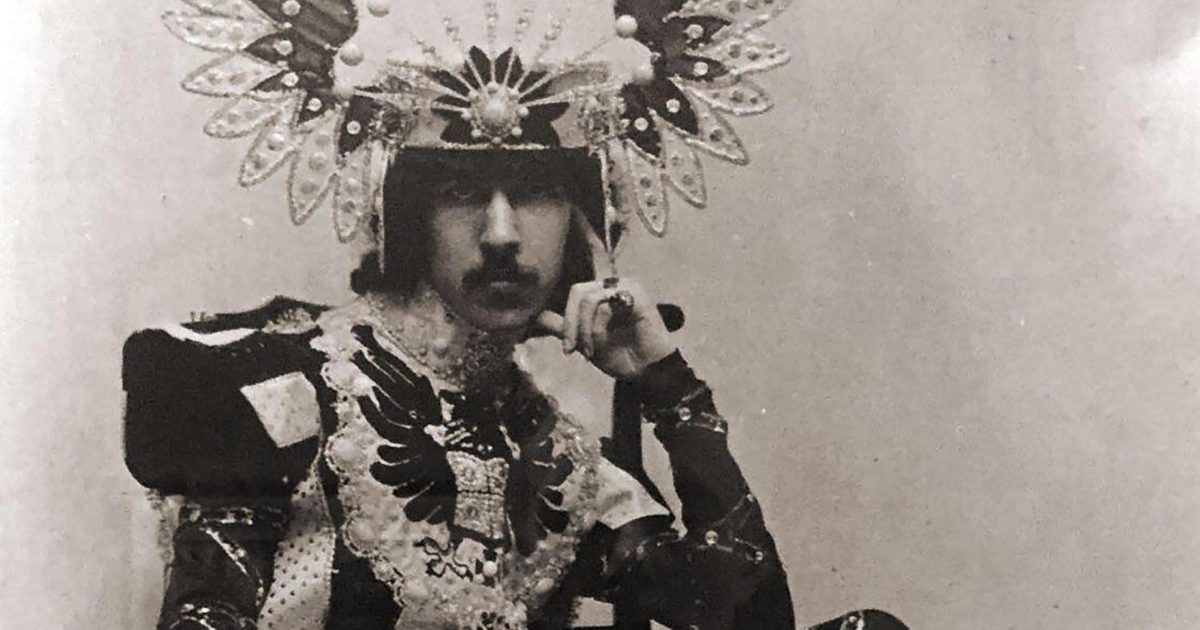
A lot of the queer people associated with the Trust’s properties were connected, and many came from a privileged background. Is there a relationship here between class and queerness?Yes, definitely – though I don’t write only about elite people in the book. The 5th Marquess of Anglesey, Henry Paget, who lived at the family seat of Plas Newydd on that island, is a good example of such privilege. On the death of his father in 1898 he inherited a huge fortune, which funded his love of dressing up. He liked to put on theatrical productions and go to fancy-dress parties in a very gender-bending way. This got him into the newspapers, and he was laughed at and ridiculed relentlessly. Eventually, he went bankrupt.
In a sense, Paget was able to dress up and perform because he was very, very rich. But the downside of his wealth was that he attracted an enormous amount of public curiosity. Endless stories about him appeared in the press. He wouldn’t have suffered such a blow to his reputation if he had been an obscure commoner. Clearly, although privilege could facilitate queer experiences, it could also attract much unwanted attention and expose scandal.
When exploring past queer experiences, we are often dealing with the feelings and emotions of historical figures. What sources did you use to explore these?Sources pose a massive question for any historian, but queer topics have always been particularly hedged with problems. Prior to 1967, all homosexual acts between men were illegal in England and Wales [even then, they were permitted only between two consenting adults over the age of 21], and this creates obvious issues with the sources from before that period. But what struck me was that if you go back to the original sources – the contemporary biographies and letter compilations of these late 19th and early 20th-century figures – it seems that many people probably knew what was going on. The Victorians weren’t fools. You just have to tune in when reading the sources, and you’ll learn a lot.
The National Trust has faced some backlash for trying to reclaim minority history more widely. How has its attitude towards queer people evolved?Traditionally, the Trust wasn’t very open about its queer connections – but then nobody was terribly open about these issues for many decades. Homophobia played a role in the modernisation of the National Trust. From the 1950s, it began trying to run its houses on a more professional basis, appointing curators. There was a bit of a standoff between the land agents – the traditional men in tweeds who dealt with forestry and estates – and the curators, who dealt with hanging the pictures and arranging the furniture.
This division reflected an essential binary within the Trust: whether it should be concerned primarily with places of historic interest or of natural beauty.
One of the ways that people who thought the National Trust wasn’t paying enough attention to nature directed criticism against the curators was through homophobia. This made life rather tricky for any gay men within the organisation, and by the 1960s and 70s the Trust attracted considerable criticism, accused of being run by queer aristocratic men. To be fair to the critics, there was considerable truth in that.
Traditionally the National Trust wasn’t very open about its queer connections – but then nobody was terribly open about these issues for many decades
Beyond its employees, the Trust remained coy about queer connections to the houses it acquired. For example – and it’s extraordinary to say now – it wasn’t until 2008 that any official publication by the National Trust about Sissinghurst, Vita Sackville-West’s later home, also in Kent, mentioned her same-sex relationships.

The Tower at Sissinghurst Castle is set in the gardens designed by Vita Sackville-West and her husband, Harold Nicolson (Image by Getty Images)
So it’s only pretty recently that the organisation has been open about this kind of history. In 2017, it made a big effort to catch up and tell these stories, and I think generally there was a feeling that this was going in the right direction. It did, however, bring up an interesting dilemma. Objections were raised by relatives and friends of some of the people who were being described as queer, criticising the National Trust for ‘outing’ them.
I don’t think that it makes any sense to talk about historical figures in terms of ‘outing’ – because, really, if you object to somebody in the past being described as queer, or raising the question about whether or not they were what we would now call gay, that might imply that you find homosexuality shameful.
In 2017, the National Trust made a big effort to catch up and tell queer stories, and I think there was a feeling this was going in the right direction
It’s interesting that the controversy around ‘outing’ these historical figures hasn’t applied so much to queer women. I don’t think people find women’s sexuality as threatening as they find men’s sexuality. And it’s most often men who get upset about other men being described as gay. Look at Lawrence of Arabia: dozens of biographies have been written about him, almost all by men and almost all hostile to the idea that he was gay.
What impact do you hope A Queer Inheritance will have?I hope that people will realise that queer history is a very rich subject, and that there’s a huge amount more that can be said about the queer lives connected to the National Trust.
Everyone I’ve spoken to about my book says: “Oh, but you haven’t said anything about X.” So, there’s lots more to explore, and different approaches that could be taken. A woman or a young person would have written a completely different book, I think.
This article was first published in the February 2026 issue of HistoryExtra Magazine
Comments (0)