
Remember me





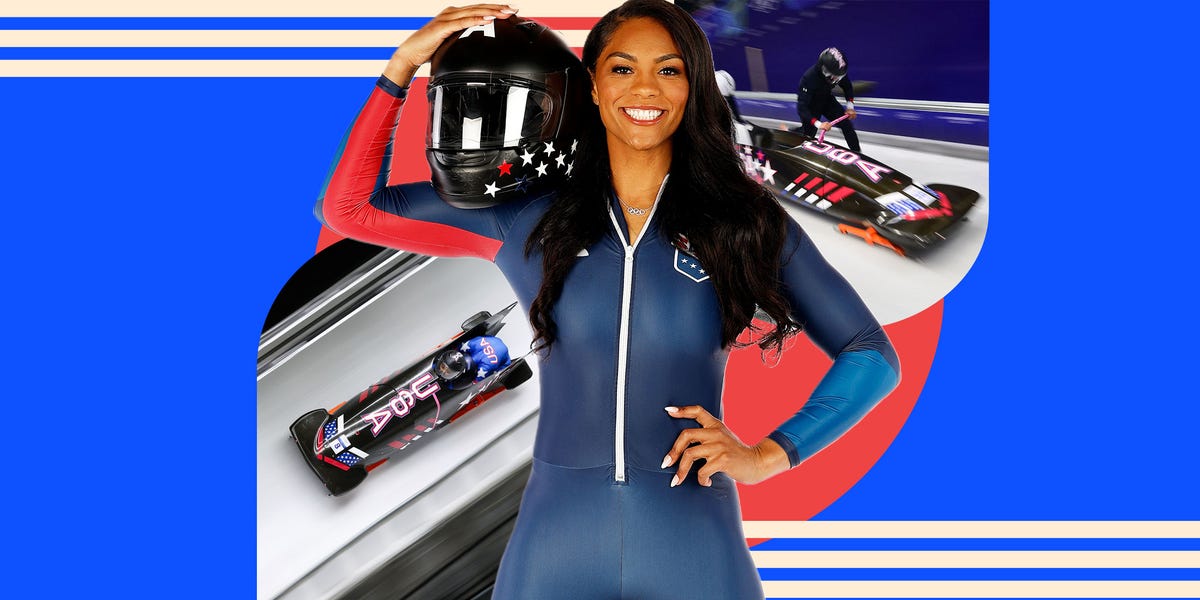
There’s not a ton of time to process decisions when you’re sliding down an icy track at 70 miles per hour. For Kaysha Love—a two-time Olympian and the 2025 monobob World Champion—that means stepping up to the start line as prepared as humanly possible, especially in her new role as a pilot.
Love, 28, entered the sport in 2020 after being recruited as a brakewoman following a successful track-and-field career at the University of Nevada, Las Vegas. As a brakewoman, she provides the final powerful push-off before loading into the sled last, and then pulls the brake lever after crossing the finish line.
In 2022, she and two-woman bobsled teammate Kaillie Humphries qualified for the Beijing Olympics—less than two years after her bobsled debut. The pair finished in seventh place. Later that year, Love decided she was ready to move into the pilot seat—a role that requires deep concentration, precise steering, and quick decision-making to keep the sled on its fastest line.
Within a year, she won her first World Cup title in the monobob, and soon after, she qualified for the 2026 Milan Cortina Winter Olympics—a feat she says she’d previously been told was impossible.
Love credits part of her rise to an innovative training partnership. In the summer of 2025, Honda partnered with U.S. Bobsled/Skeleton (USABS), giving them access to the Honda Automotive Laboratories of Ohio (HALO) Wind Tunnel in Raymond, Ohio. Originally built for vehicle aerodynamic testing and development, the wind tunnel now helps athletes and coaches gather racing data to refine equipment and strategy—where tiny details matter, and the difference between a podium finish and the middle of the pack can be less than a second.
More Olympians
 Erin Jackson Says This Olympics Is About More Than Medals
 Chloe Kim's New Outlook Is Ready For Primetime
 Mystique Ro: From Track Star To Winter Olympian
For Love, the HALO facility has been “a game changer” in understanding her best approach as a pilot. Testing has helped her see how small details like posture and placement affect her drag, and how subtle adjustments—like entry angle—can change speed through turns.
In competition, the technology has helped the athletes learn new tracks faster than ever. Because every track is different, teams often arrive with limited information about how it will race. In Milan Cortina, the Honda team pulled data from Team USA sleds after each race and used it to estimate curve-by-curve speeds and identify the best racing line. “It really opened up an entirely new knowledge of how to approach the Games,” Love says. “It's really nice to know that we have a team behind the team who puts in so many hours of effort.”
Still, Love is learning how to balance data with real-time feel. In practice, she focuses on optimizing the numbers. In competition, though, she relies on muscle memory—allowing what she’s trained to take over, and not letting the nuances of data overwhelm her mental state. The most difficult part, she says, is finding the courage to commit to changes, including new racing lines.
“Some of the lines that are the fastest are often the most dangerous,” she says. “That is why, for me, being as inexperienced as I am in the front seat, making some of those big adjustments can be a little daunting.”
That pressure can feel even heavier in the two-woman races, she says. With another athlete behind her, the stakes feel different. “One small mistake could potentially mean that we crash.”
But when she does commit—and the new line works—the payoff is worth it. Once adjustments click, “there's nothing more exciting than when the data and the numbers come all together in real life on the track.”
Love finished in seventh place in the monobob and fifth in the two-woman in Milan Cortina, but she’s proud to have qualified for her first Olympics as a pilot—and expects to keep improving as the partnership deepens. “It really is such a blessing for a program to partner with them all the way to 2030. Right now, Honda is still learning our sport, and the more they learn, the more we learn.”
Looking ahead, Love plans to keep using what she’s learning to sharpen her piloting. Reflecting on Milan Cortina, she says the experience made one thing clear: she still has room to grow.
“I want nothing more than to just do my very best, not only for myself, but for everybody that's done it with me right and sacrificed so much. Looking back [at my performance in the Games], obviously I’m going to be frustrated about my results. But I’m starting to recognize that I haven’t been doing this long enough to be frustrated.”
She’s no longer focused on simply making the Games. Now, she’s focused on medaling—and perfecting her craft over the long haul. “My career is not over. It's just getting started."
Find the Perfect Women's Health Training Program for You


Cori Ritchey, C.S.C.S., is the fitness editor at Women's Health, as well as a certified strength and condition coach and group fitness instructor. She’s reported on topics regarding health, nutrition, mental health, fitness, sex, and relationships for several years. You can find more of her work in Men’s Health, HealthCentral, Livestrong, Self, and others.