
Remember me



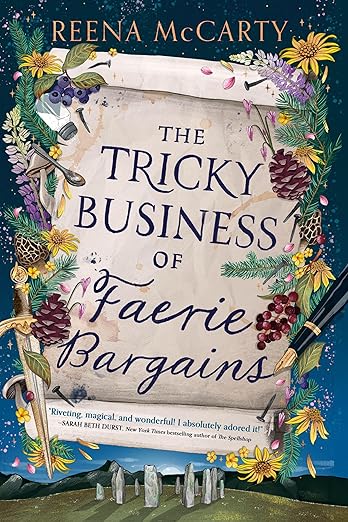



 Changelings are a rarity in American folklore, unlike in its European counterpart, as are the fae. Reena McCarty has used this fact to build a foundational part of the lore of her debut novel, The Tricky Business of Faerie Bargains, and what results is an engaging, fresh blending of two disparate realms: contemporary reality and the Otherside.
In the world of this novel, the Great War in Europe weakened the protective wards that previously separated the human world from the world of the fae, allowing the latter to further their own violent agendas. The Faerie Wars, and the massive casualties on both sides, not only forced many othersiders to flee across the Atlantic Ocean and establish their courts in the United States, but also eventually led to laws and regulations that prevented the stealing of babies, enforced with the threat of fae lands being spiked with iron.
By the terms of the Russwald treaty, the fae are restricted only to legal bargains, and by the time we enter the picture the Wild Land States of Montana, Idaho, and Wyoming are the only regions left in the United States where more traditional bargains between humans and othersiders remain legal. On the Otherside, this has led to what’s called the Great Bargain, whereby all faerie courts pledge fealty and loyalty to protecting the Wild Lands territory and its sovereign ruler.
Poppy Hill was very young when she was snatched from her family’s homestead in frontier-era Montana and spirited away to the Otherside. After spending more than a century as a cook in the employ of the King of the Wild Lands, she is thrown back without warning into a human world that is much changed from any lingering memories she has of her brief former life.
As it turns out, the human world has, in the meantime, come a long way in coexisting with its parallel realm. Carter Lane, one legal firm among many that specialise in fae law, leads the way in brokering faerie bargains. They’re the best at offering these services because they employ Returnees like Poppy to check for loopholes in the contracts. In return, they offer Returnees a fully-fledged twenty-first-century immersion so that they can survive and eventually assimilate into their new surroundings—a fresh start after a set number of years working at Carter Lane.
Of course, Carter Lane’s faerie broker services remain exclusive because of how much the firm charges its clients, and this means that their clientele is often the high-maintenance and demanding kind. Poppy is sitting in on one such protracted contract discussion when we meet her, the story throwing us straight into this new world and forcing us to “learn on the job.” At this point, she has been back in the human world for three years. A homesick Poppy is still struggling to adapt, missing her best friend Sloan, her former boyfriend Elan, and the only life she’s ever known. Sloan has found a way to stay in touch, so that is a small solace, but it has been crickets from Elan.
Soon after a successful completion for the above contract, Poppy is compelled by a senior partner to be involved in a very important (and super confidential) bargain. When it goes sideways through a series of unexpected orchestrations, a flustered but determined Poppy has no choice but to make a bargain of her own—and return to the Otherside to fix her blunder before it’s too late. There, she will uncover a sinister plot that could ruin both the human realm and the fae.
If I am being honest, all this initial infodumping felt a lot to take in, and the narrative didn’t really settle into itself until Poppy found herself back on the Otherside. But, once it got going, this book was hard to put down, well balanced in matching its action, twists, and intrigue with quieter moments of character growth and interaction.
Othersiders need bargains like plants need sunlight; they can never resist one. But having spent more than a century among them, Poppy is aware that, even though they cannot break their oaths, they are masters at sidestepping them—that, though it is impossible for them to lie (they have to at least think something is true), there is “too much space between can’t lie and telling the truth.” Herein lies the challenge, and it’s one she is usually very good at. As she says, “There was nothing like the bone-deep knowledge that the wrong words could worse than kill you to make you determined to find the right ones.”
This magical bureaucracy is one of the story’s most interesting parts—the rules offer a structure without erasing the always-inherent danger when dealing with the fae—and, even as I struggled to keep all the new facts straight in the initial chapters, Poppy’s talking us through the fine print of contracts, their lacunae; and the ways in which those loopholes can be exploited was immediately engaging. I wish this element of the plot—one that you’d assume was central given the title of the book—was more utilised, especially once Poppy was in the Otherside, rather than what we get. Ultimately, the bargains from the first third of the story are used more as tools to enable and propel the real main plot.
I will say that The Tricky Business of Faerie Bargains also suffers from incorrect marketing syndrome in stressing the “delightful cozy fantasy” and teasing a “pesky ex-boyfriend,” as if this story will have a second-chance romance. In truth, this story has fangs—reckonings with what is some pretty severe childhood trauma amounting to abuse, and the knock-on effects of that; the grief of straddling two worlds but never really belonging to either, the realisation that one can never truly return to what a place, person, or life was before; not to mention physical danger, torture, deaths, stabbings, and blood.
“Othersiders aren’t kind. It was absurd to think of one of them being nice. They demanded. They bargained. They offered favours in return for debt.” When Poppy returns to the Otherside, she is, an an escapee, captured by Theron, an enigmatic Hunter who journeys with her to the Wild Lands capital. He confounds her—because, contrary to the received wisdom about faeries, he seems to be kind. Indeed, the interactions between the novel’s two main character pairings—Elan and Poppy and Poppy and Theron—aren’t the focus of the story, either. While hints of new, and potentially rekindled, romance are present, these serve primarily as part of Poppy’s personal narrative arc.
Nowhere is the novel’s non-cozyness more evident, however, than in the emotional journey that Poppy undergoes through the course of the narrative. It forces her to confront unsettling truths and to readjust deeply held and felt perceptions about herself and the found family she thought she loved. When we first meet Poppy in Montana, she is not only homesick, but also under the impression that she “gets” the Otherside, and othersiders, more than other humans—because of Sloan and Elan, and the belonging she found there because of them. She is desperate to return to the only place she felt at home. And yet, as she gets to know Theron more, she realises that even this most well-meaning and different othersider will never truly be able to imagine a different way of tackling certain areas of governance that need to be overhauled, even though he promises to consider what she has said.
Poppy’s is a bittersweet growth, then, that stems from finally seeing something, and someone—multiple someones—for what it and they truly are (and maybe always was and were, even if it was impossible to see it through the manipulations and gaslighting back then). In fact, it’s hard to get a handle on Poppy as a character until we see her in the Otherside. Even there, we are privy only to a slow unpeeling of layers (some she herself is unaware of). But this process does a credit to her many positives (she is resourceful, smarter than she lets on as a defence mechanism, brave, sensitive, a fantastic cook, resilient). Using a first-person POV can often backfire, but here, where the narrative intention demanded an unreliable narrator, it was the perfect choice. We are an intimate observer to the process that leads Poppy to insights about Sloan and Elan and the true nature of her relationships with them, about how her life in the Otherside was nowhere close to the rose-tinted time she recalls, and how she’s never had much agency or choice. We feel the true emotional impact of the revelations (and the betrayals) along with her, even if we can see certain conclusions before she does.
This brings me to another element that I loved: the emphasis on the value of human creativity. “They don’t have it, they don’t understand it.” Othersiders cannot look at one thing and imagine another; they cannot envision the endless possibilities: “Othersiders can’t cook any more than they can paint, or dream, or design a new type of water pump [...] without humans and creativity in their Courts, othersiders died.” A story in which human creativity is impossible to replicate with magic, in which the fae need human ingenuity to show them new ways to live, feels quietly, but firmly, defiant in the age in which we live.
In recent times, there is an ever-present temptation to human-wash the fae, to attribute to them human emotions and appearance and nature. I’m happy to report that this book makes no such attempt. It embraces the trickster, glittering, uncanny, dangerous, selfish, casually cruel otherworldly creatures (some with humanoid characteristics, granted, but never fully human-appearing) who, by all earthly standards, are monsters. What I appreciated was McCarty’s choice to allow for complexity and discomfort, for solutions that are messy; to reflect life’s reality of multiple things being simultaneously true. It makes more meaningful Poppy’s eventual acceptance of reality, of her trauma and the need for her to work through it with the Carter Lane therapist she has until then mostly scoffed at. Even the resolution of the central narrative arc, the twist, ties into this character development. It feels earned, and there are many such satisfying callbacks in the final third of the story.
And yet, many narrative threads are left incomplete, in less a cliffhanger than a promise of a sequel. I hope I’m correct in that assumption.
Like Loading...
Comments (0)