
Remember me


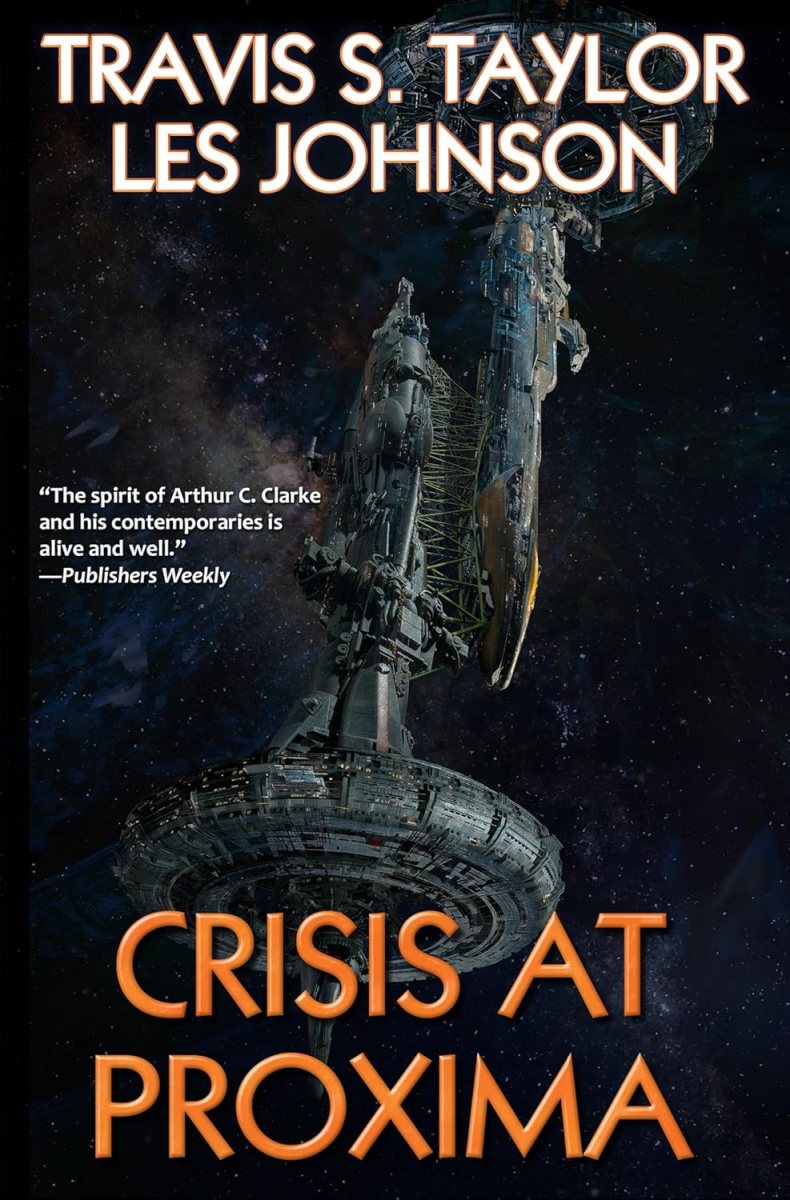






 On the front cover of Crisis at Proxima is a quote from Publishers Weekly: “The spirit of Arthur C. Clarke and his contemporaries is alive and well.” Inside, there is an unattributed epigraph (possibly the authors’): “Smart people with good intentions and high moral standards can solve any problem.” Each quote is presumably designed to show that the novel—the second part of a series entitled Orion’s Arm—is aimed at an audience which consumes what it would classify as “good old-fashioned SF”: SF based upon science and the scientific method, SF that is optimistic and celebratory. These are all categories that are sometimes looked down upon, often unfairly—there is by no means anything wrong with celebrating the human spirit, even with being old-fashioned. But the best that can be said for Crisis at Proxima is that it meanders around these quotes rather than engaging with them.
These categories can also flag a fear of the modern, the experimental, and the challenging. It’s very comforting to believe that any problem can be solved with a bit of moral rectitude and a pure mind, but it’s far from obvious that we can believe that this is actually true. More importantly, and more damagingly, the novel itself also fails to convince on even its own terms, as a piece of fiction in which we can play with that statement as a thought-experiment.
In the first volume of Orion’s Arm (we read), an expedition from Earth—whose ship is interestingly called the Samaritan—has discovered, on a planet orbiting Proxima Centauri, a human civilisation. They are the Fintidierians, who are around the technological level of 1950s USA, and were taken from somewhere in Asia some tens of thousands of years ago by a mysterious race of aliens, dubbed by the Earth visitor the “Atlanteans,” who had ruled and enslaved the Fintidierians before dying out around 50,000 years ago. On a continent named Misropos, which is deemed taboo by the Fintidierians, there are ruins and hieroglyphics which seem to offer a clue to the origin of the Atlanteans, and the superior technology of the Earth visitors allowed the detection of a signal from a particular region of space. Could this be the homeworld of the Atlanteans?
Now, plans are being made for all this to be investigated.
There are essentially two plot strands here. In one, the Fintideirians have a massive “fertility” problem (a sharp decline in the birth of females), which seems to have been caused by the Atlanteans. In the second, on the moon of a planet revolving around a nearby star, a ship with still-functioning cryogenic pods is discovered. The inhabitant of one—an Atlantean woman—is awakened and goes on the rampage, sending a signal to wherever the previously-detected signals had come from. It is clear that the technologically advanced Atlanteans are a threat to Earth, and so, partly through altruism but largely through motives of self-preservation, the leaders of the Samaritan expedition decide to track down the Atlanteans and tackle the “Gender Plague.”
So far, so standard SF plotting. Indeed, many acclaimed works of SF have had plots which are less novel. But the presentation and resolution of these plot strands quickly run into problems. First, this is the kind of science fiction where plot is developed by people talking to each other and telling them what has happened, what is going to happen, and what the “scientific” elements are. There are, in particular, several passages of people explaining maths and quantum theory to each other in ways that hold up the story. One plot strand is partially solved during an idyllic fishing trip which involves much technobabble about genetics and choosing the sex of babies, all of which kind of leads to the solution but without any real drama or tension. During another fishing trip, fish and chips are introduced to the Fintidierians, one of whom fantasises about exploiting the new exotic discovery (tomato ketchup) brought by the Earth people. This is mildly amusing but hardly gripping.
Second, this is the kind of science fiction which isn’t really science fiction, but simply has the coating of “sci-fi” to give it the flavour of things we have seen countless times on TV screens. For example: communication via implants. One character “tapped his collar to activate his microphone, exactly like the characters in the old twentieth-century sci-fi shows he watched with his grandfather as a child.” There are “smart contact lenses” and artificial intelligence assistants with no real sense of how such devices might have changed society: “He activated the star chart app in his contact lenses and let the embedded artificial intelligence find the star for him.” Here are spaceships powered by technobabble: “Powered by the ship’s fusion reactor, the Samara Drive emitted an extremely intense beam of UV light that functioned as reaction mass to accelerate the Samaritan (and the Emissary) at up to one gee for extended periods of time.” And “society,” of course, is default United States of America. The USA still exists, and the rest of the world might as well not. (There has, though, been something called the “great economic reset of 2066” which caused people to emigrate from Slovakia.)
The Samaritan is a US ship with a (largely) US crew. We do have characters like Polkingham, one of the “few Brits,” who is indistinguishable from everyone else (perhaps his use of the swear-word “bloody” is some sort of cultural marker), and Nkrumah, whose “heavily accented English” might refer to a Ghanaian origin, though he bears the Irish first name Kieren. There is a New Zealander whose cry of “I say it’s time for full bangers, Mike!” is, I assume, not a sexual invitation. The Fintidierians speak pretty much like everyone else, too, and, although initially they have names like Sgurom Smyo, many of them end up taking American names which is soon “quite the fad.” It must be obvious to at least some readers that here proceedings are following the example of many colonised countries, but this is hardly questioned.
And so, following on from this, we need to believe two things which are increasingly difficult to believe: that this near-future setting (the beginning is dated February 15, 2101) is pretty much our present given a few magical-tech items; and that an Asian society transplanted from Earth many thousands of years ago is going to end up pretty much like the twentieth-century USA. Take this description of a biology lab: “Like most Fintidierian buildings, it looked like something you would see in an old 2D movie set in the USA circa 1945 to 1950, with lots of concrete, austere windows, high ceilings, and exterior pillars.” You can hotwire Fintidierian cars just like you could twentieth-century automobiles. There is no exploration of major scientific, technological, or philosophical differences, save a passage in which the Fintidierian Secretary General Arctinier muses about the way the name of the Samaritan Ambassador Charles Jesus echoes that of someone described earlier as “his more famous and godlier namesake.” Arctinier has clearly heard about “the Christian religion’s savior of the same name”—but do the Fintidierians have a religion, or any philosophical beliefs or dogmas underpinning their society? We are not told. There are aliens, perhaps, but there is nothing alien.
There is even idiot-plotting which flags itself as idiot-plotting. During a terrorist incident, Roy Burbank, an engineer, is locked in a room from which he easily escapes. As he reflects: “Don’t kidnap and lock an engineer in a room filled with electrical equipment and expect him or her to complacently accept their fate.” On the other hand, if they hadn’t done this, it might have been more difficult for the authors to imagine his escape.
Taylor and Johnson have written a number of books, together and separately, and judging by reviews on Amazon and Goodreads there is a market for them. Most readers will not read their work critically. Crisis at Proxima is not written, or read, with any thought to literary awards. The authors have massive experience in related fields. Taylor is described as “currently working” on “very large space telescopes, space-based beamed energy systems, and next generation space launch concepts”—some of the ideas in Crisis clearly come from such work, and they are clearly in the tradition of scientists writing science fiction, which is an honourable one. Despite what I am writing, I can fully understand the appeal of this book as a moment’s entertainment. Much of what I have flagged as flaws—the avoidance of any exploration of ideas, the constant referencing of those SF images and common-stock technologies which have leaked into the mainstream, the blandness of character—identify the story’s appeal, but it is a curious one.
This is a book for readers who don’t really like reading; science fiction for readers who think that they like SF, but who don’t know what it can do to jolt people out of complacency, or who don’t care. It has some of the elements of pastiche, but unfocussed images like “[t]he door itself had grown into some strange mixture of cables, tubes, metal appendages, and the most bizarre Cthulhu shit she had ever seen” and “[t]he imagery was like something out of an animated Japanese horror movie from a century prior” are neither precise nor baroque enough to evoke any real meaning beyond their status as cliché. When Terry Pratchett, for instance, constantly drops references to the “white knowledge” that “fills up your brain without you really knowing where it came from,” he is doing something similar; but his instances are more direct, wittier, designed to allow the pleasurable shock of recognition and the sly nod indicating a shared culture. Here, it’s hard to avoid feeling that this is not comedy but simply a set of nudges towards vague icons, used because they avoid having to spend time on detail.
Some of the comments on the novel have noted approvingly its “old-fashioned” quality, but this is yet another target that is missed, as we can see by the reference to “Arthur C. Clarke and his contemporaries.” There are those among SF’s readership who read Clarke when his major works were published, and who saw in him a writer excited by the potential of the future, by genuinely observing the universe with a sense of wonder. There are those (indeed, sometimes the same readers) who—many years after Clarke’s visions have faded—see in the SF of the period a mode that simply ignores many major issues and is wooden in characterisation. Neither reaction is wholly incorrect. Positions can be debated, but what is interesting is that there now seems to be a readership that ignores or actively rejects the approach of the first tranche of readers and actively embraces what those who hold the second position condemn.
Of course, “Smart people with good intentions and high moral standards can solve any problem” is meaningless, but much entertainment can be had with problem-solving. What is questionable here is whether the characters of this story are “smart” or possess “high moral standards.” (Our ketchup millionaires seem very happy about infringing any patent held by the Heinz company because “That company is over four light-years away. What’re they going to do about it if we do copy their recipe?”) And we all know what the road to Hell is paved with.
In Clarke, we had the anticipation of the future and wonder at the universe. There is no “future” in Crisis at Proxima to wonder at, or fear. There is little in it which reflects the dreams and fears of the present, or the astonishing excitement that thinking about the universe can provoke. To the extent that “Clarke and his contemporaries” were engaging with this (and I believe that, whatever their faults, they were), the novel falls away from their model, keeping only what later generations have argued with—their deep, if often unwilling or unconscious, identification with the more conservative strands of social stances or literary style. Nor are we shown anything like the triumph of competence which writers like Heinlein argued they were promoting.
Ultimately, the basic “problems” at the heart of the novel are solved by the gosh-wow handwaving science developed by the young Fintidierian Grag, who bounces thoughts off his Earth mentor Chris Sentell, along with the help of knowledge instilled through the “superconducting quantum interference transceivers” which enable sleep-learning while he is in cryosleep. This is not so much Clarkean, in fact, as Gernsbackian: The novel’s view of science very much echoes that presented in Gernsback’s Ralph 124C 41+, serialised in 1911 and issued as a novel in 1925. Its final chapter has Ralph bringing his girlfriend Alice back to life. He needs the “rare gas” Permagatol, but there is none available … So, naturally, he invents a substitute (“The gas he evolved was Armagatol”). Or, to put it another way, “and then we were saved”; or “[w]ith one bound, Jack was free.”
This is, in fact, precisely what the science fiction of the 1950s was reacting against, and why, whatever spirit Crisis at Proxima is written in, that of “Clarke and his contemporaries” is not it. It’s a novel which meets the expectations of its readers in that it tells a story, is full of infodumps which give the impression of imparting educational information, and it passes the time. The shame is that the expectations are, clearly, so low.
Like Loading...
Comments (0)