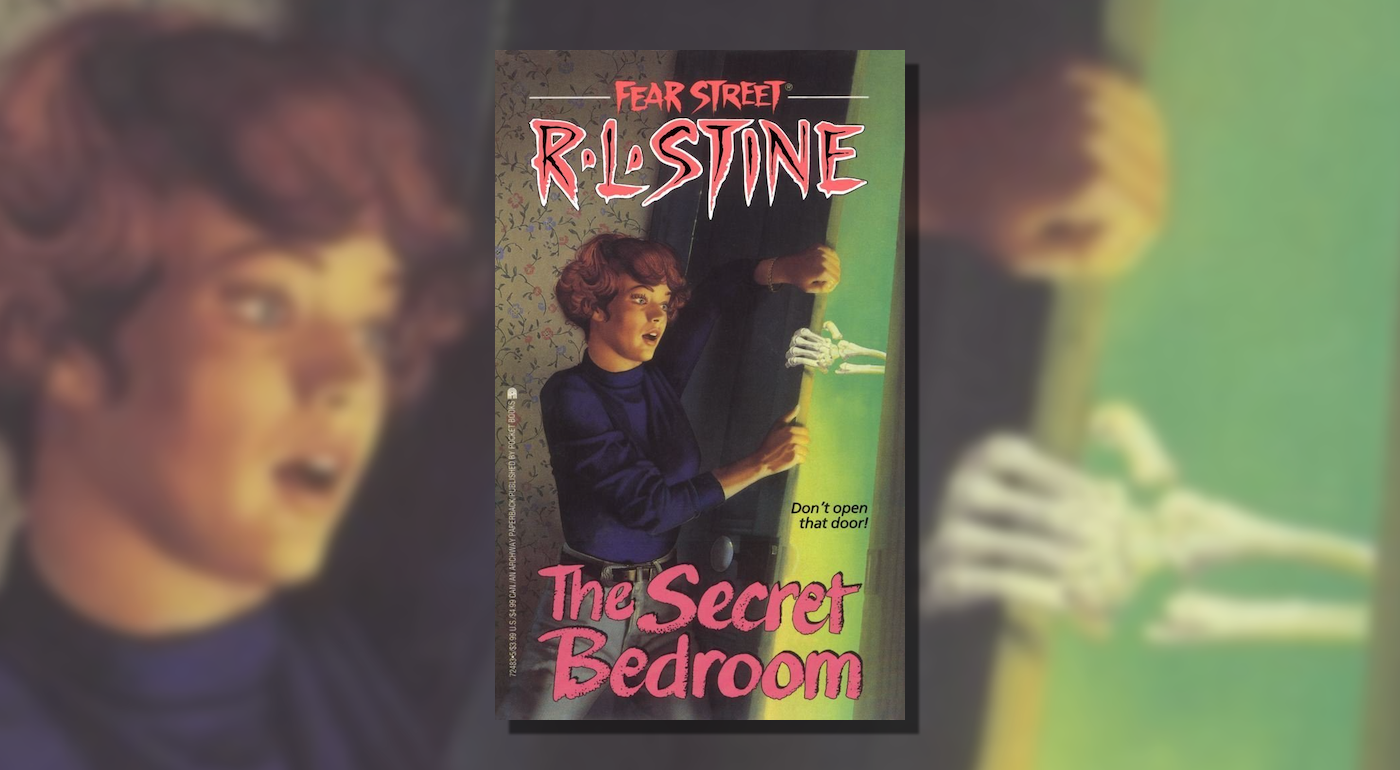
In R.L. Stine’s Shadyside and Fear Street, the past and the present can never be definitively separated. Whether it’s dark secrets that won’t stay hidden or undead cheerleaders coming back from the grave, the past can never be laid to rest. Between this persistence and the neighborhood’s generally creepy vibe, it’s no surprise that there seem to be an awful lot of haunted houses on Fear Street, including those featured in Haunted (1990) and The Secret Bedroom (1991).
The Secret Bedroom is the more traditional ghost story of the two: Lea Carson and her family are new in town and have moved into a house on Fear Street. Lea’s family moves around a lot for her father’s job, but wherever they land, her parents love to buy an old house to fix up before they move on to the next town. When they come to visit Shadyside and do some house hunting, their realtor is Mrs. Thomas, mother of Suki Thomas (STILL my favorite—and criminally underappreciated—Fear Street character!), and while Mrs. Thomas really knows how to sell the features of this big old house, she can’t resist sharing some spooky speculation about the house’s mysterious history as well, particularly regarding a locked room in the attic, where someone was allegedly murdered one hundred years ago. But that’s Fear Street for you: As Mrs. Thomas tells the Carsons, “most of the houses on Fear Street have similar stories […] They’re not true, I don’t think. At least, they’re not all true” (16, emphasis original). Mrs. Thomas tries to put a positive spin on things, telling them “there’s a horror story for every house on Fear Street. Yet the people I’ve met who live on this street are all as nice as can be” (17-18). The idea that they might be buying a murder house doesn’t bother Lea’s parents, and they move right in and start getting settled into their new home and new lives.
Lea struggles getting acclimated to Shadyside High, almost immediately making an enemy of popular girl Marci Hendryx when she trips in the lunchroom, spills chili all over Marci’s expensive sweater, and then unwittingly makes a date with Marci’s boyfriend Don Jacobs. Oops. Except it turns out that at least part of this might have been a cruel prank, when Don no-shows for their date and Lea finds out that Marci got Don to ask Lea out just to stand her up and humiliate her. While Lea is understandably furious with Marci, she’s a lot more sympathetic to Don, who sheepishly apologizes to her and seems to feel genuinely bad about what he did (though that doesn’t stop him from continuing to do Marci’s bidding as she torments Lea moving forward).
Things aren’t much better at home: Lea’s parents are out a lot, leaving her home alone, and she starts hearing footsteps pacing back and forth in the attic above her bedroom. When Lea goes to investigate, the source of the trouble seems to be behind the locked door to the secret room, which first starts to bleed and then sprouts sharp metal spikes, though every time Lea tries to show someone, it’s just a regular old door. One night when Lea goes up to the attic again to try to find the source of the mysterious footsteps, she hears the soft sound of crying from behind the door and then a sad girl’s voice pleading with her to “Open the door! Please—open the door!” (75). To her credit, Lea at least hesitates, wondering who this might be, how they got in there, and whether or not opening a murder door for a mysterious stranger might be a terrible idea. But after some brief consideration, she opens the door and finds a time capsule of a room: “The room was lit with candles […] The walls were papered in dark maroon wallpaper that appeared to be textured, like felt. A large canopy bed, all pink and satiny, with a heavy, quilted pink bedspread, practically filled the room” (81). And in the room, waiting for Lea, is the girl who called for help, who is “beautiful in a very old-fashioned kind of way” (81), with her hairstyle and clothing of the same bygone era as the room’s furnishings. The girl introduces herself as Catherine and tells Lea that she was locked in this room for her whole life, a secret her parents kept hidden because she had been conceived and born out of wedlock, and when Catherine resisted and tried to escape, they killed her. Catherine is pretty intense, “stretching her arms out toward Lea as she walked toward her. Her expression was so needy, so—hungry” (83). Lea is frightened and retreats from the room and the attic, despite Catherine’s pleas for her to stay, needing some time to process this impossible development and what to do about the ghost in the attic.
Lea’s sympathy for Catherine eventually draws her back to the attic and the secret door, and Catherine quickly begins to insidiously insert herself into Lea’s life… and body. Lea is frustrated with Marci’s relentless bullying and asks Catherine to help her scare the other girl with her ghost powers, which Catherine agrees to do, but only if she can possess Lea’s body for the walk over to Marci’s so she doesn’t wear herself out. Just like inviting a vampire into your home, inviting a ghost into your body is usually a terrible idea, and this proves to be the case for Lea. Catherine does a good job of scaring Marci but she goes overboard: When Marci runs up the stairs to try to get away from Lea, Catherine leaves Lea’s body, takes her ghostly invisible form, and pushes Marci over the second floor banister, killing her. Lea is horrified and wants to sever her connection with Catherine, but it’s too late. Now that Catherine has gained access to Lea’s body, she can force herself in pretty much any time she wants to, and she does, making Lea’s life miserable.
However, while Lea is spending her time and energy trying to figure out how she can keep Catherine out of her body, it turns out that Catherine has been in Lea’s mind all along. One night Catherine appears in Lea’s room and tells Lea that she never actually opened the door in the attic. Every time Lea thought she went upstairs, it was nothing more than a vision designed and controlled by Catherine, who has been in Lea’s room with her the whole time. As Catherine explains to Lea, “You were never in the hidden room […] You were never in the room upstairs—because I was never in the room upstairs. I never left this room” (137, emphasis original). Catherine saw Lea’s fascination with the locked room during the family’s first walkthrough with the realtor and leveraged that interest to create a dream reality for Lea, through which Catherine has been controlling and manipulating her, with a dual purpose in mind: take control of Lea’s body and keep Lea from opening the real secret room. Nothing Catherine has told Lea has been true, including the nature of the room in the attic, and she now tells Lea “It’s evil. I boarded the room up myself. A hundred years ago. I did it. And that door will stay locked forever” (138, emphasis original). The only way to free herself from Catherine is for Lea to free herself from the ghost’s control and open the room, to find out what it is that Catherine doesn’t want her to know: Catherine killed her parents and locked them in the attic room, not the other way around. These dead are just as restless as Catherine and eager to take their revenge on her. They attack their ghostly daughter, “circl[ing] her with their putrid, baggy clothes, the odor rising in a vapor of decay, parts of them dropping off, bones falling to the floor, as they swept around her […] Catherine disappeared inside this foul, murderous hug. As Lea gasped in frozen horror, the vengeful ghouls hugged their daughter, wrapping her tighter and tighter in a furious, swirling grip, suffocating her” (161-2). This final embrace seems to exorcise three ghosts with one stone, with Catherine punished and her parents at peace, leaving Lea to figure out what was real, what was all in her head, and how to move on from here.
Haunted puts a different spin on the traditional ghost story structure. Melissa Dryden is on edge about rumors of the Fear Street Prowler, who has been breaking into houses in the neighborhood, when she first sees the ghost in her bedroom. As she tries to take in the reality of his presence there, “his dark eyes stared into hers […] He had dark brown hair that looked as if it hadn’t been washed in weeks. It was parted haphazardly in the middle and hung down past his collar. He had thick, dark eyebrows, high cheekbones, and a mouth that seemed to fall naturally into an unpleasant sneer. He was wearing a faded blue denim jacket and blue denim jeans” (49). Melissa doesn’t know who he is or why he’s there, and when he tells her “you killed me!” (50), she has no idea what he’s talking about. The ghost’s name is Paul and though Melissa is absolutely sure that she’s never met him and certainly didn’t kill him, Paul is unwavering in his accusation and bent on revenge. Melissa begs him for a bit of time, hoping that she can figure out who he is and what actually happened to him, so that she can clear her name, convince him not to kill her, and through finding the truth, hopefully allow his spirit to rest peacefully.
Melissa dedicates herself to researching recently deceased local teens, but keeps coming up empty (honestly, pretty shocking in Shadyside). Her investigation gets even more complicated when she runs into Paul outside of the local teen dance club and Paul is very much ALIVE. While Melissa and Ghost Paul have begun building a kind of grudging rapport, Alive Paul is not a nice guy. He’s hanging out in the parking lot drinking with a group of friends, and when Melissa encounters them, there is a distinct threat of sexual violence, as they try to corner her in a dark part of the parking lot, saying things like “What’s your hurry? Didn’t you come out to play?” (94) and “I’ll let her go when I’m finished with her” (95). From this point on, Melissa’s relationship with Ghost Paul and Alive Paul develop in divergent ways: Ghost Paul continues to get more sympathetic, invested in solving the mystery of what happened (or rather, is going to happen) to his living self, while Alive Paul is a legitimately dangerous dude who continues to threaten Melissa—and also turns out to be the Fear Street Prowler. So he’s a bad guy, a criminal, and he knows where she lives.
Melissa wants to do everything she can to solve the mystery and help Ghost Paul, and as she gets to know him, she starts to believe that this is the “real” Paul and Alive Paul’s scariness is just a tough guy front he puts on. Melissa’s occasional conflation of the two Pauls results in her putting herself in some pretty dangerous situations, including showing up at Paul’s house alone to try to talk to him and tracking him and his friends down to another dark parking lot, this one outside of a liquor store, where the earlier harassment and threat of violence are repeated.
Melissa and the two Pauls find themselves in the same place at the same time when Alive Paul breaks into Melissa’s house, planning to assault her and rob the house. Melissa is home alone, but her dad bought a gun for protection when the Fear Street Prowler began breaking into houses in the neighborhood, and Melissa knows where he keeps it. She’s able to pull the gun on Alive Paul but can’t bring herself to pull the trigger. Alive Paul doesn’t have the same reservations and tries to take the gun from Melissa and kill her instead, but Ghost Paul doesn’t let that happen, as he “lunged forward and reached for the pistol in Paul’s hand” (160), which goes flying, and when Melissa catches it, it goes off, killing Paul. In spying on his alive self’s life, Ghost Paul hasn’t been impressed with what he’s seen or who he was when he was alive, and in this pivotal moment, he makes the decision to save Melissa’s life and resign himself to his ghostly fate. Melissa is horrified that Ghost Paul’s premonition has come true—she did technically kill him—but Ghost Paul has no regrets, telling Melissa “I couldn’t let him kill you. I—I care about you too much” (163). After sharing a ghostly but somehow tactile embrace, Paul reassures Melissa, telling her “Don’t feel guilty for killing me. Don’t ever feel guilty. You were the only one who ever cared about me” (163). And while Paul didn’t experience that care until after he was dead, this revelation transforms Melissa from a murderer to a savior, someone who released Paul from the misguided criminal life he was living… even though it took death to do so.
In both The Secret Bedroom and Haunted, these ghosts are more than just the isolated encounter of a haunting or a residual presence from the past. Both Catherine and Paul have the potential to destroy the girls they haunt, with Catherine taking over Lea’s body and manipulating her mind, and Paul threatening to kill Melissa. There’s also a good chance that both Lea and Melissa are going to be haunted by these experiences in more ways than one: They have had encounters with ghosts, but the impact of those interactions will reverberate long after the ghosts have been exorcised or laid to rest. In The Secret Bedroom, Lea has lost control of both her mind and body, albeit temporarily, which will likely have a lingering aftereffect of making her doubt her own thoughts and perceptions. When she first met Ghost Paul, Haunted’s Melissa was absolutely sure there was no circumstance in which she could take someone’s life, and even though her role in Alive Paul’s death is accidental, she did kill him, all while falling for the ghost she was trying (and failed) to save. At the end of these books, the ghosts are gone, but the girls they haunted have been fundamentally transformed.
icon-paragraph-end






Comments (0)