
Remember me



Whether its ships stranded in home ports or drones striking undefended bases, the war on Iran has forced many problems with the UK’s armed forces to the surface, where Presidents Trump and Macron are illuminating them with a spotlight of glee. It didn’t have to be like that, but perhaps it is better that these stark flaws are being made salient now and not in a more existential crisis. The run-down armed forces are not Starmer’s fault but the inevitable product of decades of managed decline. In this period, commanding our armed forces has become less important than disguising their hollow reality. And if there is a salutary response to this conflict, it is the opportunity confront this creeping failure – and reverse it if we can.
Following the Sterling Crisis of 1967, an economic reckoning over the value of the pound and the fiscal commitments of the British government, Harold Wilson decided we could no longer afford to be based East of Suez and commenced the draw back to concentrate on Nato’s back yard. This was at the height of the Cold War when the military threat – which included nuclear Armageddon – was well understood and accepted across most of our polity. Regardless of the party in power, the UK spending on defence was remarkably consistent at 4-5 per cent of GDP from then on. That era came to an end in 1989. And while the end of the Cold War and resetting the nuclear Doomsday Clock were welcome, it posed an existential question for the UK’s armed forces – what were they for now?
At this point, the Gulf and its Strait of Hormuz provided some answers. The Royal Navy’s Armilla Patrol had since 1980 been part of a loose coalition, centred on the US Navy, that had aimed to police the Strait, stabilise a volatile region, and keep the oil flowing. The volatility peaked in 1990 when Saddam invaded Kuwait, and the subsequent First Gulf War took us back East of Suez. And it did so in a way that was most appealing to the Armed Forces: a clearly bound military task, and a joint operation using just the sort of high-end equipment we had perfected during the tail-end of the Cold War. Subsequent no-fly zones over Iraq maintained an uneasy peace. Here was a raison d’etre.
In the late Nineties, Tony Blair coupled this with an ethical and doctrinal basis for military interventionism. Responsibility to protect (a UN-sanctioned commitment to intervene internationally in certain cases) as well as the battles against Al Qaeda and Isis provided the new bogeymen after 11 September 2001. And in 2003 the Western Coalition was back dealing with Saddam once again, and his putative weapons of mass destruction. But this left the UK exposed on two contentious military operations in Iraq and Afghanistan, which, inter alia, strained inter-departmental relations across Whitehall.

Subscribe to the New Statesman today and save 75%
But the high political demands of these conflicts were not supported in civic society. The consensus around the Cold War, the acceptance of living under the threat of armageddon, had not been replaced by the War on Terror. That 5 per cent of GDP was unsustainable without the visceral fear of the Red Army to underpin it. The Major Government had began the glide path with significant defence expenditure reductions beginning even as the Gulf War was burning up cash and military assets. This process only intensified by Iraq and Afghanistan, which left less to spend on core capacities.
A dynamic was established: the Treasury refusing to pay for a large standing military while funding counter-insurgency, a political leadership that wished to play on the major geostrategic stages but didn’t want to risk the peace-dividend by talking up the threat, and an armed forces used to seeing itself as leading within “Tier 1” militaries and feeling respected around the globe. These contradictory impulses have defined the shape – the breadth and depth – of our armed forces ever since. And British military hubris couldn’t countenance playing second fiddle to anyone but the US, and so it tacitly accepted a Faustian pact where the US provided a lot of the undergirding for joint military operations while we fielded some high-tech equipment that kept us at the Top Table.
The US was keen on having the UK – a permanent security council member, a nuclear power, and top-ten economy – on its side if for no other reason than it made the politics of American foreign policy more robust. And the UK did provide some excellent military capabilities, if increasingly niche, while in return getting to influence world affairs where our values and interests coincided. Keeping global shipping lanes open and dealing with international terrorism were two good causes where our powers could be flexed.
As the front-line continued to shrink, these two trends were reinforced: ever-greater dependency on US capacity to provide depth with its concomitant acceptance of a “hollow” armed forces; while chasing shiny kit to keep up in those niches where we could still play a role. And in every operation we were involved in, one or more of our overseas territories made us very useful indeed – not least the bases in Cyprus and in Diego Garcia (part of the Chagos archipelago). But these territories also needed defending – another cost. And with major, war-like operations a rarity, and with little serious chance to make a career on actual operations, peacetime “manoeuvring” around the Ministry of Defence and Whitehall to secure a greater slice of an ever-reducing financial cake became the career-defining, inter-service battle for many senior officers.
The many years of the ‘Global War on Terror’ made this even more unbalanced, as sections of the military – principally the Army – tried to make counter-insurgency not just our “main effort” (a term of art in military circles) but almost “sole effort”. The Royal Navy suffered the most with ship orders repeatedly delayed, and soldiers in the form of Royal Marines being elevated over the Navy’s “white shirts”. The army largely vacated armoured warfare at scale: the complicated business of organising and moving a military socio-economy of tanks, their recovery and repair systems, the extended logistics trains or maintaining an air-defence umbrella. This loss of capacity was covered by the seductive glamour of the Special Forces, such as the SAS. A similar process occurred inside the Royal Navy and Royal Air Force, where the dazzling brightness of the high-tech spear tip distracted from the absence of a shaft to give that spear any weight.
All this was accidentally exacerbated by the Levene reforms of 2012/13. An overhaul of Defence management, it of course set out to do the exact opposite and deliver efficiencies. The Services themselves, not The Centre in MOD, were given the controlling interest in their slice of the budget. But by fighting over that slice, military factionalism intensified, as did the tendency for the Services to chase their US sister service with their bespoke equipment, at the expense of the ability to act in an integrated way and to a defined national purpose. After the Strategic Defence and Security Review of 2010 and the Cameron-Osborne austerity years, the military front-line further shrank around an irreducible core of what was required to maintain the peacetime facade. (See, for instance, Cameron’s prioritising decorative army farriers and the Red Arrows over front-line units.)
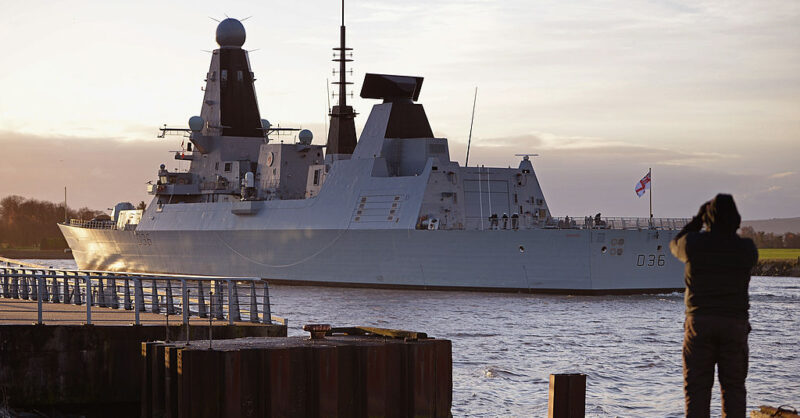
Each time an ambitious budget ran into trouble, an inevitable occurrence in any programme developing cutting edge technology, or the Treasury needed an overall financial “haircut” from Defence, all it could do was trim activity or cut the front-line forces that require cash to maintain. And so readiness took yet another hit. Delaying equipment programmes to find savings actually increases final costs. The programme’s own running costs continue to eat budgets and so reduce the residual sum available to buy the end-product – which now costs more per unit – and with fewer units finally procured. This, largely, is why we have six Type 45 destroyers, not the 12 required by policy or initially budgeted for – though as an admiral colleague reminded me: “We still paid the same for six as we had budgeted for 12.”
Careers are built on finding clever ways to mask this and keep the show on the road for another year – there is even a term for it “knife-and-forking our way to the end of the financial year”. Good knife-and-forkers are in demand as they save the blushes of the financiers, service chiefs, and ministers. It is noticeable that there has been a convergence between ministers and these senior officers in their mutual need to produce “military spin”. It worked as long as no one looked too deeply. But many junior leaders, perhaps commanding the front-line units and aware of how threadbare they are, saw it clearly – which is why morale is nose-diving. The more principled, unwilling to join in the game, leave. But others keep playing the game.
Those Nato members who hadn’t spent as much as us in the past (but had spent more soberly) are genuinely spending more now, and so show substantive increases in their armed forces. The UK, meanwhile, has dropped to near the bottom of Nato rankings on meeting agreed outputs required by Nato plans. We cling on, citing that our headline spending percentage of GDP is already above the line, and always was, and so we don’t need to make any changes. (The maintenance of the Trident nuclear deterrent also skews spending comparisons.) So the managed decline continues in contrast to the rest of Nato (bar Spain). Everyone else sees it but us.
When he was made defence secretary in 2024, John Healey came in with a plan to reform this. But – and I’d argue this goes for pretty much all his Labour colleagues – he had too optimistically assumed that the public sector would simply lay down palm fronds in front of those delivering them from “wicked Tories”. Relieved of the yoke of incompetence, the thinking went, they would sprint to deliver the new government’s manifesto promises. A cursory read of Tony Blair’s memoirs and his account of the “scars on my back” from trying to drive efficiency into the public sector should have disabused them of that.
The public sector has a hive-mind of its own and the Ministry of Defence is no different. Those at its apex are masters of the game described. Why change the game that makes them winners? The senior civil servants and many senior officers in the military, but far from all, have paid little more than lip-service to Healey’s reform programme – which has now gone on for over 20 months. In that time, any defence secretary would have to find some political successes. And so he became captured, to some extent, by the people who can produce “military spin”. Indeed, in some cases he has promoted exactly the people that the logic of his own reform programme said he should replace. Industry is confused, doesn’t know who to turn to, and lacks confidence that the rhetoric of reform and defence renewal will amount to much. And this at a time when a National Armament Director (one of Healey’s key initiatives, and a good one) is vital for gripping a defence sector that in some quarters has become complacent and risk averse.
And then came Trump, Netanyahu, and Iran. Applying the legacy formula to Trump’s demands might have worked: some risk could have been taken to get a Type 45 destroyer seaworthy and down-range to Cyprus in time, thus making a show of defending it. We might have made a political risk calculation and joined Carney, Albanese and Merz in supporting the defensive side of the operation, and so allowed the US the use of our bases. In other words we could have predicted where we’d likely end up in any case – and now are – and made a virtue of it. Just these few, inexpensive measures would in all likelihood have forestalled the criticisms the military are now facing and kept the facade propped up.
But in starting with the legality before the politics, different answers were given by the government. The props behind the facade have been exposed, tested and have failed. The world now sees the true state of the UK’s military readiness. We do not know what the long-term impact will be on our relationship with the US (though the relationship was and is neither as good or as bad as is being claimed in certain quarters).
However, something has changed. And so questions now abound: about the state of the Nato Alliance, about our reputation with allies in the Gulf, about our status in Cyprus. (The Cypriot president has called for “an open and frank discussion with the British government” about the future of the bases.) Does the US believe it can rely on the UK? Will it be there for us in future? What might European countries have to spend on defence in the absence of US willingness to pick up the slack? And how are we going to afford our part in that expansion when the markets are already very nervous about the British fiscal position?
These are very difficult political questions to answer. Starmer didn’t create our hollow military. But his actions have revealed it in all its troubling dimensions. The problem is now his to solve. The Conservatives need to be constructive and not use this crisis for party-political purposes – after all, a lot of the debilitation of our armed forces happened on their watch. And neither has made a consistently strong case for defence even though the growing threat has been clear for some time. But if Healey doesn’t get Defence Reform done and the incentives altered fundamentally so we can rebuild the military forces we need at acceptable cost, then we are destined to continue a managed decline. If we do, then the next crisis might be more than just embarrassing.
[Further reading: The new world war]
Content from our partnersRelated

Comments (0)