
Remember me



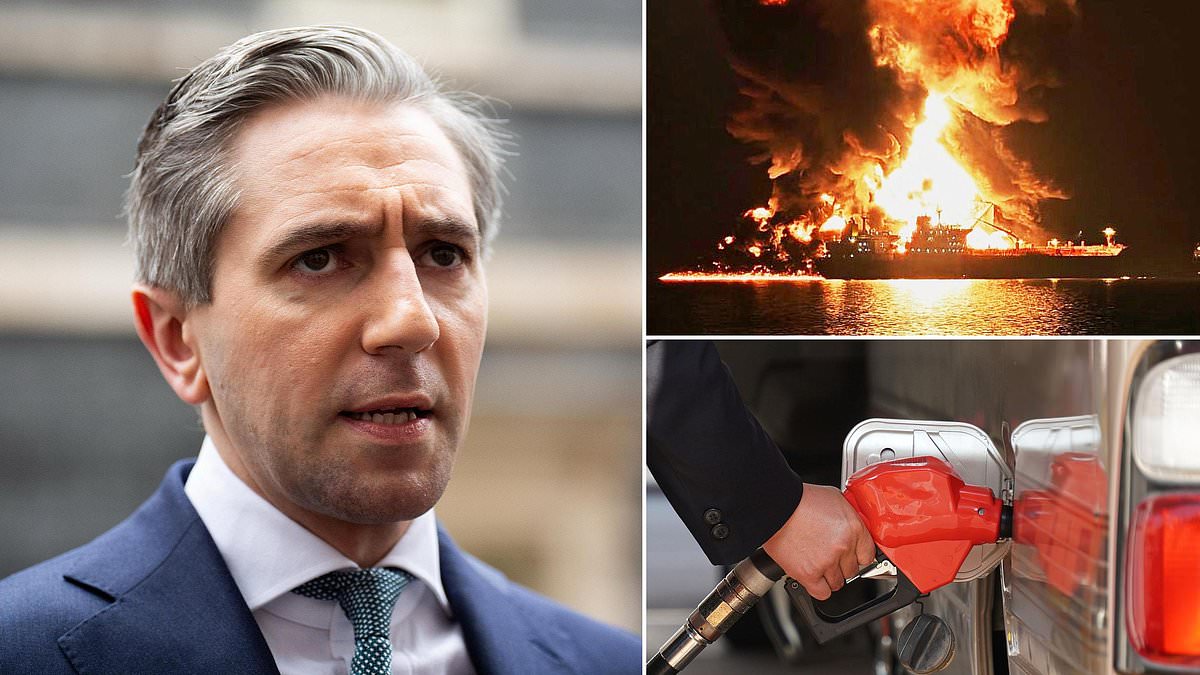




Householders and businesses are set to face fuel rationing despite the Government having a €5 billion war chest to combat the impact of the most rapidly escalating energy prices seen in a generation, the Irish Mail on Sunday can reveal.
The Government will announce a wide range of measures in the Dáil on Tuesday to assist households and industries hit the hardest by soaring oil prices as the Middle East war continues to rage.
Tánaiste and Finance Minister Simon Harris will meet with Taoiseach Micheál Martin tomorrow night to agree on an initial crisis financial package before bringing it to Cabinet on Tuesday morning.

Tánaiste and Finance Minister Simon Harris, pictured here in London earlier this week, will meet with Taoiseach Micheál Martin tomorrow night
The new fiscal measures will then be presented to the Dáil and Seanad for ratification by means of ‘financial resolution’.
In the short term, the Government will announce a range of fiscal reliefs to ease the pain of soaring fuel prices on Tuesday. These will include:
Financial assistance through excise duty cuts for motorists hit by surging petrol and diesel prices at the pumps, which have been given EU-wide ratification;Targeted supports for the elderly and most vulnerable in the form of fuel allowance increases;Measures to support the haulage sector, which will be a combination of an excise duty cut and a diesel rebate;Cuts to excise on home heating oil.However, senior ministers last night said the Government is also preparing for a longer-term crisis, which may involve more financial interventions this year.
One Cabinet source told the MoS: ‘Thank God we have a surplus – and a significant one. While, understandably, everyone is asking what can be done to help them pay bills in the short term, our job is to look at where this crisis is in six months or 12 months’ time.’
The minister said Government leaders have a ‘general surplus of about €5billion’ they can draw upon to combat the impact of the deepening economic crisis sparked by the US-Israeli invasion of Iran.
They added: ‘There are two longer-term reserve facilities, but when we are asked next week how we are paying for this short-term package, we will say that it’s from our surplus. It’s not limitless, but certainly we have €5billion.
‘We got lambasted for setting money aside. We got told: “You know, it’s raining now, why not spend the rainy day [fund]? Why you’re not doing more?” This is why,’ they added.
The Government is confident it has the capacity to fund interventions over a sustained period.
A Cabinet source noted: ‘This is the reason you run budget surpluses, so that if a shock comes to our economy, you have an ability to respond. If you look at what happened in Britain this week, borrowing costs significantly rose because Britain has a deficit. Our borrowing costs haven’t risen. Why? Because we have a surplus.’
The Government’s financial position was boosted further yesterday after one of the world’s largest credit rating agencies, S&P, upgraded Ireland’s rating from AA to AA+, putting the country within one notch of a triple-A rating for the first time since 2009.
The positive credit rating means the Coalition will be able to borrow at lower rates if required.
The Government is also planning more long-term measures in the event of the conflict dragging on.
Cabinet sources said these will include further interventions to help householders with rising energy bills. Large industrial energy users will face rationing or ‘demand management’ measures, which occurred in the aftermath of Russia’s invasion of Ukraine.
Ministers said they are also monitoring events in Asia, where some countries have closed schools for a day to save energy.
Sources indicated the Government may issue an advisory for companies to encourage more remote working.
In an indication of the scale of the global oil crisis, the Government is planning for the potential rationing of motor fuel.
Government sources noted there was a sizeable fall in motor traffic across the country this week as prices at the forecourts soared.
While some senior Government figures remained optimistic last night, stressing the initial measures are for the short term, several ministers admitted they are preparing for a long, drawn-out conflict in the Middle East.

An oil tanker burns after being hit by an Iranian strike in the ship-to-ship transfer zone at Khor al-Zubair port near Basra, Iraq
A Cabinet source said: ‘Ultimately, we are preparing for a long disruption to energy supply, perhaps the greatest the Western world has ever experienced. Later this year, we could see demand management for energy, which would require companies to show energy conservation measures in return for subsidies.’
‘Demand management’ measures for industry in Ireland followed the Russian invasion of Ukraine, and these are expected to be introduced again as early as next month.
The Government believes it will have to look at a whole range of fiscal options over the coming months. One minister told the MoS yesterday: ‘The problem is so f***ing volatile; we use excise and other measures… and then it just goes up again.
'This is a war, and events so far have been unpredicted, certainly by the US administration, so what happens with oil is unpredictable.
‘On one hand you’ve [US president] Donald Trump saying the war is going to be de-escalated this weekend but, on the other hand, only today Israel’s minister for defence, Israel Katz, has said that they are going to “significantly escalate”.

Donald Trump has suggested that the war is going to be de-escalated this weekend, but Israel, their parters in the attack on Iran, are sending out a very different message
‘Trump says a lot of things, but ending this conflict and the attendant chaos is beyond his control. Beginning a war is one thing but ending it is a whole other thing.
‘The US was of the mind that Iran’s missiles had 2,000km range and now they’ve gone to 4,000km.’
A minister involved in compiling the relief measures warned that householders will have to react to the changed reality.
They told the MoS: ‘If the price is going to continue at a high level, and we don’t see how it won’t, then the whole of society is going to have to change how it operates. The gravity and scope of behavioural changes is going to be dictated by the length of the conflict.
‘The Government is observing what other countries are doing, including Asia, where they are sending children home from school one day a week. Companies will be encouraged to widen work- from-home policies.’
Cabinet sources also warned that other sectors, including agriculture and construction, will be hit.
One minister said: ‘The Government has an absolute understanding of how bad this is and it could well be a Covid-level crisis. But, like then, we have to bring the public along with us. It’s incredibly serious. It’s not just about price frustration. It’s about the whole system in the world.
‘I mean, you look at fertiliser, you look at helium, you look at nitrogen… all these products, a huge amount of them, are petroleum or gas-derived,’ they said.
‘The whole thing is mental and there is not much we can do to influence the conflict.’
But, they added: ‘We can act here financially.’
Speaking about the longer-term effects of a prolonged conflict, the minister said: ‘There is, understandably, a society-wide urge to know what the Government is going to do to help me now? But if you’re doing our job, the bigger issue is actually what this looks like economically in three months’, six months’, 12 months’ time.’
Simon Harris yesterday noted that ‘the hit to oil supplies is of the order of 20 million barrels per day – making it the largest-ever shock to the global oil market’.
The Tánaiste and Finance Minister added: ‘At this point, there is no clarity regarding the depth and duration of the conflict – this means there is considerable uncertainty regarding the economic fallout from the shock to oil supplies. If the conflict continues for a prolonged period, the impact on the global economy will be real – Ireland could not be immune from such an outcome.’
The Fine Gael leader said the intervention the Government will announce on Tuesday ‘will strike an appropriate balance between providing help now and keeping some of our powder dry’, adding, ‘Nobody knows what the situation will be in a month from now, so we must remain nimble and flexible.’