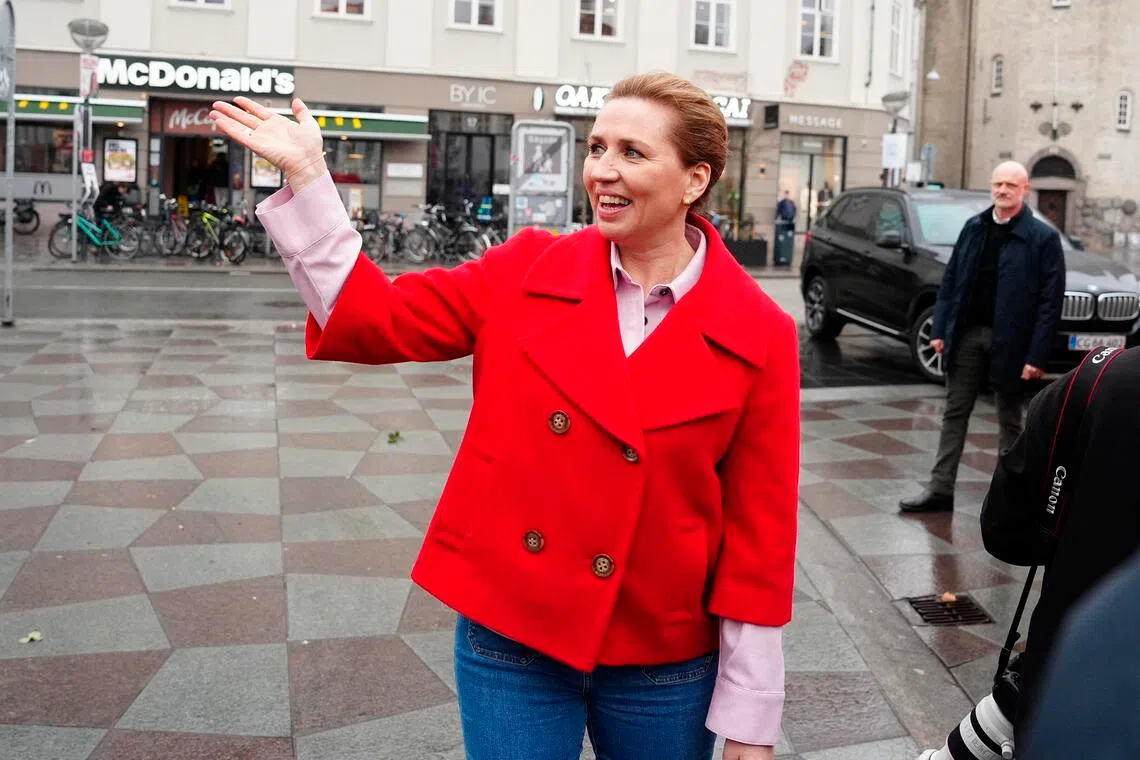
COPENHAGEN – Danish Prime Minister Mette Frederiksen’s party won a closely contested election by pledging stability in global turmoil, setting the stage for difficult coalition talks to secure a third term in power.
The premier’s Social Democrats emerged as the biggest with 21.9 per cent of the March 24 parliamentary vote overshadowed by US President Donald Trump’s threats over Greenland, after all ballots were preliminarily counted.
Still, it’s the party’s worst result in more than a century.
With both traditional camps short of a clear majority, Foreign Minister Lars Lokke Rasmussen of the centrist Moderates landed the role of kingmaker.
His election-night plea to continue with a cross-bloc coalition was dismissed by Liberal leader Troels Lund Poulsen who ruled out cooperating with Ms Frederiksen, narrowing options for the talks that are due to start on March 25.
The election is one in a string of European ballots shaped by Mr Trump’s return to the White House.
While Danish parties are unified in standing up to the US, key votes starting with an April ballot in Hungary will help determine how Europe positions itself toward the US.
The Danish election – typically a domestically focused race – was dominated by foreign and security policy in light of Mr Trump’s designs for Greenland.
The crisis drove home to the Danes just how directly impacted they are by the shift in the global order.
The 48-year-old Ms Frederiksen had been polling poorly before the US president renewed his claims over the Arctic territory in January, but saw a boost in backing following her handling of the dispute.
That prompted her to call the vote early, with Danes galvanised by Mr Trump’s pressure to rally around their leader – mirroring the outcomes of Canadian and Australian votes in 2025.
“The world is turbulent, there’s a strong wind blowing,” Ms Frederiksen said at her party event after the preliminary results. “Denmark needs a stable government. A competent government. We’re ready to take the lead.”
Ms Frederiksen’s leftist ally the Green Left followed her party with 11.6 per cent backing, with right-leaning rival Liberals at 10.1 per cent – which was also that party’s worst on record.
Turnout was 84 per cent.
Overall, the left-leaning bloc had 84 seats, its opponent 77, leaving Moderates with 14.
With the Liberals unwilling to join another Ms Frederiksen coalition, her options to secure another term are narrowing.
Failure to win sufficient backing could open the way for alternative coalition talks that may ultimately lead to a different prime minister.
Still, with Denmark’s right-leaning bloc lacking a clear, unifying leader, Ms Frederiksen has a tactical advantage.
As a next step, party leaders meet for a debate on March 25 hosted by Denmark’s largest press club.
Liberal Party leader Mr Poulsen, her most prominent rival, has struggled to gain traction in the polls.
He said he’d be open to working with 61-year-old Mr Rasmussen of the Moderates, often dubbed the comeback king of Danish politics.
Mr Rasmussen took a leading role in managing diplomatic talks with the US during tensions over Greenland earlier in 2026, positioning himself as an experienced negotiator at a tense moment for the Danish kingdom.
Mr Rasmussen owes “his entire success” to having “engaged in an arm-wrestling match with Donald Trump,” said Mr Soren Lippert, a former political adviser to the Social Democrats who runs political analysis company GeoPolitik.
“Lars Lokke Rasmussen will determine who becomes prime minister in Denmark. And he does so on a line that has been very confrontational toward the American administration,” Mr Lippert said. “The course is set for Denmark to be on a confrontational path with Donald Trump in the years to come.”
Part of the political centre, the Moderates have campaigned on pragmatic cooperation across Denmark’s traditional left-right divide.
Four representatives from Greenland and Faroe Islands may also tilt the balance of some potential coalition formations, though local media reported the Faroe representatives went one for each bloc.
Ms Frederiksen rose to power in 2019 in Denmark by steering her party toward a tougher stance on immigration, reclaiming working-class voters who had drifted to the right.
At 41, she became the country’s youngest-ever prime minister.
The premier has emerged as one of Europe’s most influential leaders, bolstered by a hardline on immigration, strong backing for Ukraine and standing up to Mr Trump.
Still, Ms Frederiksen’s party slid almost 6 percentage points from the 2022 ballot.
The poor backing evokes local municipal elections in November, when the Social Democrats lost the mayor position in capital Copenhagen for the first time since 1903.
“It takes a toll to hold power – it takes a toll to be in power in a government like the one we’ve had,” Mr Jeppe Bruus, minister for green transition for Social Democrats, said in an interview at an election party before all votes were counted. “We would have liked a better election result.” BLOOMBERG








Comments (0)