Follow our live coverage here.
HOUSTON - The Trump administration may be neck-deep in its nearly month-long war on Iran but its focus on the “China threat” remains undiluted.
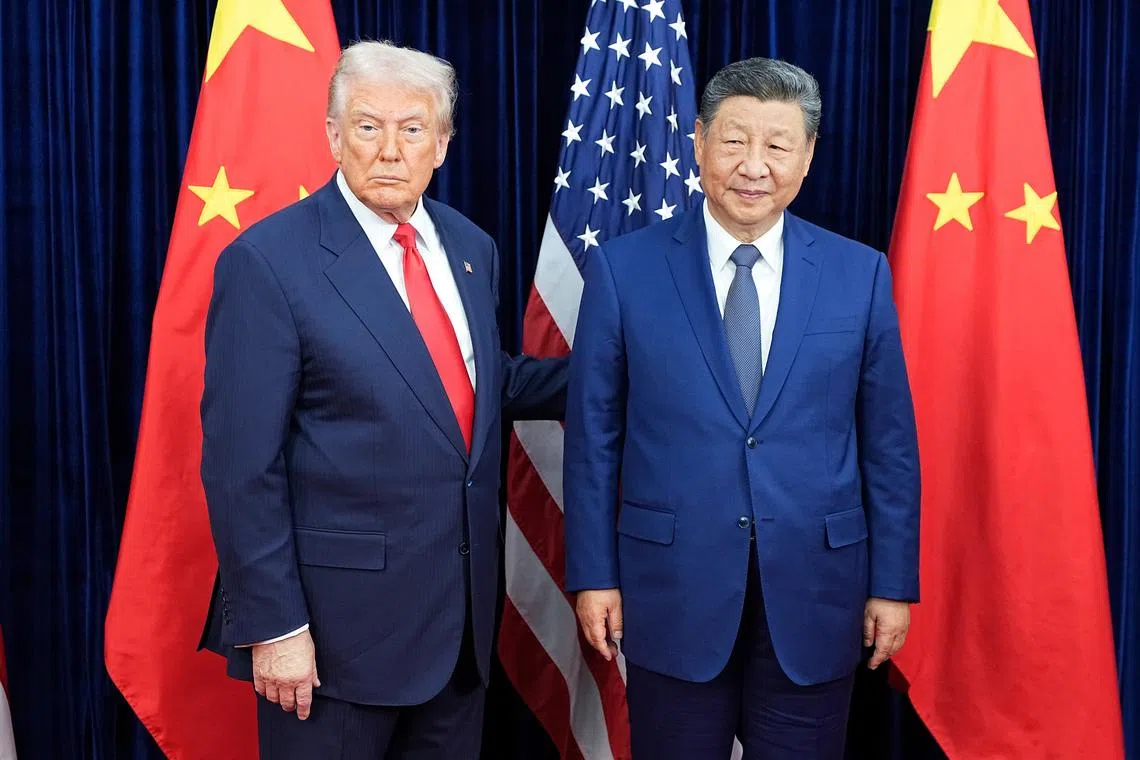
Uncertainty continues to surround the planned summit between US President Donald Trump and his Chinese counterpart Xi Jinping.
No new dates have been announced for the high-stakes meeting, which was postponed as the war broke out. The summit will provide the clearest indication of how the consequential bilateral relationship, with deep implications for South-east Asia, is shaping up.
But, in the meantime, the administration is devising new ways to sharpen its competitive edge against China and facing increased pressure from Congress to do so.
On March 23, even as Mr Trump announced he was holding off for five days on his threat to bomb Iran’s power plants if it does not open up the Strait of Hormuz, the US State Department expanded the scope of the Pax Silica forum to include investments related to energy security.
The 13-member forum – which includes Japan, South Korea, Australia, India, Britain and Singapore – is focused on ensuring resilience of the global AI and semiconductor supply chain.
Mr Jacob Helberg, Under Secretary of State in charge of economic affairs, announced the formation of a new US$1 trillion (S$1.28 trillion) consortium under Pax Silica with the goal of ensuring that critical minerals, ports, corridors, factories and energy assets “stay in trusted hands”.
Speaking at a Hill and Valley Forum event in Washington, DC, on March 23, he described the investor consortium as a “coalition of sovereign wealth funds and institutional investors joining forces around a single strategic imperative”.
The voluntary consortium will include countries such as Singapore, the United Arab Emirates, Qatar and Sweden, in addition to the US, which will contribute US$250 million towards the investment, the New York Times said in a March 23 report.
Global institutional investors, such as Japanese investment bank SoftBank and Singapore’s Temasek, would be among a group of founding members, Mr Helberg told a side event related to the forum.
Mr Helberg is the co-founder of the Hill and Valley Forum, which brings together government and technology leaders to discuss industry and innovation in annual summits.
The blockade of the Strait of Hormuz was a wake-up call, he suggested, underscoring that no single nation should dominate strategic industries or resources.
“The lesson here is not just about oil but about dependency on specific countries,” he said.
“We will never tolerate calculations like Iran’s weaponisation of global economic chokepoints spreading to advanced technology and semiconductor supply chains.”
Other details of the consortium remain unclear.
The development comes as the US grapples with concerns that China could surpass the US in deploying AI in its economy or choke off supplies of critical minerals and rare earths that are the essential ingredients for advanced technologies. China dominates the mining and refining of many such raw materials.
The Republican-led Congress has also been weighing in with discussions and Bills centred on China. These moves seem to place it at odds with Mr Trump’s dealmaking approach that is more in favour of engaging China.
In 2025, Congress held 56 China-related hearings – 36 in the House, 19 in the Senate and one joint hearing, an analysis by The Asia Group found. This represented a 47 per cent increase in total China hearings from 2024. Tech rivalry and cybersecurity issues with China were the dominant topics, with six hearings dedicated solely to AI.
The latest from the lawmakers is a call for immediate action to block the flow of advanced AI tech to China.
Senator Jim Banks, a Republican from Indiana, and Senator Elizabeth Warren, a Democrat from Massachusetts, have written to Commerce Secretary Howard Lutnick to demand the suspension of Nvidia’s export licences following evidence that cutting-edge AI chips were diverted to China through intermediaries in South-east Asia.
“We urge all necessary and appropriate actions,” the senators wrote in a March 23 letter to Mr Lutnick, including pausing or revoking licences tied to shipments into China and countries such as Malaysia, Thailand, Vietnam and Singapore.
The call came after federal prosecutors indicted Super Micro Computer co-founder Yih-Shyan “Wally” Liaw on March 19 for allegedly leading a scheme to funnel restricted chips worth billions into China in violation of US export controls that protect national security.
There appears to be a growing appetite for actions that lawmakers see as holding China to account for violations.
A new Bill, introduced on March 17 by House Democrat Derek Tran from California, demands that the administration assess the national security implications of “increased foreign malign influence by the Chinese Communist Party”.
Several other China-related Bills are pending in Congress as well, including the Comprehensive Outbound Investment National Security Act which imposes tighter controls on US outbound investments into sensitive Chinese sectors. And the STOP China Act, that protects transit systems and supply chains from alleged risks from Chinese manufacturing technologies.
On March 25, the House Committee on Small Business will meet to discuss China’s impact on US small businesses.
The House Education Committee will on March 26 host a hearing on foreign espionage at US universities while the House Homeland Security Committee will be looking at US security in the Arctic.
In the meantime, a group of 71 House Republicans is asking Mr Trump to ensure that any new trade agreement with China includes a crackdown on illegal Chinese-made vapes.
“As trade discussions with the People’s Republic of China advance, it is critical that the United States Trade Representative (USTR) and the Department of the Treasury confront the ongoing exploitation of our trade system,” Mr Mike Carey, an Ohio congressman, wrote in a March 4 letter to USTR Jamieson Greer and Treasury Secretary Scott Bessent.
“Any new trade agreement with China should require the Chinese government, through its oversight of e-cigarette exports, to take decisive action to curb the influx of illegal, youth-oriented e-cigarettes that openly flout US and Chinese law,” the letter said.
The latest national security-driven enforcement action against China came after a White House review found that Wi-Fi routers made in China posed “a severe cybersecurity risk that could be leveraged to immediately and severely disrupt US critical infrastructure”.
The US Federal Communications Commission announced on March 23 that it was banning the import of all new foreign-made consumer routers. It did not single out China, which is said to have 60 per cent of the US market for home routers.
Another issue receiving attention in the conservative media involves US flight schools training Chinese nationals as pilots. Senator Banks, a China hawk, said in a March 11 letter to the Transportation Security Administration that this raised national security fears because it bolsters the supply of pilots for China at a time of shortage in their commercial and military aviation sector.
Early indications are that the Republicans and Democrats are likely to make China a key part of their campaigning for the Nov 3 midterm elections, which will determine whether the Republican Party can keep control of both Houses of Congress and let Mr Trump elude harsh legislative scrutiny for the remainder of his term.
Several Republicans who lead China policy in the Senate are up for re-election in 2026. These include Senators Tom Cotton of Arkansas, Pete Ricketts of Nebraska, Mike Rounds of South Dakota, John Cornyn of Texas, Lindsey Graham of South Carolina, Dan Sullivan of Arkansas and Steve Daines of Montana.
The Democrats want to paint Mr Trump as weak on China while the Republicans seek to partially forestall that strategy by driving harder scrutiny of the Trump administration’s dealings with China.








Comments (0)