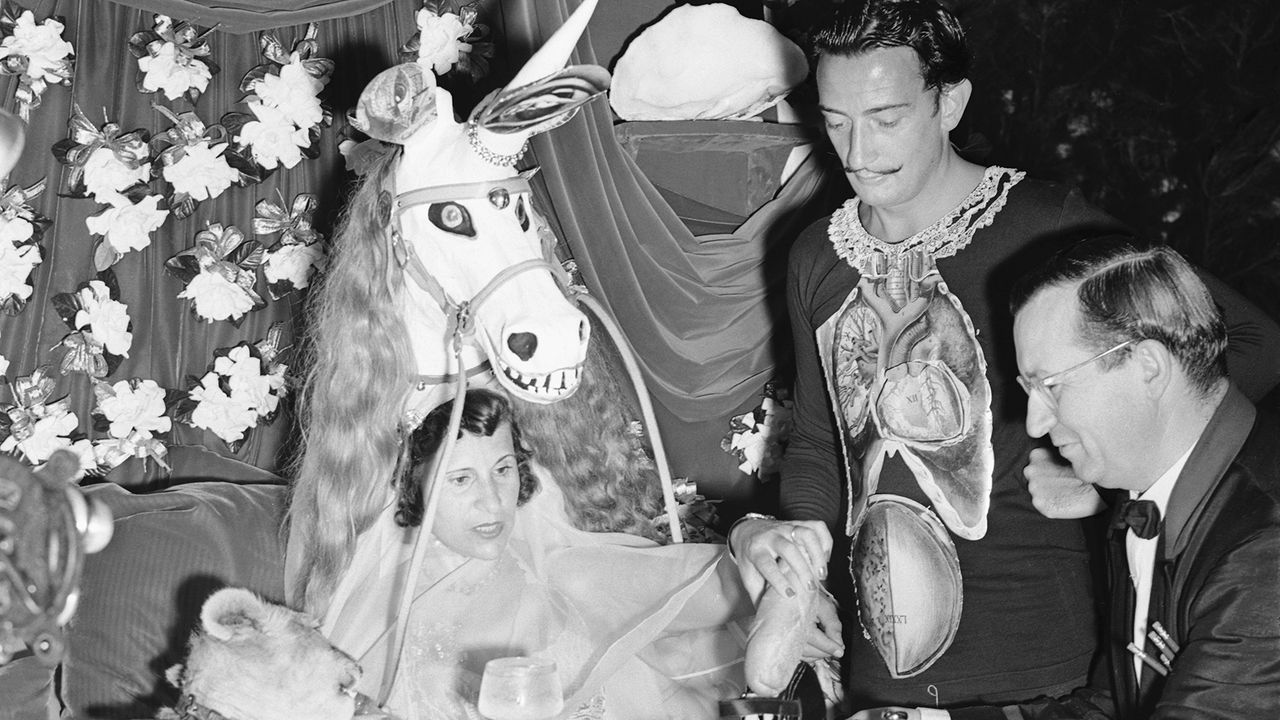
Decades before Versace turned his opulent lifestyle into a marketing machine, Dali and Gala were already practicing what we now call personal branding—engineering moments that they knew would be irresistible to photographers. They both understood how powerful visibility can be in a modern, image-driven world. The couple anticipated the mechanics of contemporary celebrity culture, demonstrating that even scandal could elevate an artist, and that controversy could be a tool rather than a liability. When the Museum of Modern Art requested the party’s proceeds for refugee artists, Del Monte sent an itemized list of the party’s accounting, detailing a staggering red ink. Reportedly, MoMA never received a dime.
Today, Dali is most remembered for his waxed mustache, melting clocks, and wacky personality; many have all but forgotten that he was also a Nazi sympathizer. In that sense, the surrealist forest helped lay the groundwork for a new model of fame: one in which spectacle sustains myth, and myth sustains the brand—often even outliving the man who put on the show.
On July 15th, 1997, Gianni Versace was shot in cold blood on the front steps of his beloved Casa Casuarina. Everything changed after Versace died. “It was like Studio 54 after it was raided. The whole thing began to fall apart,” said Miami club owner Chris Paciello. His death wasn’t only mourned by the fashion community, it was mourned by us all.
Like Dali, Versace spun dreams—not just from the clothes he designed, but also from the mansions he owned, the celebrities he entertained, and the parties he hosted. He understood that the fantasy around the brand could be just as powerful as the clothes themselves. Tara Solomon tells Vanity Fair, Versace “knew how to cast a party like he cast a runway show. Each person was there because they brought something unique… But it was never contrived.” is parties were advertisements with a pulse, and all the supermodels, movie stars, and rock gods who rocked his designs became part of the Versace mythology. He helped invent the modern luxury-brand ecosystem, where brand identity is built as much around culture and image as it is through product. Versace’s social life also normalized cultural crossover—pop stars at fashion week, campaigns starring celebrities, influencers at movie premieres. Before the ‘90s, most designers were relatively private figures, but Versace became a star attraction. Admirers often camped outside Casa Casuarina, desperate for his autograph or even just a glimpse at the silver-haired designer. After Versace was killed, Madonna, Mickey Rourke, and Sylvester Stallone left their homes in Miami. Hotspots closed. Photographers stopped coming. The vibe of the beach became more guarded, and those who still went were far less glamorous than the old crowd. The party was over.
Yet the Versace brand refused to go home, thanks to Gianni’s sister. Donatella has been described as her brother’s “muse,” “right hand,” “a gay man’s trophy wife,” “half Gianni in drag,” and a “rib taken from his side.” In Versace’s own words, Donatella was his “ideal woman.” It was she who tirelessly courted Madonna; who designed the brand’s edgier Versus line; who cast models for the legendary photo shoots. One of history’s most iconic pieces of clothing, Jennifer Lopez’s jungle dress, was her design. And it was Donatella who took the wheel in 1996 when Versace was diagnosed with cancer in his left ear. “Well, every day that I live from now on—it’s my party,’” the designer said after going into remission. But Donatella, with that trademark platinum blonde hair and a cigarette forever dangling from her mouth, was the one who kept the parties—and thus, the brand—raging.

Comments (0)