
Remember me

THERE is a large housing estate adjacent to a scenic area of Belfast which has regularly featured in best kept civic awards, and where the residents plainly take great pride in the maintenance of their properties.
It does not need to be identified, but the exteriors of practically all the dwellings are pristine, gardens are perfectly manicured with an array of colourful flower beds, and the kind of problems with graffiti and litter witnessed elsewhere in the city are practically unknown.
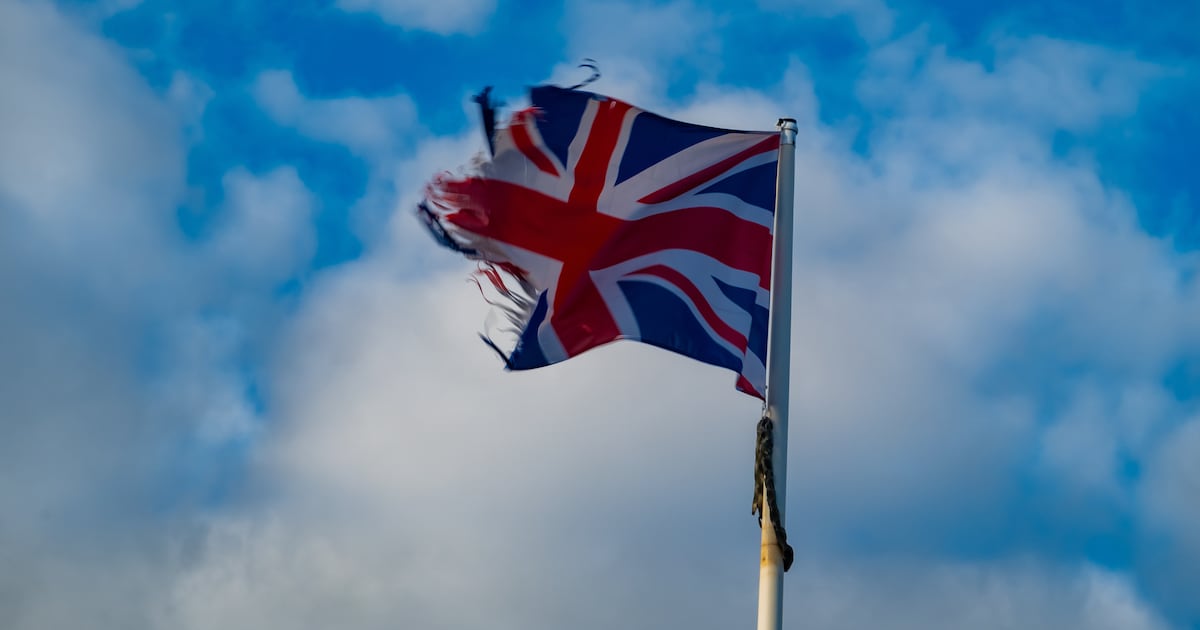
What was striking while driving past last week was the sight of a long row of lamp posts flying tattered union flags, one of which had disintegrated and blown into an adjoining tree but had still been left untouched for months.
The juxtaposition between the bedraggled emblems and the immaculate homes was depressing, but clearly, regardless of their private thoughts about the matter, the people who live there are unable or unwilling to intervene.
While it must be acknowledged that both traditions are regularly guilty of the aggressive and unacceptable use of flags, significant numbers of loyalists appear to be convinced that a point of principle is involved in indefinitely displaying as many of them as possible, regardless of their condition.
 Flags erected around Ballymacarrett playground in east Belfast, which council contractors attempted to take down
 It all sends out a message of uncertainty, rather than any form of confidence, particularly when some unionist politicians frequently suggest that official attempts to intervene somehow represent an act of betrayal.
While the new legislation we have been promised may eventually make a difference, for now we are stuck with the consequences of an unwanted but escalating set of culture wars.
It is telling, as previously noted in this column, that the more outspoken unionists ignore the bilingual policies promoted by public transport hubs in other parts of the UK, specifically Scotland and Wales, but are adamant that they must be opposed by all means possible in Belfast.
Although the Irish language threatens no-one, and deserves to be respected and where possible embraced by all communities, I am still concerned by aspects of the well-intentioned protocols introduced over street signs.
While different criteria have been established by other district authorities, Belfast City Council guidelines say that if 15 per cent or more of local householders who are contacted want to have a dual language sign, a report will be passed to the relevant committee before a decision is made.
It is fair to point out that this is not an arbitrary figure, and was based on recommendations on minority languages from a United Nations special rapporteur in 2017, with supporters insisting that the procedure should not be regarded as a referendum.
However, it still seems to me that, given the prevailing sensitivities in our divided society, 15 per cent is a notably low threshold for triggering a process which often attracts strongly conflicting responses before it reaches an outcome.
 A proposal to put up a dual language street sign near Stormont was narrowly voted down by Belfast City Council
 The recent and much discussed case of Stormont Park, a street which happens to be beside the main entrance leading to Parliament Buildings in east Belfast, is instructive, as a survey of 83 householders found that 56 (67.4%) said they were against the introduction of a dual language sign referring to Páirc Chnoc an Anfa, while 13 people (15.7%) were in favour.
A City Hall committee justifiably resolved that 15.7% was not a high enough level to merit taking the proposal to the next stage, a vote narrowly endorsed by the full council last week, but it all unfortunately meant that, not for the first occasion, sharp divisions among neighbours were placed very much in the public domain.
Audits of other districts in the city have led to the approval of dual signs after attracting a higher but crucially still minority level of backing for the change, and I am struggling to see how the associated upheaval ultimately benefits the growth of the Irish language.
While it is a legitimate issue that a disproportionate total of our thoroughfares, bridges and public spaces honour past and present members of the British monarchy – remarkably still including the discredited individual formerly known as Prince Andrew – extending an unnecessary sense of alienation in other directions makes little sense.
The dramatic expansion of interest in the Irish language across the north has been heartening, and there are many parts of Belfast where its presence will never be divisive, but it is difficult to see why unnecessary disputes should be allowed to fester in unionist heartlands.
Finalising a properly constructed new law which ensures the removal of provocative flags on all sides should surely be regarded as a greater priority than pursuing a separate debate over dual language signage which in its present form has sadly become counterproductive.
n.doran@irishnews.com
If you have an opinion on the issues raised in this article and would like to submit a Letter to the Editor to be considered for publication, please click here.
Letters to the Editor are invited on any subject. They should be authenticated with a full name, address and a daytime telephone number. Pen names are not allowed.

