
Remember me



 Save
SaveYou have reached your maximum number of saved items.
Remove items from your saved list to add more.
Save this article for later
Add articles to your saved list and come back to them anytime.
Got itAAA
For those who believe that “Trump Always Chickens Out”, this is the US president’s biggest TACO moment to date – extra meat, extra cheese, extra guacamole.
His rhetorical threats against Iran reached outlandish levels, even for him – pledges to bomb the country back to the Stone Age if it didn’t “open the fuckin’ strait”, then his ghoulish warning that “a whole civilisation will die tonight” unless there was a deal.
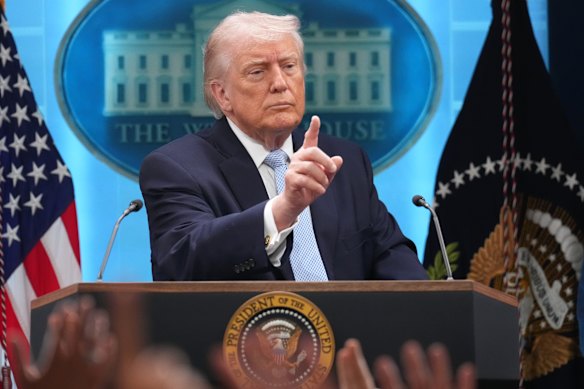 Nobody knows whether this erratic president will again extend his repeated deadlines to deliver “hell” to Iran.AP
It was so over the top that it defied belief – and it began to seem much more likely Trump was indulging the madman theory: appear as erratic and dangerous as possible to extract as many concessions as possible.
So, did it work? Well, in one sense, yes.
Iran has promised to reopen the Strait of Hormuz, albeit under some level of Iranian control, for the next two weeks. Ships will be allowed to pass in co-ordination with Iran’s armed forces and within the limits of what is technically possible, the regime says.
Related Article
That was the most urgent of Trump’s demands. If it happens, and the ships move through freely, he will be able to call it a win. The markets already have: the price of oil plunged 15 per cent and the ASX200 soared. Time will tell, as the cliché goes.
More broadly, though, this purported ceasefire is highly tenuous – and not only because air raid sirens were ringing in Israel, Kuwait and Bahrain in the hours following the announcement, and parts of the agreement were immediately contested by Israel.
Trump says the negotiations to follow will be based on a “workable” 10-point plan submitted by the Iranians. He didn’t say what that plan involved, but one has been on the table since Monday, and it seems a world away from what the US and Israel are seeking.
Iran’s proposal reportedly includes demands such as withdrawing US forces from military bases in the region, war reparations, the lifting of all sanctions on Iran and even allowing the regime to toll the Strait of Hormuz – none of which are plausible.
What of Iran’s 440kg of highly enriched uranium? What of its future enrichment capacity? And what of the regime itself – and its support for, and funding of, terrorism around the world? Nothing at all was said about those fundamental issues.
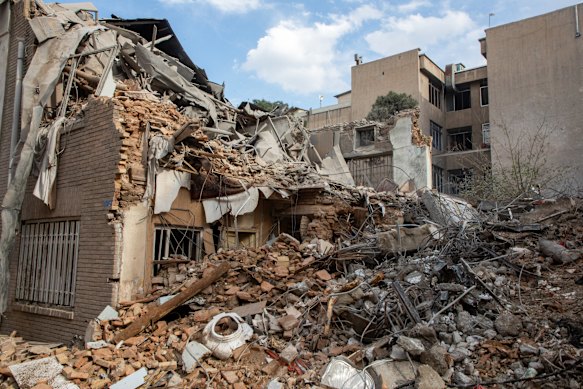 The aftermath of a US-Israeli strike on a residential building in Tehran.Getty Images
“Key details are missing, especially what was actually promised to Iran,” said Danny Citrinowicz, an Iran expert at Israel’s Institute for National Security Studies, and a fellow at the Atlantic Institute, on X.
“If Iran did in fact secure guarantees based on the ‘ten principles’ Trump referenced, that is not a marginal outcome, it is a strategic win for Tehran, reinforcing its narrative and positioning.”
Citrinowicz makes two other important observations about Trump’s decision: firstly, that when he was forced to choose, he leant away from Israel’s maximalist objectives and towards a ceasefire (as he did with the war in Gaza last year).
Secondly, no matter how Trump harangued his allies – including Australia – that the Strait of Hormuz was their concern, not his, it ultimately became the central objective of the negotiations “above all else”.
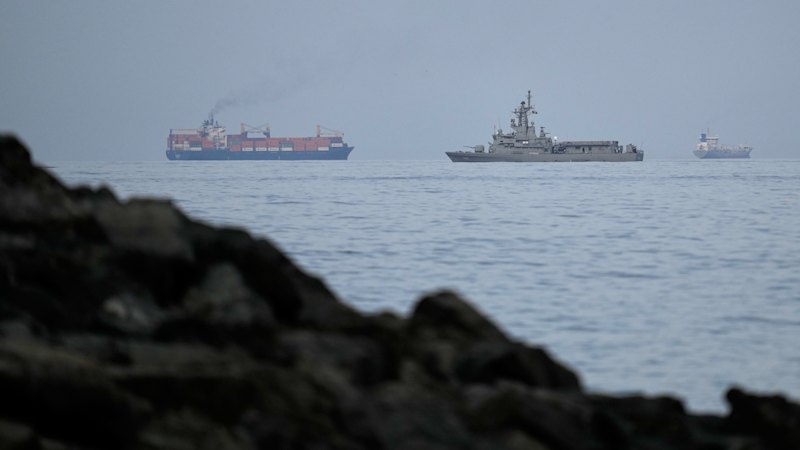
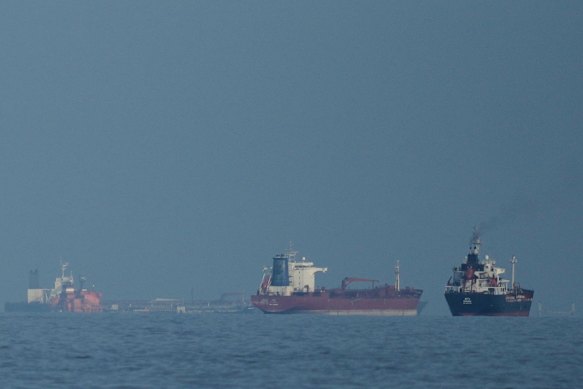 Oil tankers and cargo ships line up in the Strait of Hormuz, as seen from Mina Al Fajer, United Arab Emirates.AP
Other experts believe Trump’s handling of the crisis – including his extreme rhetoric – has advantaged the hard-line Islamic regime in Tehran in the long term.
“I think their ability to project power is weaker, but their hold over society right now is stronger,” said Karim Sadjadpour, an Iran analyst at the Carnegie Endowment for International Peace, on CNN.
In reality, Trump has been heading towards this kind of outcome for a while now, despite his wild rhetoric. His hyperbolic threats were betrayed by his admission – while surrounded by Easter bunnies at the White House on Monday – that Americans wanted the war to end and their troops to come home.
He is also under increasing pressure from parts of his America First base, including media personality Tucker Carlson, who unleashed a tirade against the president, and urged his advisers to refuse to carry out his orders.
At the same time, analysis of what this alleged ceasefire means is largely pointless because we don’t know if it will hold and because all three parties – the US, Iran and Israel – are so given to spin, histrionics, empty threats and patriotic bluster that it can be difficult to determine what’s grounded in reality and what’s not.
They are also capricious – Trump could change his mind tomorrow, as could Netanyahu or the Iranian regime.
All we can really say for now is that there appears to be a greater opportunity for peace today than there was yesterday. And that’s no bad thing.
Get a note directly from our foreign correspondents on what’s making headlines around the world. Sign up for our weekly What in the World newsletter.
SaveYou have reached your maximum number of saved items.
Remove items from your saved list to add more.
 Michael Koziol is the North America correspondent for The Age and Sydney Morning Herald. He is a former Sydney editor, Sun-Herald deputy editor and a federal political reporter in Canberra.Connect via X or email.From our partners