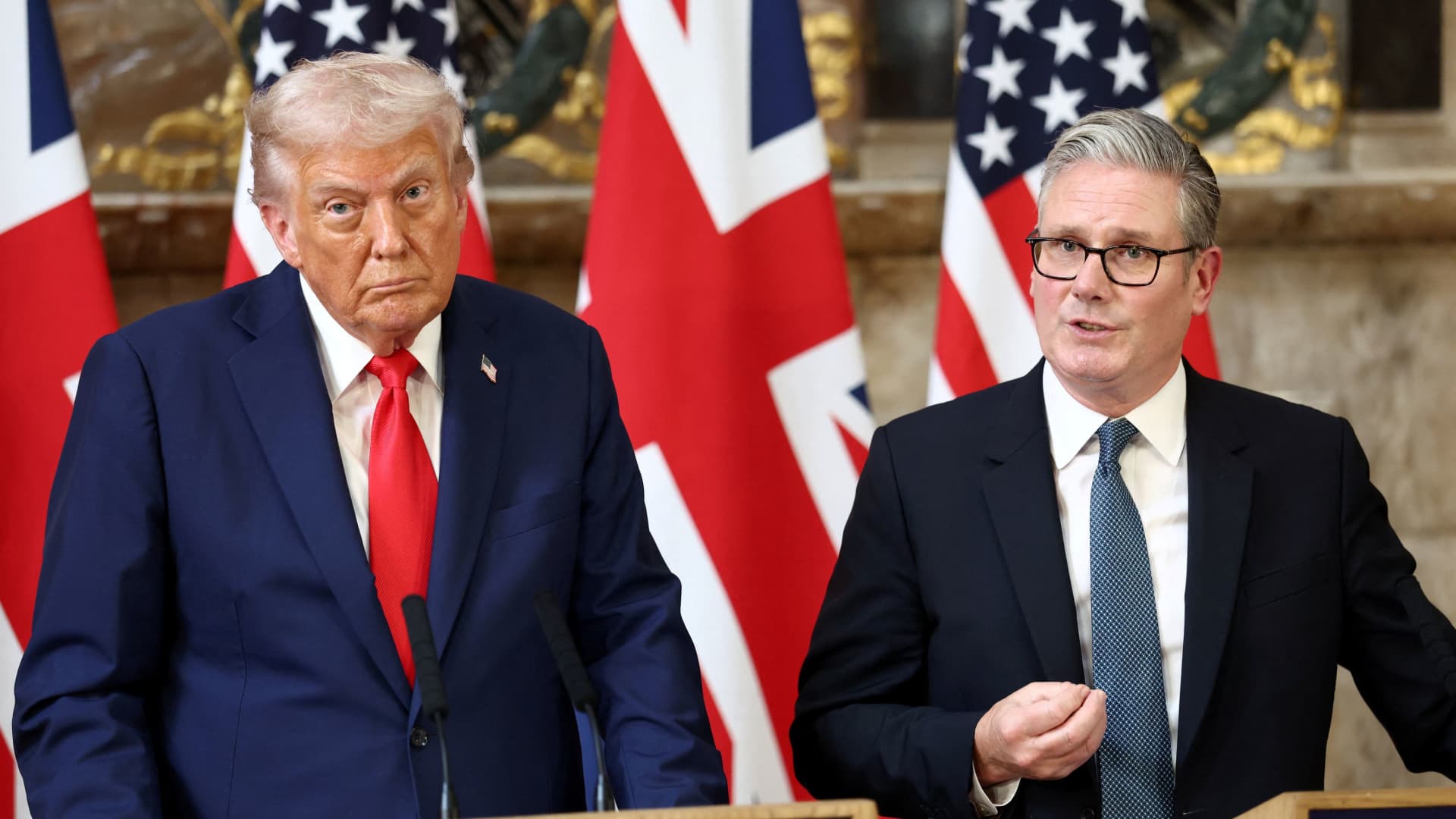
U.S. President Donald Trump and British Prime Minister Keir Starmer hold a press conference following their meeting at Chequers, near Aylesbury, Britain, Sept. 18, 2025.
Kevin Lamarque | Reuters
The U.K. is "not supporting" the U.S. blockade of Iranian ports, Prime Minister Keir Starmer said on Monday, insisting that the country would not get "dragged in" to the Iran war.
It came as President Emmanuel Macron confirmed France and the U.K. would, in the coming days, co-host a conference aimed at restoring freedom of navigation in the Strait of Hormuz.
Macron has not explicitly ruled out France's involvement in the U.S. blockade but said the planned conference would create a "peaceful multinational" and "strictly defensive" mission, separate from the belligerents.
Britain's Starmer told BBC's Radio 5 Live on Monday: "We're not supporting the blockade, and all of the marshalling – diplomatically, politically and [in terms of] capability – we do have mine-sweeping capability, I won't go into operational matters, but we do have that capability – that's all focused, from our point of view, on getting the Strait fully open."
"What we've been doing over the last few weeks – and this was part of what I was discussing with the Gulf states last week – is bringing countries together to keep the strait open, not shut."
Starmer's comments come after U.S. President Donald Trump signaled that other countries would help the U.S. implement its blockade, due to start at 10 a.m. ET on Monday, on vessels entering or exiting Iranian ports.
The move was announced after talks between Washington and Tehran over the weekend failed to produce an agreement to end the conflict in the Middle East.
Speaking to reporters on Sunday, Trump said: "At 10 tomorrow, we have a blockade going into effect," adding that "other nations are working so that Iran will not be able to sell oil."
He did not say which other countries would be helping; however, CNBC has requested further comment and clarification from governments in Europe and the Middle East on whether they intend to help the U.S.
Both European and Gulf states have previously been reluctant to get involved in the conflict, wary of escalating a conflict they see as Washington's "war of choice," rather than necessity.
Germany also signaled it is not participating in the blockade, with government sources telling CNBC on Monday that Trump's comments were "a vague statement that is not based on any new facts."
Berlin has repeatedly ruled out any military involvement in the Iran war, and the government repeated that position on Monday, stating: "In recent days, the federal government has commented on several occasions regarding possible participation and the conditions for it. These statements still stand."
France's Macron said in a post on X that the country would host a conference "with the United Kingdom and those countries willing to join us" for a "peaceful multinational mission aimed at restoring freedom of navigation in the Strait."
He added: "This strictly defensive mission, which will be separate from the warring parties, is intended to be deployed as soon as the situation allows."
Starmer said U.K. citizens were being affected by the war in Iran, with higher energy costs, and that he didn't want them "paying the price" for the conflict. Asked if he held Trump personally responsible for the impact on UK energy bills, Starmer said it was Iran that was restricting navigation of the Strait of Hormuz.
"We, the United Kingdom, were very clear that we weren't going to get dragged into this war, and we're not, but equally, we have been involved in defensive action," the PM said.




Comments (0)