Remember me
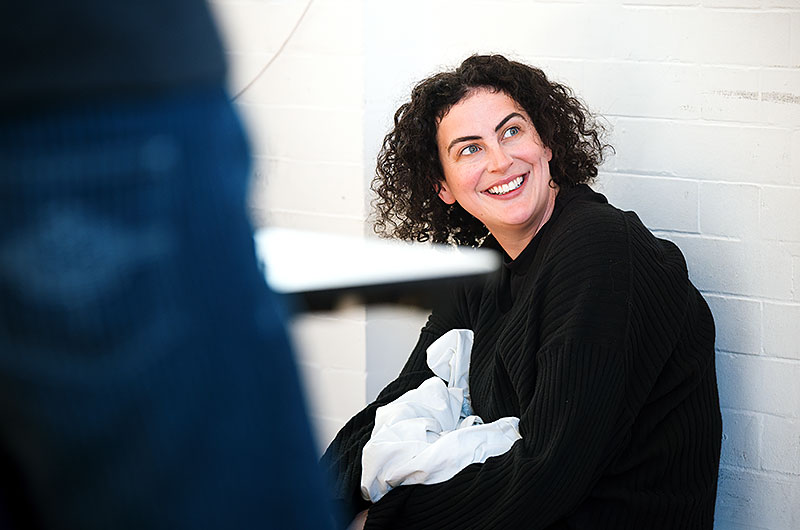
 Breffni in rehearsals. Rehearsal pictures by Alex Brenner.
Breffni Holahan told David Hennessy about being part of a new adaptation of Virginia Woolf’s The Waves at Jermyn Street Theatre.
Jermyn Street Theatre is presenting Flora Wilson Brown’s adaptation of Virginia Woolf’s literary classic The Waves.
Cabinteely actress Breffni Holahan plays Susan.
Júlia Levai directs the cast that is completed by Archie Backhouse as Louis, Pedro Leandro as Neville, Syakira Moeladi as Jinny, Tom Varey as Bernard, and Ria Zmitrowicz as Rhoda.
The Waves follows six friends from childhood to adulthood in a story about about growing up together.
Virginia Woolf was one of the most influential modernist writers of the 20th century.
The Waves is regarded as a landmark of literary modernism, notable for its experimental structure departing from traditional narrative form. Her major other works include The Voyage Out, Night and Day, Jacob’s Room, Mrs. Dalloway, To the Lighthouse, Orlando, A Room of One’s Own, and Three Guineas.
Breffni Holahan’s theatre credits include Electric Rosary (Royal Exchange), Collapsible (The Bush Theatre and The Abbey Theatre, Dublin), for which she was awarded The Stage Edinburgh Award for Acting Excellence, Drama at Inish (The Abbey Theatre, Dublin), It Was Easy in the End (The Abbey Theatre), Dog Shit (Theatre503) and The Flea (The Yard Theatre).
Her screen credits include About Joan, The Racer, The Nevers, Vikings, Everything Not Saved and Balor Hall.
Breffni took time out of rehearsals to chat to The Irish World.
- Advertisement -
What drew you to The Waves?
“I’m a Virginia Woolf fan.
“I really enjoyed her work as a teenager and then I studied English in Trinity so read quite a lot of hers and just kept her in the back of my mind for a really long time.
“She’s been represented in media a few times so always curious to see what people do with her work and then when this one came up, I was just really curious about how you could make such a poem of a book into a play.”
And how did you respond to the script because it is a new adaptation…
“I can’t imagine how Flora came to choose what to cut out and what to keep in because the space is very small and intimate but the work is so expansive.
“It covers friendship, coming of age, grief, and a thread that I really enjoy is the difficulties of making art as you’re growing up with other people and comparisons with other people and finding joy in alternative ways of life when things don’t go exactly how you imagined.
“She’s managed to pack pretty much all of it in.
“It’s very rounded.
“We’re starting as five-year-olds and we’re going all the way up until we reference being 80 at times so it’s the whole shebang really.”

Can you put your finger on why her writing means so much to you?
“I think there’s quite a few reasons.
“As a woman writing under her own name was really exciting.
“There’s also an unapologetic representation of queerness in her work and in her letters especially and in the non-traditional way of life, of her marriage being non-traditional and moving out of London and all of these choices that she made.
“I’ve started a master’s in psychology and I’m fascinated by how her mental health is sewn through her work not that that’s the only lens you can look through but it’s certainly a strong lens for me for sure.”
How have you found the rehearsal process?
“There’s six narrator characters in the book that are represented on stage.
“We’ve joked in rehearsals that there’s enough material in the book to have a solo show for each character because it’s so rich.
“We’ve actually had a really fascinating session where a Jungian psychologist came in to discuss the collective unconscious with us because these six people, there is a seventh character, grow up together from such a young age that a lot of the play is dealing with trying to figure out who you are when most of you is made up of your friends.
“It was just a really interesting couple of hours that we spent with this man who just said that it’s a very real thing to have a society or community or this group of friends grow up and be indistinguishable from each other while being very, very different.
“My character is the only one that moves out of London in adult life and chooses not to pursue a career in arts and chooses to run a farm and chooses to push London away but still has this haunting of being formed by these other people in her youth and I can certainly relate to that growing up in Ireland and moving here.
“I think a lot of people can.”

Is there a lot of passion in the rehearsal room for the piece?
“Absolutely.
“Everyone has good ideas and everyone is clever and I think that’s a real boon.
“Julia, the director, might have a real task on her hands, to peel back the actors.
“We’re always like, ‘What if I did this upside down? What if I did it like I’m underwater? What if I did it like this?’
“And then she can just say, ‘That’s a really clear shape’.
“And another one is, ‘Very nice, super clear’.
“So she might say that and then say, ‘No, let’s maybe do this instead’.
“But she’ll let us try the wacky thing.”
Tell us more about Susan because, as you say, she opts out of the rat race and moves to the countryside..
“I think you’ve put it best, opting out of that rat race and finding contentment in nature and quiet.
“Flora has handled it so well in the adaptation that there’s quite sublime loneliness for Susan as well.
“There’s also a fierce loneliness in that when you choose your happiness but it doesn’t fit with everyone else’s and she’s certainly grappling with that especially as she becomes the first to become a parent and she becomes the last to know about things in her friendship group.
“It’s a very isolating choice that she’s made for herself and then being prideful in that and doubling down on it when really you might benefit from saying, ‘That was a tough decision I made and some parts of that decision are difficult’, but we’re all prideful, I think.”
Your character Susan is somewhat based on her sister, Vanessa Bell..
“Yeah, there’s similarities between all of the characters and someone in Virginia’s own life.
“I think it would be almost reductive to her imagination to say that it’s autobiographical because there’s a lot of invention in it but apparently my character Susan is somewhat based on her sister who was an artist.
“Similarly she elected to practice her art form of painting and some writing outside of town, away from the Bloomsbury group and the kind of chaos and incest of that, I suppose.”
You mentioned the seventh character. There is another character Percival who is not seen or heard but still very present..
“There’s certainly a mythologising of this character, Percival and it’s what we do with that mythologised character in our attempts to get closer to them or to become them that I think where the drama is.”

People have their own ideas of Virginia Woolf and her work. Are you looking forward to showing this new take on The Waves?
“Yeah, I think what’s fuelling us is that we’re not saying that this is the definitive adaptation of The Waves.
“It’s an adaptation.
“It’s what was singing off the page to Flora when she was adapting it and what’s singing off the script to us when we’re rehearsing with the director.
“The book is so personal to everyone who reads it that I’m hoping the play is the same.
“It’s Flora’s personal reaction to it.
“Then Julia, the director’s and then the cast’s and the creative team, and then the audience is the final piece.
“Virginia Woolf is herself a real London staple but it’s quite exciting to know that we’re going to be talking to full houses soon.
“I can’t wait to share it.”
Is there extra meaning in it being the 95th anniversary of The Waves this year?
“Absolutely, yeah.
“It’s a special place to be doing a Virginia Woolf as well.
“To be doing it in London is very exciting and to be so in the centre of town celebrating an anniversary with a very exciting new adaptation.
“It’s one of her least produced or least adapted works.
“I think we’ve all seen a million or read a million versions of Mrs. Dalloway which I love, absolutely adore but it’s exciting to give The Waves her time to shine.”

Would you say The Waves is underappreciated?
“I think she just she wrote so much.
“She wrote so much and I think in recent years, people have become very fascinated by her personal life, especially with increased representation of LGBTQIA+ characters.
“There’s been film adaptations of her life, major Hollywood ones, some more indie ones that are really wonderful.
“But I love her work so I think giving The Waves a chance to speak on its own without having to be an autobiographical representation is really exciting.
“There’s a Vanessa Redgrave adaptation of Mrs. Dalloway on film that is just gorgeous and I’d love to see The Waves given the same credence.”
Have you worked at Jermyn Street Theatre before?
“I’ve done a couple of readings there but never a play.
“The space is very particular.
“It’s a huge story but it’s really intimate and the crowd is right here.”
It couldn’t be more different from the last play we spoke about The Flea which was very all singing and dancing whereas this is more monologue driven and, as you say, intimate in its setting..
“Yeah, there’s a great mix between direct address to the audience and then really snappy, funny and heartbreaking scenes between multiple people so we’re kind of getting the best of both worlds in that regard.
“It is certainly a very intimate telling of an intimate story.
“It covers an awful lot of themes but at the end of the day, it is six people telling the story of trying to figure out who they are when they’re from the ages of five till whatever.”
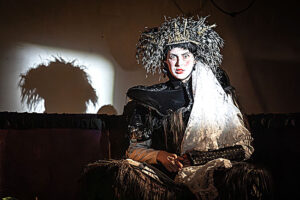 Breffni as Queen Victoria in The Flea.
Is something that the shows, The Flea and The Waves, have in common that they both deal with ripple effects and how one’s actions affects those around them?
“Yeah, maybe the action is a person, this Percival character.
“That kind of is the big bang.
“’What’s the big bang of every play?’ is a fun question to ask and I think the big bang in this is Percival and growing up.
“In The Flea it was a flea bites a horse’s leg and from there, the Queen gets involved.
“That’s a joy to go from the smallest interaction with Percival, into how it affects your character’s whole life.
“It’s a fun exploration.”
You moved to London around lockdown, isn’t that right?
“I moved just before lockdown to do a solo play in the Bush and I’ve stayed here since.
“It’s been great.”
You must be at home here at this point then..
“I really, really am.
“I’m really rooted down in my community, in where I live in London.
“I’m involved in quite a few local charities and it’s a frustrating situation because I love living and being part of where I am but we are just getting slowly, slowly priced out of that area but it is an absolute goal to stay rooted where we’ve found ourselves in London.”
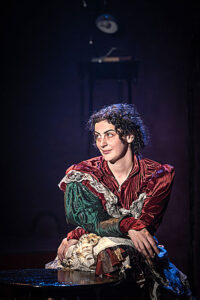 Breffni in The Flea.
You are involved in a soup kitchen and food bank, services that are being called upon more and more in this cost of living crisis..
“Yeah, absolutely.
“We have a policy in our soup kitchen, which is one of the few in the city that doesn’t require a referral from the council to use so you could turn up.
“I always say you could turn up in a Gucci suit, you’re going to get the exact same treatment and the exact same service and items as someone who’s wearing the same clothes for days.
“It doesn’t matter at all.”
And I would say you see Gucci suits and the like because just because people have material things does not mean they have liquid cash, circumstances change..
“Absolutely, I think it’s important to have more no questions asked services available to us.
“The Guardian has recently been posting quite a few articles on charities having to close down due to lack of funding and what that ends up reading like is a lot of asking for proof of need.
“That makes me a little bit uncomfortable.
“It’s so hard to ask for help in whatever way to ask for help is surely enough proof of need.”
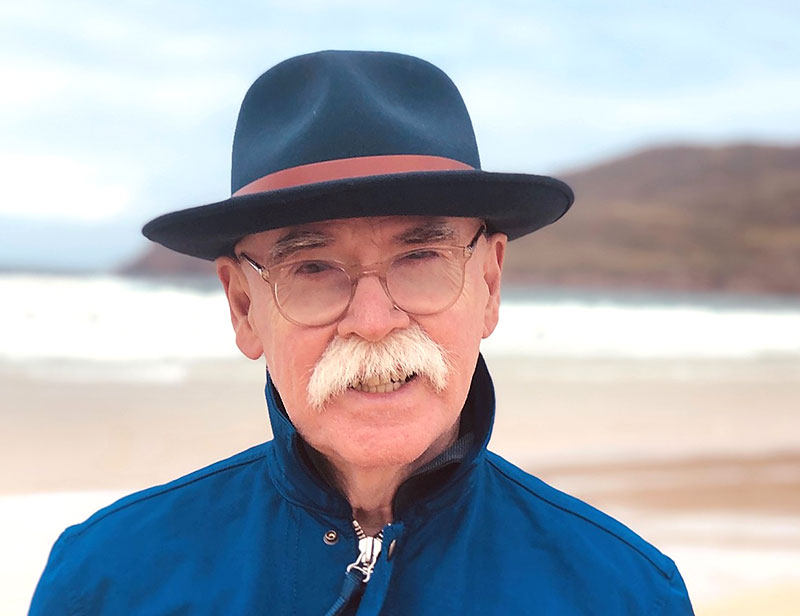
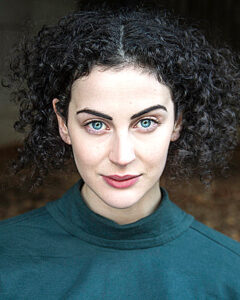 Breffni Holahan.
You also volunteer with helplines..
“I volunteer for one mental health crisis text line and I volunteer for an LGBTQIA+ focused helpline and I’ve been volunteering with both for a few years now and both have really brought me to that master’s in psychology.
“It all lends itself to a better understanding of people.”
A lot of people don’t know what to say to people in crisis, do you find it’s more about listening and going through it with them?
“Generally it is mostly about listening and creating a space where the person feels safe and entitled to talk about what’s on their mind and also not shying away from what they’re saying.
“Maybe they have really dark thoughts.
“Maybe they’re going through the worst of the worst.
“I know in our play there’s themes of suicide, there’s themes of all sorts of things that are really difficult to talk about but if you just take away the guilt or shame- I find guilt and shame to be really unconstructive emotions and if we can take those out of a conversation, then we can honestly talk with someone about where they’re at and yes, if we’re lucky, we’ll get on to some coping strategies and we’ll talk about things to look forward to or to plan or how to cope in a crisis.
“Really it is just saying, ‘You’ve called, this is your time. This is your time. What’s up?’
“We’re all so busy all the time that it’s so nice to just go, ‘What’s on your mind? I’m not hanging up on you. I’m not doing something else while I’m talking to you. I’m listening’.
“Doing one thing at a time seems like a thing gone by that we don’t do anymore but those help lines have really helped me slow down because the whole point is that you don’t do anything else other than listen to that person, be there for them and try help them out of the hole they’re in.”
The play deals with themes of suicide. Do you feel it was ahead of its time because it seems like we have only got in the last few years about how to talk about these things..
“The vocabulary seems to be there now but certainly what Flora has really picked up on in this adaptation is where Virginia Woolf was making some kind of slight references to things and we can see them for what they are now.
“There’s her own life and the discovery of her letters and how she came to her own end but I think this adaptation focusing on the terror of growing up and trying to become a grown person with any kind of solid identity. That’s really hard and we don’t really shy away from that.
“In this there are characters very honestly grappling with that and struggling with that.
“There’s plenty of light as well.
“There’s a lot of levity in this as well which is kind of hard to imagine when you think of some of the themes in it.”
The Waves is at Jermyn Street Theatre 16 April- 23 May. For booking and more information, click here.
- Advertisement -