Remember me

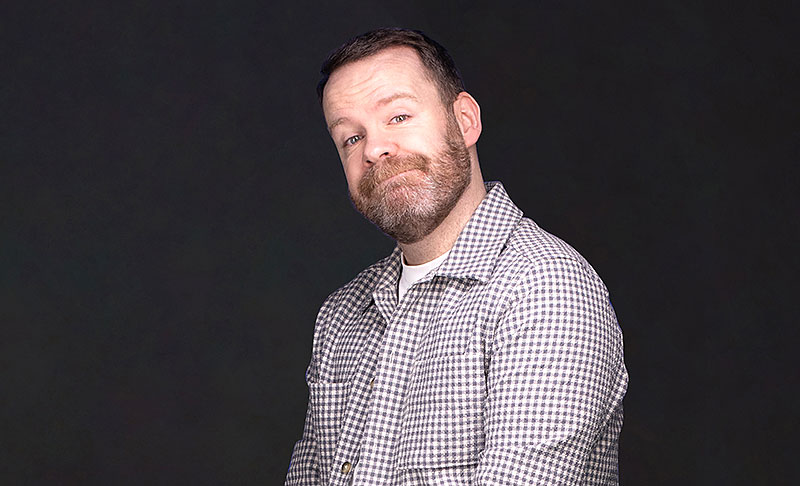
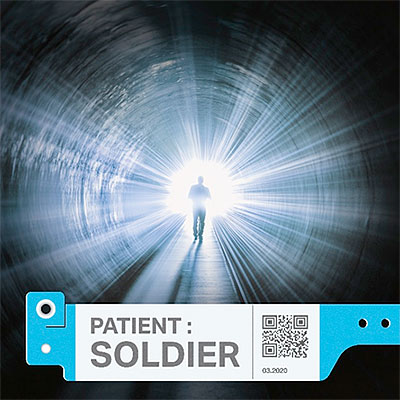
David Hennessy spoke to Barra Fitzgibbon and Katherine White about their play about Barra’s real life brush with the Grim Reaper in the days of the pandemic. Patient: Soldier has played in the West End and is touring Ireland and going to the Edinburgh Fringe.
An Irish man living in London’s true story of life and death during the darkest days of COVID is going to tour Ireland and feature at the Edinburgh Fringe. This follows its run last year at Seven Dials in London’s West End.
In the early days of the pandemic, Barra Fitzgibbon (54), from Killiney in Dublin, was taken into Lewisham Hospital ill from a new virus that little was known about.
From his ICU bed, he saw the pandemic unfold with 20 patients becoming 60.
He describes it as both like ‘a war zone’ and something from a film such as 28 Days Later.
But it was no movie, it was a very real crisis the NHS was struggling with.
But more than a play about COVID or the pandemic, it’s a man’s fight for life.
Barra would get his story out first in a blog that would strike a chord.
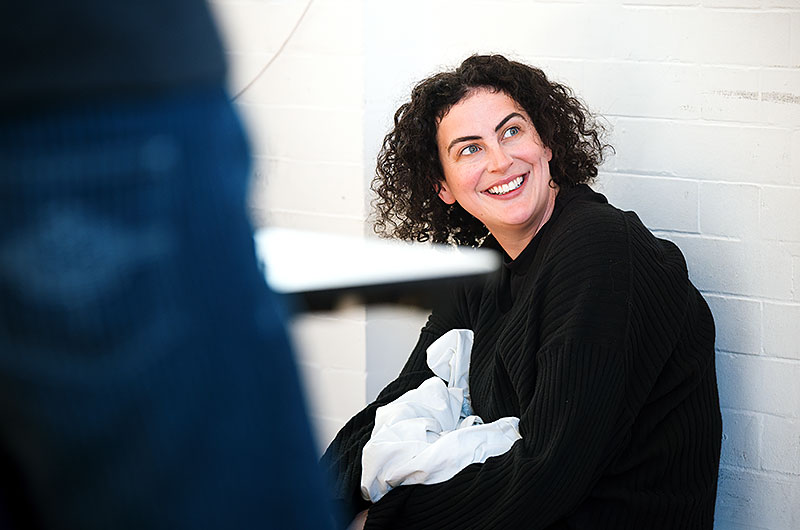
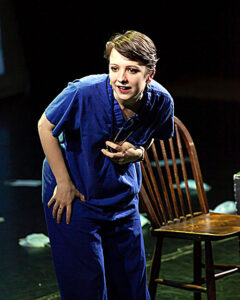
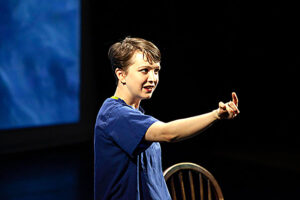
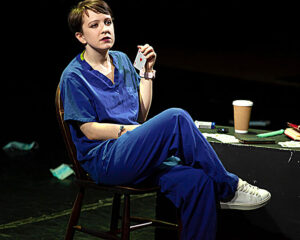
He would then develop it into a play with the help of playwright and actress Katherine White who would also perform it.
It would get its first airing at Bloomsbury Festival.
- Advertisement -
Narrated by the Grim Reaper, it got its next airing on the West End with Katherine sharing the role with Irish actor Michael Mahony.
Next year it will play venues in Dublin, Kilkenny, Kerry, Wexford and Cork before the show travels to Edinburgh.
Gary Trainor, whose West End credits include Back to the Future, School of Rock and Beautiful: The Carole King Musical, has been cast for Ireland while Katherine will be associate directing and return to the role for Edinburgh.
Barra and Katherine took time to chat to The Irish World.
The last time we spoke it was around the time of the run at Seven Dials, how did it feel to stage it there?
Barra: “It was brilliant.
“We did a Q A at the end of each performance which became part of the play in a way.
“To have the real life people (featured in the story) there in the room come up on stage and sit down and be asked questions from the audience was really a powerful section of the play and we’re going to continue that in Ireland.”
Katherine: “Very surreal.
“It was incredible to be on the doorstep of the West End with this amazingly personal, beautiful story.
“You weren’t going to find a story like this anywhere else.
“It just felt amazing and I think it was just full of love.
“Backstage, onstage, in the foyer: Just love in every room for this process, for the story and I think that’s what made it really, really special because it meant so much to so many people.
“It was incredible.”
Barra: “You kind of expect people to say ‘good script’ or ‘you could improve it here, you could improve it there’ but one of the unintended consequences was the amount of people that came up to us to say, ‘Thank you for giving us a space to process what happened back in 2020’.
“There has been this rush, and I understand why, to bury it under the carpet, to shove it in the corner and pretend it never happened but I think that’s giving people a disservice.
“It hasn’t allowed people to process what actually happened during those incredibly tough couple of years and people have come to us and not just with COVID stories, I’ve had people come to me and talk to me about their cancer story and saying, ‘Thank you for allowing me to process my cancer story’.
“That surprised me the most because I didn’t expect that.”
As extreme as your experience was, Barra, everyone had their experience of being a soldier in 2020..
Barra: “Absolutely.
“We had a fair few young people in the audience as well and their understanding and their resonance of it was also there.
“I think you’re absolutely right.
“There’s definitely an immediate resonance and also it was funnier than I thought it was going to be.
“There are real laugh out loud moments.
“Actually what really convinced me to bring it to Ireland was there were a couple of Irish people that had come over for it and they were roaring laughing.
“That’s when I kind of thought to myself, ‘This is going to work in Ireland. It might even work better than it did in the UK’.
“UK was great but the Irish love a good laugh and I could sense the jokes were landing more with the Irish than maybe with the English audience.
“That made me think, ‘This could work back home’.
“One of the things with this play is that it always seems to be, ‘Right, what’s next?’
“Then we decided, ‘Right, let’s see if we can get this across to Ireland’.
“And that felt like a natural next step.
“It’s going to be an interesting one because when I’ve spoken to friends and stuff back home in Ireland there’s definitely, ‘Oh, Jesus, nobody wants to talk about COVID’.
“There’s definitely that in people’s heads so it’s going to be an interesting one.
“We don’t mention COVID.
“It’s interesting.
“We try to avoid the word COVID because I think it does put people off.
“But I think what’s really important to remember is that it has all the emotions in there: Funny, dark, tragic, sad but uplifting ultimately.
“I think it’s a cracking night out.
“It’s very immersive.
“You get a reminder to be grateful for whatever you’ve got in your life.
“It’s such an evolving piece.
“It doesn’t stop evolving this thing and I’m forever thinking, ‘What’s the next step for this?’
“Now it’s going to be Ireland, then it’s going to be Edinburgh but I’m thinking beyond Edinburgh.
“I mean, could this be a musical?
“I don’t know if it could be but then I met somebody recently who is a person who does look at turning these things into musicals so I just sent her the script and said, ‘Have a look, see what you think’.
“If she comes back in six months and says, ‘Yeah, we can make this work’, why not? Let’s keep evolving the story, try and get it to the masses as much as we can.
“If it all finishes in Edinburgh, then so be it.
“We’ve already had more of this than we expected but something tells me it’s going to keep going because of its story, because of its healing power.
“That’s what’s been kind of extraordinary.”
What was your experiences of audience reactions, Katherine?
Katherine: “I had a few people wait after the show for me and would want to have a private chat and say about how they’ve experienced different life changing events and then suddenly seeing it represented on stage, you sort of feel like you’re not going mad and that the feelings that you have are valid.
“I think that was something I hadn’t expected because you don’t write with that intention, that’s just a wonderful bonus.
“The fact that someone can finally put words to a feeling or an experience when I think otherwise, like Barra said, people would bury it because that feels like the safer option.
“It was amazing to spend five, ten minutes with different people and letting them then talk because obviously I had just been gassing for an hour at people.
“It was really lovely to hear and very emotional but an incredibly humbling moment.”
Barra: “I remember very specifically people coming up saying to me that when people fall ill, all the thought goes to the person that fell ill but what they said was the play made them realise what the family goes through back at home.
“I thought this play was about me but what I’ve realised is it’s actually not about me at all.
“What’s really interesting is one of the biggest feedbacks was, ‘We want to hear more of Jen’, my wife. ‘We want to hear more of Jen’s story’.
“We have done a little bit of rewrites to bring more of Jen’s story in as a result of that feedback.”
You feel that it helps people talk about something that they have to talk about because looking back, the pandemic just faded into the background and so was never really dealt with..
Barra: “Definitely not and I don’t think it’s a question that people have to talk about it, I actually think people want to talk about it but they’ve been told by the media not to do it.
“There is definitely a massive population out there that do want to talk about it but they’ve got no forum to do it.
“This gives you the space in a wonderful, unexpected space like theatre to do that, to talk about it.”
Of course, Ireland went through the pandemic differently but I’m sure the emotions were much the same..
Barra: “They dealt with it better than we did.
“The Irish were locked down a week before.
“In fact I would not have got COVID, I’m convinced, if I was in Ireland.
“I got it because the UK took an extra week to lock down, that’s when I actually got it.
“And the Irish get the NHS.
“I think it’s a love letter to the health service, anybody working for the health service globally.
“That’s why I think this could play anywhere.
“Doesn’t have to be England.
“It’s an Irish man’s story and how the NHS treated an Irish man so there’s a whole narrative arc of bringing this story home as well which is very exciting.
“I think it’s going to be very immersive.
“I think the biggest theatre is 100 people.
“Because it’s a one person play, we’re focusing on the immersive experience and you might lose that if you start going into a 200/300 capacity size.
“We have focused on smaller theatres. Even bigger theatres, we’re in their smaller space to keep it within that 60 to 100 bracket is important as well, I think, to keep it as immersive as it has been.
“And when I said to the theatres there’s the chance of a Q and A they all said, ‘Yes, please. Absolutely, audiences like that. They like that interaction’.”
Katherine you have family in Cork and Mayo, how does it feel for you to be bringing the show over there?
Katherine: “Amazing, absolutely amazing.
“It does feel like it’s going home.
“I was pretty much raised by my Irish family so it feels like a huge honour as well.
“I can’t wait.”
Back to what you were saying about the jokes landing with Irish audience members, do you think it is geared to that dark Irish sense of humour?
Katherine: “My nana always says, ‘If you don’t laugh, you’ll cry’.
“You just have to find some way of seeing the humour in it because otherwise, you’d go mad.
“On those nights when we had the majority Irish audience, a lot of the English people were sort of looking going, ‘How could they laugh at that?’
“And then you could also see it also welcomed them to laugh because they kind of had permission, ‘I guess if everybody else is..’
“You could sort of see the stiff upper lip dwindling and it was lovely.”
Barra: “One of the highlights for me was the actual matron from that time came to see the play.
“We don’t depict matron as the kindest person in the hospital at that time.
“She was under a lot of stress and stuff but there’s a couple of lines where I wouldn’t say she’s nasty but she’s closer to it than not.
“And she roared out laughing the loudest when she heard those lines coming out.
“We were actually quite worried, even thinking of playing it down a bit when she came along to that particular performance.
“But she absolutely roared out laughing when she saw her character being depicted.”
Katherine: “I’ve never apologised to someone so quickly in a Q and A, ‘I’m so sorry. Thank you for everything you’re doing. You’re great’.”
Barra: “But she loved it.
“She loved it because she got it. She gets it.
“And she probably did say those things.
“It’s just we all completely have forgotten what went on during those couple of weeks.
“It was just beyond madness and we sort of forget and I think that’s what’s good about this.
“It does highlight that despite the madness and the tragedy, there was a lot of comical characters in that hospital during that time.”
Was it or is it emotional Barra to work on this show about your own brush with mortality?
Barra: “To be honest with you it’s become such a piece of performance now, all I care about is that it’s performed to its best ability.
“The best bit that helped me kind of deal with it all was hearing other people saying, ‘You know what? You’ve helped me process what I went through’.
“Now that was what really stuck with me.
“I think it probably is less about me now, there’s much more of a universal story here.
“There’s Jen’s story and there’s Katherine.
“Katherine is extraordinary.
“She is neurodivergent but to watch her write this, stage it, perform it, it kind of takes your breath away.
“If I saw all the neurodivergent challenges that Katherine has, I would never think for a second she’d be capable of doing something like this.
“But I think she probably would say it’s her superpower, it’s maybe her strength.
“Katherine is also a writer on Doctor Who right now.
“We’re talking about an extraordinary, creative person here who’s sitting in our midst here and we forget that.
“Daniel Clarkson is an Olivier nominated director.
“I think about the people behind it.”
Katherine: “Barra is totally right.
“The creative team that we’ve got are insanely talented. We’re very, very lucky.
“I have quite a few learning difficulties and a few mental health challenges.
“My English teachers always used to joke with me like, ‘Well, you’ll never be a writer. Your reading and writing is appalling’.
“Even when I went to university a lecturer sat me down to be like, ‘Give up. Please give up. This is painful’.
“But finding people that believe in you really, really helps.
“Barra’s confidence in my abilities allowed me to sort of use what I’ve got mentally because you do think very black and white in order to cope with daily life.
“Actually Barra kind of invited me to start looking at the grey areas with confidence and anything that I produced he met with joy, with curiosity, and you don’t tend to get that.
“Whenever you tell someone you’re neurodivergent a lot of people are like, ‘Okay, you’re going to be hard work’.
“And never once has Barra made me feel like that ever so it did allow me to use what I’ve got as a kind of superpower which I’m very lucky to be able to do.
“I can’t wait to see where it takes us next.”
I asked Barra but is it emotional for you to do, Katherine?
Katherine: “Yeah, absolutely.
“I’m a very emotional person anyway and anything remotely serious and heartfelt, I want to pour my heart into it as well.
“When you finish, you are a whole mix of adrenaline and tears but that’s the beauty of it.
“It’s a really gorgeous rollercoaster.”
Barra: “One of the things that we got from people was how much of a cracking night out it is.
“All these emotional things are there.
“The heavy stuff is there.
“It’s funny.
“It’s interactive in a way that’s unexpected.
“It’s been so well directed now and produced that it’s just risen 20 levels compared to where it was at Bloomsbury festival where it started.
“And I think that’s to remind people that it is a cracking night out.
“It’s just an opportunity, really, to experience something you don’t usually get to experience.”
Katherine: “It’s such a labour of love.
“I’d also say to people, ‘Don’t be put off by the COVID part of it. You will laugh about it way more than you expect.
“I think people will be delighted at just how multifaceted it is and how much they’ll feel.
“Every time I have finished reading the script or performing it, I’m reminded how much I love my family and how much love I have to give.
“I hope that that comes across to other people as something to take away.”
Patient: Soldier goes to Civic Theatre, Tallaght, Dublin 28 April- 2 May, Draiocht Theatre, Blanchardstown, Dublin on 7 May, Watergate Theatre, Kilkenny 14 May, St John’s Theatre, Listowel, Co. Kerry 16 May, Cork Arts Theatre 20- 23 May and Mermaid Arts Centre, Bray, Wicklow 26 May.
- Advertisement -