Ukraine’s resistance is killing the Russian empire, even if Moscow won’t admit it
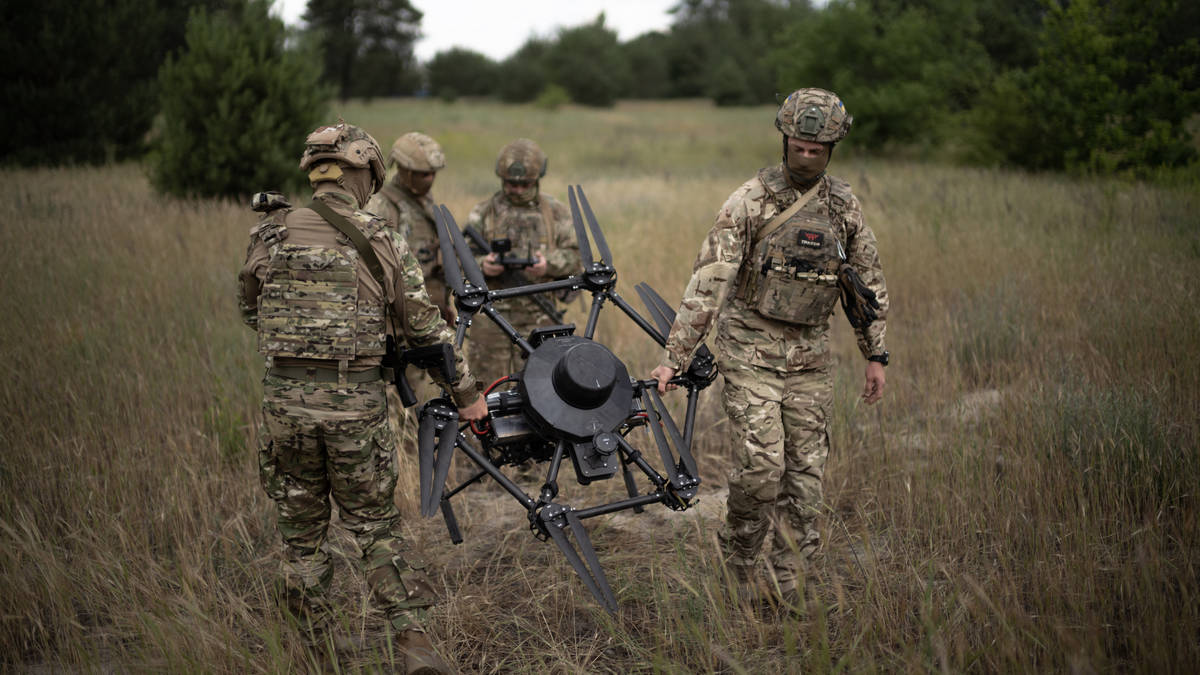
Soldiers from the "Black Sky" battalion of the Spartan brigade calibrate an agricultural drone, transformed into a front-line delivery cargo.
Picture:
Getty
Since Russia’s full-scale invasion of Ukraine, Western officials and analysts have repeatedly forecast Kyiv’s collapse. Grim assessments have appeared with predictable regularity, warning that Ukraine cannot hold out and that Russian victory is only a matter of time. Yet the longer Ukraine resists, the more damage it does not just to Russia’s army, but to the imperial idea at the center of the Russian state.For centuries, Russia’s rulers have treated Ukraine as indispensable to their vision of power. The claim that Moscow is the rightful heir to Kyivan Rus has long served as one of the empire’s founding myths. If Ukraine exists as a sovereign nation beyond the Kremlin’s control, that myth weakens, along with the Russian state. That obsession has outlasted every political system Russia has tried. It was true of the czars, true of the Soviets, and true of Vladimir Putin. Even Boris Yeltsin, often remembered in the West as a democrat, saw the post-Soviet space less as a community of fully independent states than as a zone Russia was entitled to dominate through the Commonwealth of Independent States.Russia’s refusal to accept Ukrainian sovereignty did not begin in 2014, let alone in 2022. As the Soviet Union unraveled, Yeltsin warned that Russia might reconsider its borders with republics that chose independence, including Ukraine. The evil of the Russian imperial dream never died.
In 1994, Moscow backed efforts to stir separatism in Crimea. In 2003, it provoked the Tuzla Island crisis by building a dam toward Ukrainian territory in the Kerch Strait. Each episode tested Kyiv’s resolve and signaled that the Kremlin had never reconciled itself to Ukraine’s independence. The break came after the Euromaidan protests of 2013-14, when Ukrainians demanded a more European future. Russia responded first by annexing Crimea and then by fueling war in eastern Ukraine, beginning a gradual unraveling of the international order. Putin’s motives are geopolitical, but they are also personal. The fall of Muammar Qaddafi after Western intervention in Libya appears to have left a deep impression on him. So did the mass protests in Moscow in 2011-12, which further convinced him that popular movements, especially democratic ones, such as Ukraine’s own Orange Revolution in 2004, could one day threaten his own rule. In that worldview, an independent and democratic Ukraine is dangerous not just because it escapes Russia’s orbit, but because it offers Russians an alternative model of statehood.This is why the Kremlin’s war aims have always gone beyond territory. Russia seeks both to dominate Ukraine and to secure the regime at home. The two ambitions reinforce one another. As Zbigniew Brzezinski once observed, without Ukraine, Russia ceases to be an empire. The point remains uncomfortable for the Kremlin because it is still true.
Alexander Motyl, a professor of political science at Rutgers University-Newark, told me that empires rarely endure indefinitely. Most decline gradually, shedding territory over time, unless a major shock brings about sudden collapse. Imperial Russia fell as a result of the first world war; the Soviet Union unraveled under perestroika. Russia today, he suggests, is already on a downward slope, and a decisive defeat in Ukraine could accelerate that process dramatically. For many in Moscow, this war has become a do-or-die moment for the state itself.That logic helps explain why Russia has found it so difficult to let go of Ukraine. Motyl believes that the issue is bound up with the legacy of Kyivan Rus: if Ukraine can credibly claim that inheritance, Russia’s own historical narrative shrinks, reduced to a narrower Muscovite past. Survey data, meanwhile, suggest a country caught between fatigue and imperial reflex. He added that many Russians appear to want the war to end, even as they continue to support Putin, who has come to embody it, suggesting that what many want is not peace at any price but an end on terms that can still be called victory.That helps explain Moscow’s refusal to compromise. Putin does not merely want victory in Ukraine. He needs some version of it to justify the immense costs of the war and to protect himself politically. Defeat would not just expose military weakness. It would call into question the imperial mission on which his rule increasingly rests.
Yet the effort is corroding the Russian state from within. Russia’s leading economic officials have begun to acknowledge that the country’s troubles are structural rather than temporary. Nicholas Trickett, a commodities analyst, noted that labor shortages, stubborn inflation, weakening consumer demand, falling construction activity, and worsening external conditions point not to a brief slowdown, but to prolonged stagnation. The Kremlin’s technocrats may be able, but ability matters only so much in a system that has subordinated economic policy to war and cannot allocate resources in the public interest.That leaves Russia in an awkward middle ground. Trickett added that market mechanisms are no longer sufficient to sustain the war economy at its current intensity. Yet the regime is too ideologically rigid, and perhaps too fearful of the political consequences, to embrace full mobilization. The result is policy by half-measure: enough intervention to deepen distortions, not enough to resolve them.Russia can still keep fighting. But it is doing so by consuming the foundations of its own future. Living standards are likely to keep falling even if the war grinds on. The Kremlin’s attempts at stabilization increasingly worsen the bottlenecks they are meant to fix. Ukraine, by continuing to resist, is not only frustrating Russian military aims. It is accelerating the exhaustion of the imperial model itself.But there isn’t much reason to expect meaningful pressure from above or below. “Even the elites roughly share the Kremlin’s war objectives of expansionism and great-power status,” says Maria Popova, an associate professor of political science at McGill University. For that reason, she adds, “I don’t think we should hold out strong hope for societal pressure on the Kremlin to end the war.” Taras Kuzio, a professor of political science at the National University of Kyiv-Mohyla Academy, makes a similar point. It is ‘wishful thinking,’ he argues, to believe Russians will suddenly say ‘enough’ and stop fighting, as in 1917. Many are fighting for money after three decades of anti-Ukrainian and anti-Western propaganda.” Even Putin’s passing would not necessarily mean the system passes with him. As the political scientist Alexey Uvarov notes, any post-Putin transition is more likely to be managed by segments of the existing elite than to produce a clean break with the system.George Barros, director of innovation and open-source tradecraft at the Institute for the Study of War, told me that “any successor would likely ideologically support the Russian revanchism that Putin brought given the Kremlin’s success in cultivating a pro-war, pro-expansionist ideology.” Such a figure, he adds, “may or may not want to continue the conquest immediately, but rather wait for an opportunity.” In his view, “the odds of the Kremlin being led by a democratic liberal are exceedingly low.”David Kirichenko is a war correspondent and researcher specialising in irregular warfare and military strategy and is reporting from Ukraine.





Comments (0)