
Remember me

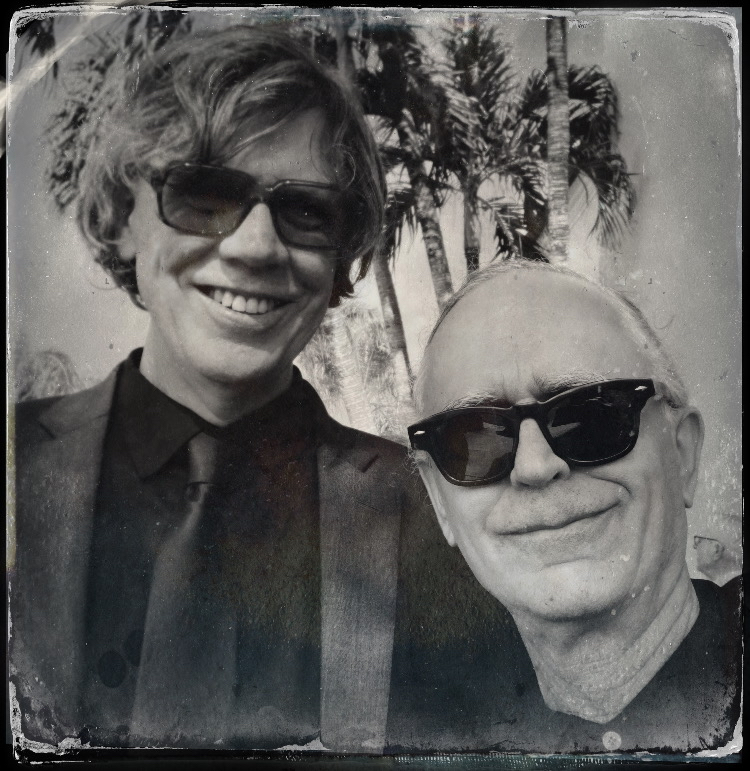

Music writers. Who needs ’em? We recently had the opportunity to get Sonic Youth rocker, improviser, publisher Thurston Moore and B.A.L.L. rocker, producer, honcho Bonner Kramer together, so we left them to interview one another with no interference from us.
Thurston Moore was radicalised by punk rock’s first transmissions to move to NYC and make a racket, playing, notably, in The Coachmen, Swans, one of Glenn Branca’s Guitar Orchestras as well as being a founding member of Sonic Youth. As well as three decades of no-wave, psychedelic, transcendent, punk rock goodness, Moore has also had a long solo career and has become a prolific collaborator, especially in the fields of noise and free rock. He is a co-founder of the Ecstatic Peace Library imprint, published his memoir Sonic Life in 2023 and recently published a book on improvised music, Now Jazz Now, along with Byron Coley and Mats Gustafson.
Bonner Kramer, FKA Kramer, FKA Mark Kramer, was born in NYC and became a full-blown member of Bongwater, B.A.L.L., Shockabilly and New York Gong, as well as having a touring role with the Buttholes, the Fugs, Ween and Half-Japanese. He set up the legendary Shimmy-Disc records, putting out records by King Missile, John Zorn, GWAR, Daniel Johnston, Boredoms and Spongehead. He is a producer of great renown having worked on records by Low, Galaxie 500, Will Oldham, White Zombie and Urge Overkill.
While the pair have crossed paths socially and creatively at many points over the last 45 years, They Came Like Swallows is their first duo record, which is released by Silver Current on Friday 1 May. It was, we feel, well worth the wait.
Thurston Moore interviews Bonner Kramer
Where did the name for your label Shimmy-Disc come from?
Bonner Kramer: The song, ‘Shimmy Shimmy Koko Bop’. You and I are the same age, old friend. When I was a boy, in the early 60s, my father used to put a little portable AM radio powered by a 9v battery, beside my pillow when I went to sleep at night and I would fall asleep to the sounds of AM radio from NYC. At some point a few hours later, the music would gently fade away, growing quieter and quieter as the little battery died. The next night my father would put in a new battery when I was ready for bed. As the years passed, I was spoon-fed a steady stream of repeat-play R&B hits from that era, like ‘Be My Baby’, ‘He’s So Fine’, ‘My Boyfriend’s Back, and ‘Shimmy Shimmy Koko Bop’, songs that burned themselves straight into my psyche. I couldn’t resist how good the name Shimmy-Disc sounded, how it looked, and how it felt.
Were you ever a hippie? Did you have long hair down your back? Did wear sandals and tiptoe through the tulips?
BK: I was absolutely a stupid fucking hippie in high school and a tad beyond. But my hair was a kinky Black-Jewish fiasco and my laughable Afro didn’t reach all the way down my back. It kinda sprouted up and out and sideways. I could show you a few pics but then I’d have to kill you. I wore tattered sandals to the beach on Long Island in the summer but generally it was red white & blue American flag sneakers and torn jeans (before it was in fashion to tear them on purpose). But I was susceptible to poison ivy so I kept my distance from tulips and anything else potentially itchy.
What was the first record you ever bought?
BK: Sgt. Pepper’s Lonely Hearts Club Band. My father had given me the earlier Beatles records in the years prior – ‘I Want To Hold Your Hand’ was a game-changer when I was about seven. I wore those records out from years of play, and multiple copies with skips and scratches all over them went into the trash, including the infamous “butcher cover” Yesterday And Today. But my first memory of walking into a store and buying a record with money from my own pocket was definitely Sgt. Pepper. I was smitten. But I was hooked before I heard it. The Beatles were my thing. Nothing else mattered much at that age, musically or otherwise. I was 13 before I heard Pink Floyd, Zappa’s Uncle Meat, and 15 before I first heard Captain Beefheart.
Was there one producer whose work ignited your desire to produce?
BK: There were several of equal importance and I’ll give them to you in order of me realising their existence. First was George Martin. I studied record covers obsessively and his name was right there at center stage before I knew what his producer’s credit even meant. But before that, I was reared on Phil Spector, with that little AM radio next to my pillow. It may explain (at least in part) my lifelong attraction to the big sculpted audio space of reverb. To me, reverb gave recordings an other-worldly life, and I just loved it. Later on, in the 1980s when discovering composers like Morton Feldman and Pauline Oliveros who dedicated their lives to depicting the “departing landscapes” of our audio imaginations and the potential of their effect on the psyche, I felt even more at home with the limitlessness of repetition, loops, drones, and reverb. But, I digress. Back to the producers. Then there was Joe Boyd, Bob Johnston, Tom Wilson and Brian Wilson. I haven’t really had my attention drawn closely to anyone else since Martin Hannett, whose work served to reinforce the ethos I already had in place in my twenties: there are no rules.
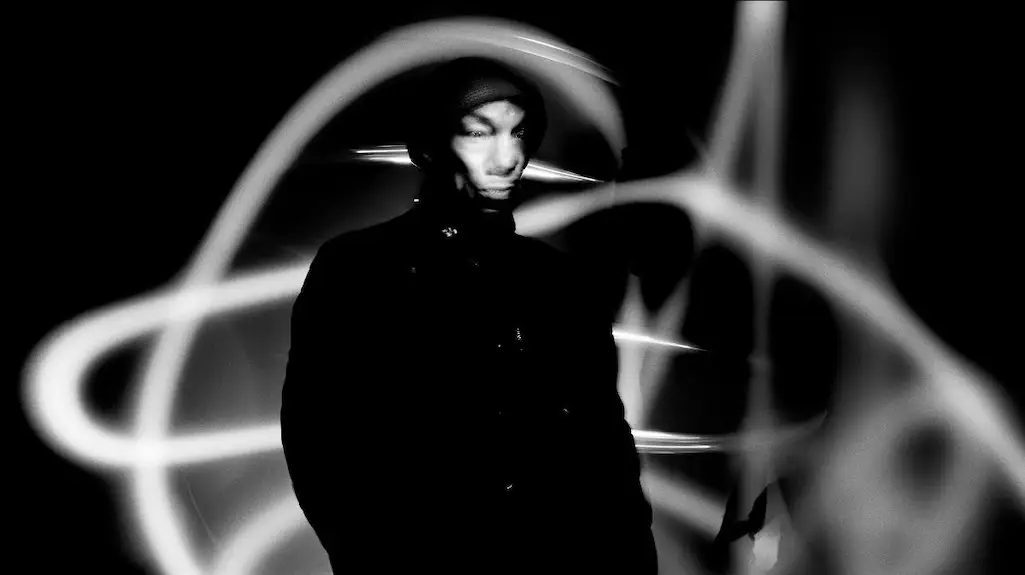
 Thurston Moore & Kramer, by Zarstar
You seem to know your way around the bass and guitar and piano etc. Did you attend music school?BK: I did, on and off. I took an Electronic Music course with Bob Moog at Hofstra University on Long Island in 1976, but it had nothing to do with music. I remember walking into the classroom on the first day with such great anticipation, and seeing a massive blackboard with a schematic scribbled on it. The class was about how synthesizers worked, and I didn’t give a flying fuck about that. All I cared about was how they sounded, and how to make them sound different, so I didn’t get far with Bob Moog. Then I went to The Creative Music Studio (“CMS”) in the Woodstock Valley, which was run by my great teacher, Dr Karl Hans Berger. I doubt I’d be here today if not for him. I applied to the school in 1977 because I saw an ad in the back of Downbeat Magazine inviting young musicians to apply, stating that Ornette Coleman was the co-founder. I was way more obsessed with Ornette Coleman than I was with any other jazz composer at that time, so I applied. And I was quickly accepted, for no reason that I can honestly offer you today. I sent a $50 check for the application fee, and I was in. No interview, no audition, no questions asked. Red flag right there. When I got to the campus I found out that Ornette had actually been there only once, at the ground-breaking ceremony a few years prior. I laughed myself to sleep that night, but I was fortunate enough (thanks, again, to Karl Berger) to meet and spend some quality time with Ornette a couple of years later at his ramshackle loft on the Bowery in NYC. But CMS was a jazz school, and I didn’t fit in. Then John Zorn and Eugene Chadbourne came up from NYC to teach composition for a “weekend intensive”, and I fell in love. They dug me, too, and I wound up working with both of them for years thereafter. So CMS was my creative birthplace. Going back to the beginning, I studied classical organ throughout my childhood, and was a keyboardist in plenty of shitty bands. Then I taught myself the bass, and really didn’t get serious about it until I joined The Butthole Surfers about one week before flying to Europe with them for their first tour there. Trial by fire. I learned fast. An MXR Distortion and fuzzbox helped. Plus, everyone had their eyes fixed on Gibby, so no one really noticed that I was still learning how to play that thing. I lost the strap before the first gig and went onstage without it. It seemed like the right thing to do, so I stuck with it.
When did you first hear the Ramones and what did you think?
BK: I must confess, I didn’t think much. It was the mid-70s and I was mainly listening to modern composers. John Cage was my god, and he still is, to a certain extent. I was a real art snob back then. The only then-current ‘rock’ music I was really listening to was by Fripp, or Fripp & Eno, or Eno and his various collaborators at that time. The intellectuals. Eno’s Obscure Records series was my audio bible when the Ramones were running the town in NYC. I thought they were tons of fun but totally stupid, and I fancied myself a composer. I dismissed a lot of music in those years. I didn’t judge it. I just didn’t care to give it my attention. I also didn’t give a fuck about the Velvet Underground at that time. I had no idea what all the fuss was about until ten years later. I was listening to Pet Sounds. The last thing I was interested in was “Gabba gabba hey!” But it all became clear to me, eventually, and I love it all now. I later saw them at Glastonbury in 1990 when I was there doing live sound for Galaxie 500, and it was one of the greatest shows I ever saw in my life. And Joey was so sweet. I only spent a few hours with him here and there in the years to follow but he always treated me like an old friend. Same with Iggy. The first time I met him, he smiled from ear to ear, shook my hand wildly, and said, “Oh man, it’s so great to see you again!”
While it seems to me that people are excited by the “first meeting” of our duo record, for me it feels like we have been doing inter-related music all along, it’s just that we have never recorded it. So while it’s “new” it feels like it’s something we’ve always done, possibly just spiritually. Does that make sense?
BK: I couldn’t have said it better and it makes perfect sense, echoing my feelings with frightening precision. We’d been onstage together often enough, and we shared a lot of music over the course of the last 45 years, so I definitely share the feeling you have of us having made a lot of music together prior to the recording of this LP. We’ve been making this LP for a long, long time. We just never got around to recording it until March 2024. It’s like it’s both old and new at the same time, with a good serving of The Future imbued throughout. And I feel like we’re only just getting started. I’d like to live long enough to do more.
Have you experienced “the zone” whilst playing live? By which I mean the experience when all good nature comes into some sonic alignment of clarity and otherworldliness?
BK: Oh yes. On several occasions onstage with Don Cherry in the early 80s, with Eugene Chadbourne on his guitar each and every fucking night when I played with Shockabilly, inside Marianne Zazeela & La Monte Young’s Dream House, and just last year at the Big Ears Festival while onstage with Lonnie Holley. Miraculous. But most of the experiences I’ve had that match your description came as witness to things that happened spontaneously in the recording studio. The first three days recording Low in the early 90s. Pinch me. I couldn’t believe what I was hearing, watching, and experiencing. Watching Will Oldham spontaneously write the lyrics for ‘Gulf Shores’ right in front of me in the control room while listening to his band – an early iteration of Slint – rehearsing the music on the other side of the glass. And when he was done, I looked at what he had written, and not a single word had been crossed out, not a single line replaced, or repaired, or changed in any way. Stream of consciousness. Genius. Then he went out into the studio and sang it in a single take. I also recall a Sonic Youth gig at TT The Bear’s in Boston in the early 90s when I was doing live sound, and for about 20 minutes, I swear I felt as though I was standing in front of a 747 on the runway, its engine coming toward me, the plane about to take-off. It was almost frightening, the sound you and the band made that night. I’ll never forget that.
If you could lock the current US administration in a cell and torment them with one album – what would that be?
BK: That’s too easy. There’s no contest. It would be the 1939 Commodore Records 78rpm release of ‘Strange Fruit’ by Billie Holiday. Side A, on repeat play for all eternity. And I’d stand by and watch the terrible beauty of it crush them like ants.
Bonner Kramer interviews Thurston Moore
I’ve always assumed that the name Sonic Youth was arrived at following extensive debate between yourself and your fellow bandmates. Perhaps at times the debate became heated. What is the origin point of the band’s name?
Thurston Moore: I initially named the group Male Bonding after an article Kim [Gordon] wrote in Real Time art magazine about Rhys Chatham and Robert Longo snorting canisters of [air-freshener] Locker Room and playing loud minimalist guitars together. We never actually played a gig under that name and soon changed it to Red Milk. But the debut gig was a travesty and I decided to change the name to The Arcadians, which I liked as it denoted the peaceful people in opposition to the warring Spartans of antiquity. I decided then to name the group Sonic Youth, a name that had been in my mind for some time. It was a melding of Sonic from Fred “Sonic” Smith, the guitarist in The MC5, and Youth from the constant usage of that word in radical Reggae culture which I was immersed in; Big Youth, Natty Youth, Dread Youth. After that first Sonic Youth gig Lee Ranaldo joined. The rest is history. Or myth. Your choice.
Were you ever a punk? I mean a real punk, with a mohawk or a shaved head?
TM: I certainly cut my hair shorter than it had been pre-1977. I started going to Max’s Kansas City and CBGB in late 1976. Before that I saw Patti, Ramones, David Johansen, Talking Heads and a few others in various Connecticut clubs. My family lived in Bethel, Connecticut and NYC was about an hour and a half away. The city was notorious and scary but eventually I got there after reading and seeing so much of what was going on with very seductive images and curious suggestions in regards to bands with names like Television and Blondie and Suicide. Ramones were the great blueprint of punk but they all had long(ish) hair and were somewhat high concept (same last name, same style of dress), Patti and her boys, particularly Lenny Kaye, all had long hair. The short hair thing was very much Richard Hell and Tom Verlaine wanting to look like Jean-Pierre Léaud in Truffaut’s The 400 Blows. I totally fell for that. I related to the same sensibility after experiencing the je ne sais quoi of that film one late night on PBS TV. Hell’s chopped hair and ripped clothing put back together with safety pins was taken by Malcolm McLaren and utilised for the presentation of Sex Pistols advertising his Sex shop of radical apparel. An incredible departure from the proper glam of Bolan and Bowie but still garish and loud. I preferred the black and white minimalism of Television and Mapplethorpe’s iconic photo of Patti on the cover of Horses. That’s what I modeled myself on. So, no, I never went the Sid Vicious chains and mohawk route so much but I did start shaving my head to a nub in appreciation of the early 80s US-based hardcore bands I thought were so startling and great like Minor Threat, Negative Approach and SS Decontrol.
I assume you had a garage band. What was the very first band you tried to ‘cover”?
TM: I didn’t have a band in high school at all. I was into the more outsider stuff like Stooges, Captain Beefheart, even Bowie who was looked at with some suspicion by those with an early 70s USA high school mentality. I also liked the thug rock of Deep Purple, Bachman-Turner Overdrive, Sabbath, and Zeppelin which allowed me to commiserate with fellow teen cretins but I was drawn toward the otherness of bands like the Dictators and the New York Dolls. I would invent fake band names and fantasise about being a member of them, and I would even make discographies for them. There’s a 2016 novel by the fiction writer Dana Spiotta titled Stone Arabia where one of the characters is a musician who never amounted to anything in the public sphere but had created an entire fantasy history of detailed musical activity and recordings. I very much relate to that character. It made me reflect on what my existence might have been like if had I never made the physical move to NYC to actually engage with the providence of my artistic desire and life.
Name three guitarists you heard in your youth that convinced you to become a musician?
TM: I was never really a guitar fetishist. I wanted to be a drummer at first. I had some sticks and a pad and tried to play [mummy-daddy] basic patterns on the drum pad as a starting point but I couldn’t keep any semblance of foot to hand to brain coordination in my rhythm. Frustrated, I turned to guitar. Hearing Zappa play that extended mantra wah-wah lead on Hot Rats was big. Hearing Tom Verlaine deliver a song based on a three note motif on ‘Little Johnny Jewel’ in 1976 was huge. Seeing and hearing Glenn Branca lead a six-guitar army in 1979 at A’s, where all the guitars were tuned to a single note actually made me have to take a walk afterwards through the streets of Little Italy to process the utter magnificence of it. Radical guitarists always and continue to thrill me whether it’s Pat Place in Contortions, Derek Bailey every time I saw him play. Greg Ginn’s wild punk infused scattershot playing in Black Flag. Eventually hearing Masayuki Takayanagi and Fred Frith. Meeting Lee Ranaldo and the two of us checking out Rhys Chatham performing a retrospective of his guitar compositions in 1980 at the Kitchen was major. In a very real way Lee became the most important guitarist for me right then. But still I’m not Mr. Guitar. When other guitarists on tour run off to visit the music stores to salivate over vintage guitars I’d rather not. Give me a record or book store or a Russ Meyer film extravaganza happening in Leicester Square.
Can you point to one musician who inspired you the most in forging a style of playing that I’ve always found to be wholly unique?
TM: It could very well be the guitarist Rudolph Grey. He was a free jazz action guitarist who was part of the downtown no wave scene. He had a band with a wild nut named Von Lmo called Red Transistor in the mid-70s. He would jump on stage and play free noise guitar with the band Mars. One night the Glenn Branca Ensemble had played a very intense set. Rudolph was standing there off stage with his guitar case, chain-smoking brown Sherman’s cigarillos. I saw Rudolph approach Glenn – even though he was wiped out – and I could see him concede to Rudolph’s request. Everyone left the room and went out to rest their ear torn ears but I stuck around and was amazed at Rudolph’s take on how to approach the guitar – just in the moment and listening and playing across the frets as if he were Marshall Allen of Sun Ra’s group whipping across the keys and notes. In a very real way he validated that activity of creating a sheet of open music as expression and as a sonic space for anyone to improvise with in any which way. I found this liberating and beautiful and I began to employ it in my playing. It conjured ideas of new chordings and progressions and motifs which I could refine into song compositions. Years later I would play a bit with Rudolph in a group he always called The Blue Humans which at times would consist of free jazz luminaries such as Arthur Doyle, Beaver Harris, and Charles Gayle.
What is the strongest memory you have of first performing your own music live?
TM: I played in an art rock band from 1978 to 1980 called The Coachmen. They were all older than me. They were graduates of the Rhode Island School of Design, and in the class after the Talking Heads people who they were friendly with. Our first gig was in a loft downtown with all those people there, including David Byrne and a young RISD grad named Gus van Sant. It was the first time I played in front of people and they were the art school intelligentsia. It felt like an out of body experience, as if I could project myself out in front of myself and see my physical being accomplishing a dream come true. My next gig was at CBGB and I was so anxious I cut my finger on the guitar strings and blood sprayed all over the pick guard and there were a few people standing at the front – basically all the same RISD art people. In the dressing room one of them came in and walked over to Jenny Holzer and said, “Did you get any [blood] on you?” I felt like Iggy Stooge at a presidential dinner.
Do you remember the first time you heard a piece of music by Morton Feldman, or La Monte Young? What kind of an impact did that have on you?
TM: I had taken it upon myself to hear Philip Glass in 1977 when his North Star LP was released. The concert was at Hotel Diplomat Grand Ballroom at 108 West 43rd St at 3pm on a Sunday. It re-jigged my perception of how electric music could function. It introduced me to long durational minimalism at its most high powered. It also involved a realisation of its fastidious beauty whereupon mind/body transcendence is exacted. I wasn’t able to contextualise the music though and considered it as much an outlier as anything happening in punk rock but it did lead me into discovering the community of composers connected to Glass, particularly Steve Reich. La Monte Young came into my purview via his association with John Cale. In fact Cale was very important in signposting contemporary composer music to those of us besotted by The Velvet Underground. So that world of music was always very close to my heart early on and became more pronounced as a historical inspiration as I got older and continued to discover the rich ores in both academic and vernacular musics. Morton Feldman’s pieces… my God they are elegant, and so genuine in their personal singularity.
What’s on your musical bucket list? What are you dying to do before you die?
TM: I would have liked to play more with Derek Bailey. We did play together once or twice but it was always on a crowded stage of improvisers. He stood next to me at one gig, at NYC’s Tonic, and said, “I’m just going to unplug my amplifier. Nobody will be able to tell anyway.” And I laughed and said, “I’ll do the same!” It’s a great memory but I would have truly liked to have sat across from him and played in a duo. I think sometimes how cool it would be to go into a studio and write and record with Neil Young, do something really out there. I have the urge to keep composing and recording new music – in some ways now more than ever – the gates are wide open, the sensors aflame. We’re not getting any younger and I think we should just let the sonic rivers flow and flower!
Of all your senses, which one is most mysterious to you, and what rule do you think musicians need to break the most?
TM: My sense of hearing has been compromised as I have tinnitus, and I wish I did not. You would think a cure for this would have happened by 2026. I mean that’s not so much mysterious as just aggravating. I think musicians need to forget about seeking acceptance and offer all their music as a prayer and gift to being alive and to the welfare of those less fortunate to them. There I said it! Amen!
Comments (0)