“I am interested in a perceptible process. I want to be able to hear the process happening throughout the sounding music,” wrote Steve Reich in 1968, describing one of the fundamental principles of what he called “music as a gradual process” (and what history tends to remember by the name ‘minimalism’). Depending on how you interpret Reich’s thoughts, the works of Quentin Tolimieri might seem devoid of process or represent its most extreme, maximalist manifestations.
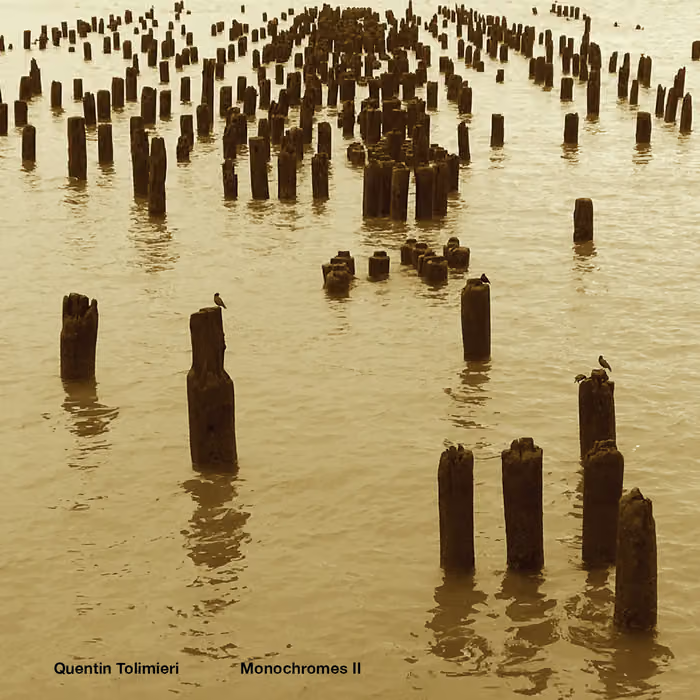
Take, for example, the opening piece from the Berlin-based composer, pianist, and improviser’s new collection of solo piano pieces, Monochromes II. During the eight and a half minutes of ‘Monochrome 16a’, we hear only an alternation of one or two pitches. The bright, glassy keys, located somewhere in the piano’s uppermost register – a G in the 7th octave, perhaps – are hit fervently with obsessive clarity, over and over again. Oscillating at frequencies where human hearing begins to mask sonic information, the tightly packed sequence of notes acquires an almost percussive, metronomic quality. No progress, only repetition. And the process? Either missing or distilled to its purest form.
Spend enough time with the piece to allow acoustic saturation to set in, and a new dimension opens up. After about two minutes, your brain surrenders, stops waiting for change, and starts noticing the tiny details beside the notes themselves: the piano’s wood creaking as the keys cluck against the frame; the mallets altering the strings’ vibration after each imperfect shift in cadence; the performer’s force and volume wavering. It’s such a simple concept that its mesmerising effect seems almost preposterous.
For all the recorded history of minimal piano music, few works demonstrate Tolimieri’s level of rigour and devotion. On the surface, sections of Charlemagne Palestine’s 1974 work Strumming Music bear the closest resemblance to Monochromes II. However, the US musician’s composition develops and evolves, even if microscopically. Similarly, the trilling chords of ‘Monochrome 17a’, a counterpoint of note clusters played in high and low registers, shares DNA with Reich’s Phase Patterns, La Monte Young’s X For Henry Flynt, and, further away, György Ligeti’s Musica Ricercata and Galina Ustvolskaya’s Sonata No. 6. Yet, the presence of these influences is only vestigial.
By stripping his music of melody, harmony, rhythm, and development, Tolimieri lets the piano’s vast spectrum of tonal colours and resonant depth shine through, uncovering aspects that otherwise remain hidden. ‘Monochrome 17b’ takes this concept and applies it to a lighter vamp. Here, the notes drift apart, opening up a space that fills up with ambient-like textural ripples. As the weighed-down piano strings vibrate relentlessly between hits, with no reprieve in sight, they build up a cloud of overtones that sounds almost synthetic, a result of some granular microtonal process.
Other pieces are sparser still, inviting headphone listening to enjoy all the music’s nuances: the ghostly echoes of the elemental notes in ‘Monochrome 18a’; the coiling mist released from the grave chords of ‘Monochrome 19a’; and the mechanical byproducts of ‘Monochrome 16c’.
At three hours long and with an almost dogmatic vision, Monochromes II might seem like a difficult listen. But beneath this mask, it’s alchemical. Once those first cognitive barriers go down, the music’s recursive nature becomes irresistible, moving from the gentle low murmur of ‘Monochrome 16b’, which sounds like one of Chris Abrahams’ grooves unable to get off the ground, and the almost-melody of ‘Monochrome 21’ to notes eternally marching, then falling down a flight of stairs on ‘Monochrome 19b’. If Reich wanted us to hear the process, Tolimieri invites us to inhabit it.






Comments (0)