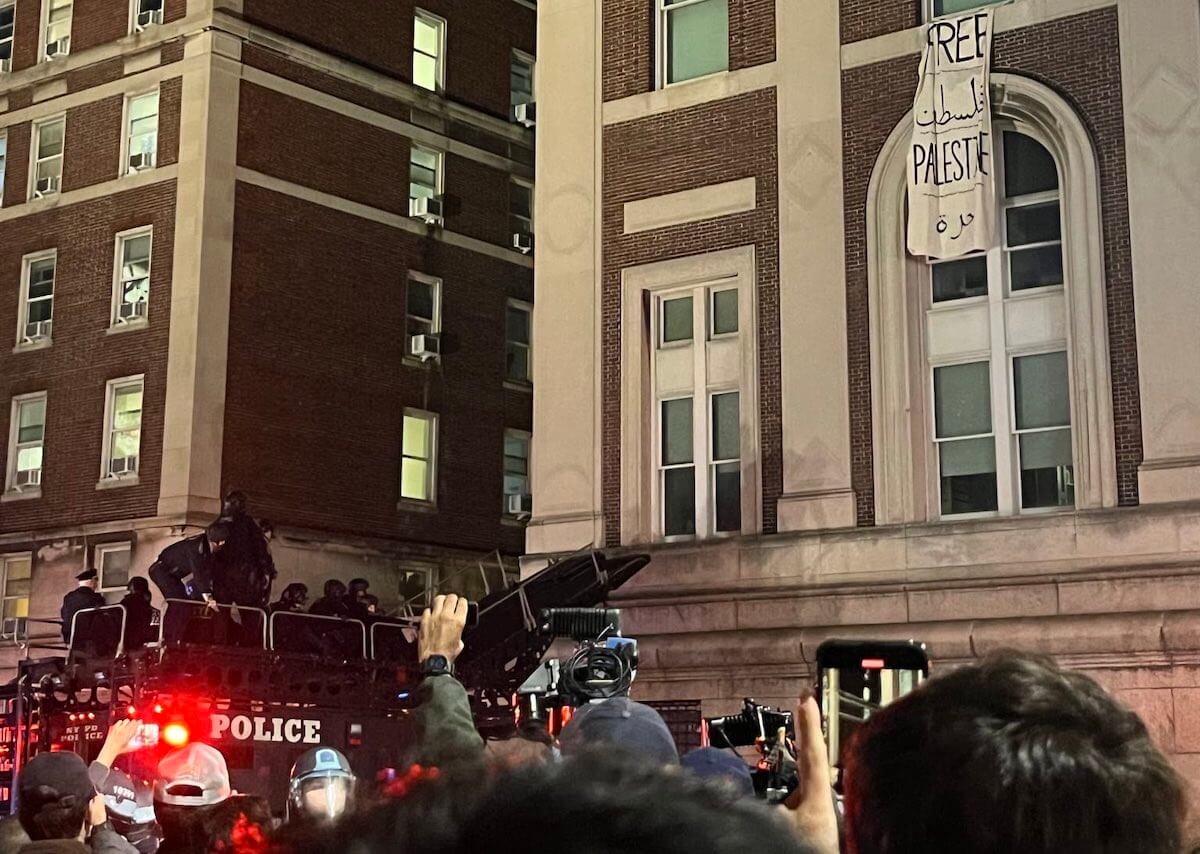
On April 17, 2024, Columbia University students hoisted tents onto the grass of the East Butler Lawn, initiating an international reckoning with the Israeli genocide in Gaza.
The initial encampment was met immediately with a police sweep and the mass arrest of student participants, but this did not deter activists and only prompted a second mass entry into the adjacent lawns mere moments later.
I was at the second encampment as an admitted student attending spring orientation. The dynamism of that moment feels surreal now – hundreds of people waving hand-painted banners and flags, cheering to song and chant, and the almost comical, stiff communication from the university as it attempted to maintain a veneer of business as usual, all a portent of the institutional reprisal to come. I remember standing on the cobblestone that divided the Butler lawns, my eyes glued to the border that delineated the beginning of the grass, resolutely convinced that if I stepped over, I would risk the revocation of my admission.
The dissonance of the spectacle – students in their thousands, reprising the movements of the 1968 student occupations against the Vietnam War, refusing to surrender physical space in pursuit of a total divorce between their university and the genocide – resonated deeply across and beyond American society.
Within days, encampments sprang up at hundreds of other schools. The movement’s rallying cry – “Disclose, divest, we will not stop, we will not rest” – embedded itself deeply into the American consciousness.
On April 30, following the occupation of a Columbia academic building renamed ‘Hind’s Hall’ in honor of Hind Rajab, a five-year-old Palestinian girl martyred by the occupation forces, a second police sweep and mass arrest concluded the Gaza solidarity encampment at Columbia University.
Two years to that day, almost invariably, universities that were at the heart of the encampments – even those that made express commitments as part of negotiated conclusions to the occupations – have not divested from enterprises complicit in the genocide on Gaza.
The conclusion of many observers, therefore, has been to write off the encampments as having failed. The relative silence on college campuses in the two years since, a frustrated state of malaise imposed by force through massive surveillance, heightened disciplinary reprisals, and retaliatory lawfare against student activists from universities, well-connected legal actors, and the state itself, has also prompted interrogation.
Though the encampments mostly have concluded and many of its actors have been forced from view, the mass student movement for Palestinian liberation it cohered endures. And as the focus of the Palestine solidarity movement in the United States shifts towards halting arms shipments, the encampments continue to offer pressing lessons about the path forward.
While it would be easy to analyze the encampments as a vindication of spontaneous direct action, this would betray a lack of understanding of the work. The process of cultivating a mass base of people prepared to assume considerable personal risks was intentional and gradual, emerging from a string of cumulative, visible public actions rapidly deepening students’ consciousness around the genocide and its relationship to the elite university’s role as a site of imperialist reproduction and capital accumulation. Wide-reaching relational and community organizing enabled an ever-increasing number of participants in the field of action. This strategy – utilizing street mobilizations as opportunities for mass political education and the development of hard skills – echoes the tactics of the international anti-war movement’s most successful campaigns of mass direct action, such as Palestine Action in the United Kingdom.
Carefully leveraging mass communications, engaging with mainstream press, while simultaneously maintaining autonomous media infrastructure and being willing to criticize media actors for bad-faith reporting, created (the analysis of detractors notwithstanding) one of the movement’s most effective and far-reaching messaging campaigns.
Similarly, using visible public figures and elected officials as surrogates while remaining willing to publicly check them when necessary further expanded the encampments’ reach, the intentionally provocative yet reasoned rationale of contesting liberal media spaces reiterating the seriousness and strategic caliber of the encampments themselves.
And while it would be inaccurate to reduce the encampments merely to spontaneous action, they also reflect the necessity of understanding when it is opportune to lean into public spectacle, and of being able to exploit moments of mass outrage and fervor into tangible action with political direction and concrete organization.
These tactical reflections are consistent with the lessons of the marquee victories of the Palestine solidarity movement in the United States, from the Brooklyn Navy Yard to the eviction of Elbit Systems in Boston. Sustained, mass relational organizing that fires multiple cylinders at once and leverages several simultaneous tactics can move people in their thousands into action.
This has been borne out in every far-flung corner of American society, far beyond the college campus. The median American today disapproves of Israel. Today, the arms deals are so universally reviled that even components of the Zionist lobby itself must pay lip service in repudiating them. The encampments, while now receding from view, belong to a broader body of movement work that has played a direct role in shifting that needle.
Certainly, many of the critiques of the encampments are well deserved. Balancing competing interests, making decisions democratically, and correctly reading the temperature of the political moment are all incredibly difficult under constant state assault. But to overlook the lessons the encampments offer is to ignore that they not only share in a call to collective action that has drawn millions, but also have ushered in a new generation into their ranks.
That movement continues to press on against the United States’ relationship with Israel, and over the long haul, we will win.