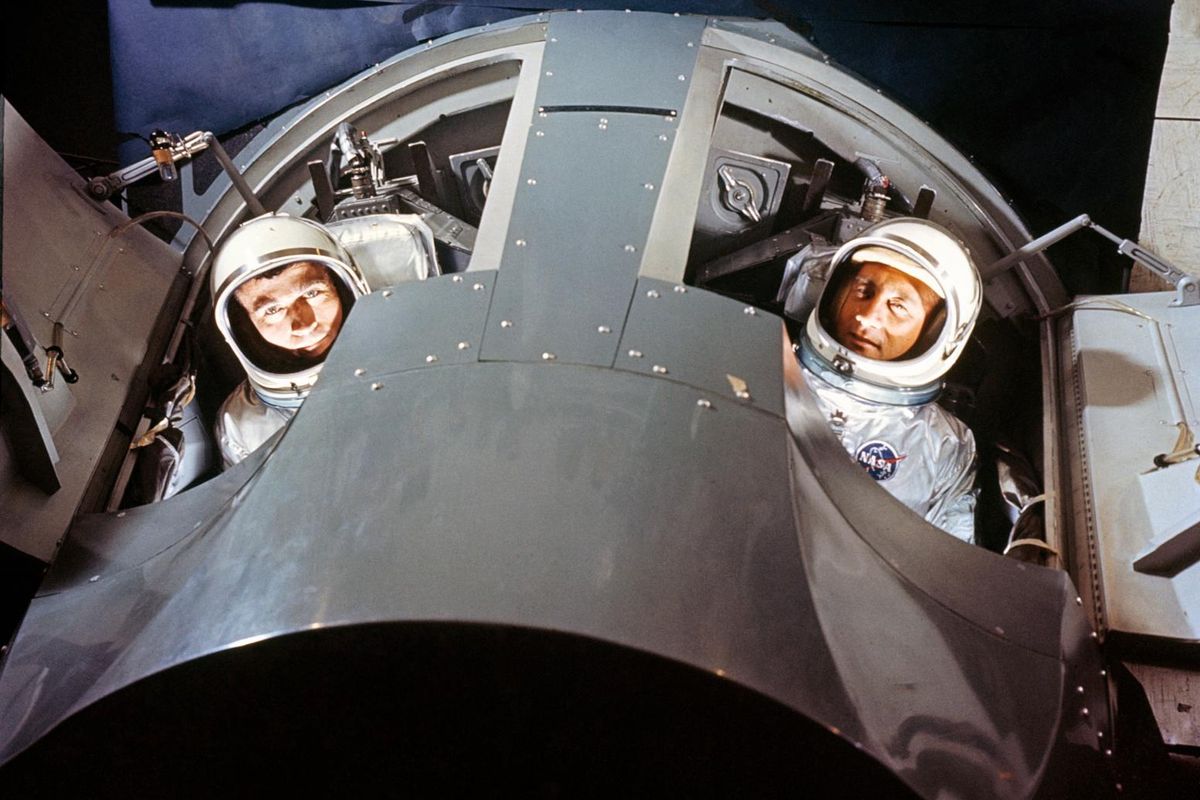
In March of 1965, Gemini III launched. It was a short mission — just a few orbits around the Earth and about five hours in space total. But it was noteworthy as it was the first crewed mission of that program, and NASA’s first time sending more than one astronaut into space.
The two-man crew included mission commander Virgil “Gus” Grissom, one of the original “Mercury 7” astronauts, and pilot John Young, who would be making his first trip into space.
Once the capsule, which the crew had nicknamed The Molly Brown, was on its second orbit, Young decided to play a wry joke when he opened a pouch on his suit and pulled out a genuine, Earth-made corned beef sandwich, Grissom’s favorite.
“Where did that come from?” Grissom asked, surprised and delighted, according to mission transcripts. The mission commander was one of the most vocal critics of NASA’s menu choices, so he happily bit into the sandwich. “Pretty good, if it would just hold together,” he remarked.
But that was the problem: It didn’t hold together. As soon as Grissom bit into the sandwich, breadcrumbs filled the air and began floating everywhere inside the capsule.
“When it comes to food in microgravity, crumb control is one of those things you have to be careful of,” Vickie Kloeris, who managed NASA’s Space Food Systems lab at Johnson Space Center in Houston, told Discover. “It’s not just a nuisance; when crumbs are floating all around the cabin, there’s a risk you can get particles in your eyes or even your lungs.”
Or they could end up getting caught in sensitive parts of the spacecraft, potentially causing a malfunction. In other words, Young and Grissom had introduced an unauthorized and unnecessary risk into the carefully controlled environment of the mission.
The Risk of a Corned Beef Sandwich in Space
As it turned out, nothing malfunctioned. Grissom quickly put the sandwich in his own pocket, and he and Young completed the mission, returning to Earth safely. But NASA and Congress found Young’s little stunt hard to swallow.
Administrators at the space agency addressed the incident. At a congressional budget hearing for NASA in 1966, U.S. Representative George Shipley (D-Ill) scolded NASA officials for allowing the stunt to occur, especially given how many millions had been spent on both the flight and the food prepared for space missions.
NASA representatives pointed out that the unsanctioned deli sandwich ultimately did nothing to jeopardize the mission or the crew, but they nevertheless dutifully promised Congress and the American people that the space agency would “prevent the recurrence of corned-beef sandwiches in future flights.”
Since then, Kloeris says that NASA scientists are a little more relaxed about the food that is brought on missions.
While food pouches that can be rehydrated are still the norm, candy, nuts, fresh fruits and vegetables, and cookies have been allowed on shuttle flights and the ISS.
“You want items that can last for several days, and you still want to limit crumbs as much as you can,” she told Discover.
For more than 30 years, Kloeris developed newer, tastier, longer-lasting, and more nutritious foods that could survive space missions.
“What a lot of people don’t realize is that all the food brought to space is ‘regular’ food you’ll find on Earth,” Kloeris told Discover. “It just has to be prepared in different ways so that it is shelf-stable and can last for a long-duration flight without spoiling or losing its nutritional value.”
Read More: NASA Unveils Roadmap for Permanent Moon Base and Increased Missions to the Moon
Nutritional Science for Space Travel
Kloeris’s work helped establish the healthy and sustainable staffing of crews for numerous shuttle and ISS missions, while also paving the way for long-term human exploration of the solar system. This includes early planning for the provisioning of manned missions to Mars.
Now retired, Kloeris, author of the book Space Bites: Reflections of a NASA Food Scientist, reminds us that humanity’s exploration of the cosmos depends as much on solving basic human nutritional needs as it does on high-tech ships, suits, and other equipment.
Before Kloeris’ time, at the beginning of the Space Race, the food that NASA provided to its astronauts was nutritious, but it sure wasn’t tasty. This led to the menu mutiny that became one of the most infamous in-flight meal moments in history.
At the very dawn of space exploration, we weren’t sure how well humans could even process or consume nutrients in a microgravity environment. So, some of the earliest orbital missions launched by both the U.S. and the former Soviet Union included time devoted to food experiments to sustain crew health and nutrition.
Throughout the Mercury and Gemini programs, NASA was constantly testing ways to provide palatable, digestible foods to its astronauts.
By the time that John Glenn’s mission aboard Friendship 7 launched in 1962, we knew that astronauts could at least hold down water and mostly liquefied foods (served in tubes, like toothpaste), if they swallowed hard and tried not to burp afterwards. But early astronauts hated the flavor, quality, and consistency of their limited menus, and they regularly lost weight while on their missions.
This was a problem. When humans don’t eat, our bodies will start to consume muscle mass as our go-to source of emergency nutrients.
As if that’s not bad enough, Kloeris added, “When the crew is on a long-duration mission, the microgravity environment causes them to lose bone mass. It’s why the crew has to exercise every day. But NASA also found that foods high in sodium make bone loss worse, so that was something that had to be taken into account as well.”
Food Fit for an Astronaut
Obviously, astronauts needed to be well-nourished enough to conduct scientific experiments and sufficiently fit to perform whatever tasks were needed for the mission, whether it was conducting mundane repairs on a station or recording critical data during a walk on the moon.
So, NASA was constantly tinkering with food formulations and regularly included nutritional experiments for astronauts from the beginning of the Mercury project, and well into the second phase of American space exploration, the Gemini program.
Gemini was an important stepping-stone to the Apollo missions that would ultimately land humans on the moon. By this time, NASA sent up freeze-dried and dehydrated food in pouches, which could be reconstituted with cold water.
It was about as appetizing as it sounds, and it was here that Young conducted his food experiment.
While traditional bread may still be too crummy to bring into space, today’s generation of space explorers has other options, including pita pockets and wraps. As long as NASA’s food experts approve it first, no one has a beef with astronauts eating sandwiches in space anymore.
Read More: Artemis II Crew Returned to Earth Safely — What's Next for NASA's Moon Exploration Program?
Article Sources
Our writers at Discovermagazine.com use peer-reviewed studies and high-quality sources for our articles, and our editors review for scientific accuracy and editorial standards. Review the sources used below for this article: