Remember me


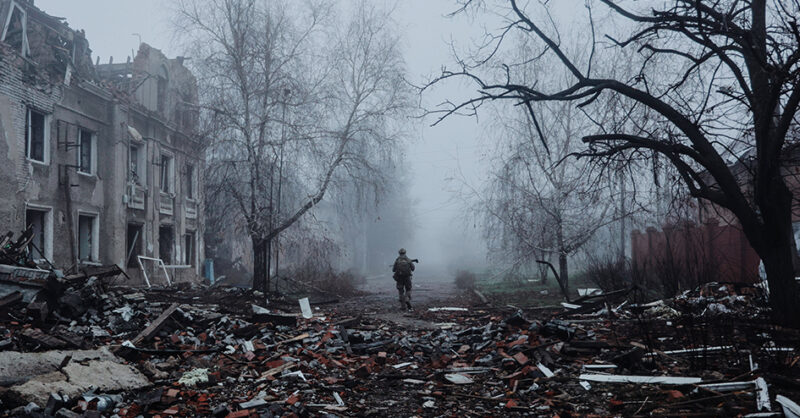




By the end of this year, Russia’s war against Ukraine will have lasted as long as the Soviet Union’s against Nazi Germany. That war ended with a huge Soviet army steamrollering its way to victory in Berlin. This one began with Russian forces trying to take Kyiv – and failing. Vladimir Putin now seems fixated on one outcome to demonstrate that the war has achieved something, and that is to have the entirety of the eastern provinces of Luhansk and Donetsk under his control. They were prematurely annexed by Russia in September 2022, after risible referendums, in anticipation of their full occupation. But that has yet to happen. Meanwhile, Putin seems to have accepted that the conquest of two other supposedly annexed provinces – Kherson and Zaporizhzhia – cannot be completed.
It is true that in the long battle for Donetsk, Russian forces are still going forwards rather than backwards. They still just manage to find 30,000 new recruits each month while Ukraine struggles to meet its manpower targets. Yet they also keep getting stuck in battles for cities whose capture Putin has declared imminent for months. In part to help keep up with these claims, Russian commanders waste time and troops trying to take them. There is no particular reason, for example, why their forces need full control of Pokrovsk, which was first declared about to fall in August 2024. To boost his negotiating stance, Putin even claimed to have captured the city on 1 December, though this was immediately denied by Ukrainian commanders.
The cost of this war to Ukraine has been, and continues to be, enormous. Russia may have fought an unimpressive land campaign, despite its advantages, but it has worked out how to inflict regular damage on Ukrainian civilians, leaving the people weary, lacking basic amenities because of strikes against infrastructure, and too often pulling the dead and wounded out of wrecked apartment buildings. Things have not been helped by a corruption scandal in Ukraine that rocked the political establishment, leading to high-level resignations – including by Volodymyr Zelensky’s close ally and chief of staff, Andriy Yermak. That the investigations got this far shows signs of health in the Ukrainian system.
Despite these hardships and distractions, Ukrainians have no interest in capitulation or conceding more territory. They would nonetheless welcome a ceasefire – even though ending the war at the current line of contact would leave Russia occupying around a fifth of their territory. Putin wants to keep going. To stop without any of his core objectives achieved would highlight his original folly and raise questions about the point of this calamitous war. He has therefore refused a ceasefire until a full political settlement is agreed, which could take months of haggling, and insisted that a settlement must involve Ukraine handing over the rest of Donetsk. If it does not, it will be taken by force, even though current assessments suggest that would take at least another two years.

Treat yourself or a friend this Christmas to a New Statesman subscription for just £2
This is the main, though not the only, reason that Donald Trump has been denied the opportunity to preside over a peace deal. He came to office convinced that Putin was also keen on a ceasefire and that the main problem was Zelensky’s obstinate determination to chase the Russians out of the territory they’d occupied. It took several rebuffs from Putin to disabuse him of this notion.
The Russian president has instead tried to convince the Americans of the reasonableness of his demands. In this he has been helped by the interventions of Steve Witkoff, Trump’s friend, fellow realtor, envoy, all-purpose negotiator and diplomatic amateur. Trump has trusted him with some of the most sensitive files, including about Iran and Gaza. His desire, and Trump’s, to find ways to end painful and costly wars is commendable, but when it comes to the Russo-Ukraine War his contributions have so far helped foster confusion and false starts in the peace process, and invariably favour Putin.
Witkoff’s ability to play a mediating role is hindered because of the respect he has shown Putin and his evident sympathy for the Russian position. In August, Witkoff was tasked with exploring whether there had been a shift in the Russia’s position. He visited Putin and reported back positively about a possible new approach leading to “land swaps”. Essentially, Ukraine would hand over the rest of Donetsk but would get back in return some of Kherson and Zaporizhzhia. By the time it was apparent that Witkoff had overinterpreted Putin’s position, the Alaska summit of 15 August had been arranged.
Trump confirmed the tilt in Putin’s direction by giving him the red-carpet treatment as he landed on American soil. But the summit was not a success. It finished early and a lunch was cancelled. Instead of an agreed communiqué there were only a couple of concluding statements with no questions from reporters. It was later reported that Putin had irritated Trump by embarking on one of his rambling disquisitions about the history of the Ukrainian and Russian peoples to prove that Ukraine was not a real country. The summit was followed by a White House meeting attended by Zelensky and a posse of friendly European leaders who managed to tilt the process back towards Ukraine. This meeting ended with smiles and relief that a diplomatic disaster had been avoided.
Putin’s intransigence led to a steady shift within the US administration towards more support for Ukraine, with extra sanctions on Russia, American arms reaching Ukraine, albeit only if paid for by Europeans, and support for Ukrainian strikes on infrastructure targets well inside Russia. Yet Trump has never shaken off the idea that he was uniquely placed to do a deal to end this terrible war.
In October, Zelensky was due to arrive in Washington to discuss yet more support for Ukraine, such as the supply of Tomahawk cruise missiles. US-Russian relations were deteriorating – Trump traded insults with the former president Dmitry Medvedev. This was the context for a call on 14 October between Witkoff and Putin’s foreign policy adviser Yuri Ushakov, a transcript of which was later leaked. Witkoff advised Ushakov that Putin should call before Zelensky arrived and praise Trump as a man of peace for the then-announced Israel-Gaza peace deal. Putin did as he was told and so gained an agreement for yet another summit with Trump, this time to be hosted by their mutual friend Viktor Orbán in Hungary.
Because of this, when Zelensky arrived in the Oval Office, instead of talking about Tomahawks, he found himself being urged by both Witkoff and Trump to give up Donetsk to get peace. Zelensky resisted and Trump did not push the issue further in public. He reverted to his preference for a quick ceasefire. The secretary of state Marco Rubio was charged with preparing the summit with his Russian counterpart Sergei Lavrov. After confirming that there had been no change in the Russian position, Rubio aborted the summit.
Out of this failure came Witkoff’s next effort. Convinced he could repeat the success of the Gaza peace plan, he agreed with his co-conspirator in that process, Trump’s son-in-law Jared Kushner, that they use it as a model for a deal between Russia and Ukraine. They got to work on 22 October and soon drew in Kirill Dmitriev, head of Russia’s sovereign wealth fund, whose main job was to persuade the Americans about the amazing economic deals that could be done once peace was achieved. We know from another leaked transcript that Dmitriev persuaded Ushakov on 29 October that if he was allowed a little flexibility, and by not sticking to the hardest line, he could move the draft plan along in a favourable direction. “I don’t think they [the Americans] will take exactly our version,” explained Dmitriev, “but at least it’ll be as close to it as possible.”
Out of this came a plan of 28 points. Even by the standards of this US administration, the rollout was chaotic: it was leaked in mid-November before it was ready for publication, apparently by Dmitriev. It also contained clauses that made no sense, and language which had been translated from Russian. The authors seemed not to understand the meaning of “de facto” and were confused about the details of various arms control treaties. There was a bizarre clause that prohibited Ukrainian missile strikes against Moscow or St Petersburg but did not mention drones or preclude other possible targets. The US would be a financial beneficiary – of, for example, frozen Russian assets.
While elements of the plan seemed an attempt to make it palatable to Kyiv, it was largely geared towards Russia. It required Ukraine to leave the parts of Donetsk it still retains and precluded membership of Nato, though accepted the need for some sort of security guarantee, and capped Ukraine’s armed forces. The initial leaks stated that the plan would be presented to Kyiv as a fait accompli, followed by dark hints that if Ukraine failed to embrace the plan it would be punished. Objections were soon heard from Congress, which is less cowed by Trump than before. Rubio then moved quickly to promise that this was no more than a work in progress and regained some control over the process. At a meeting in Geneva on 23 November, Ukrainians and Europeans were able to make changes, the deadline was forgotten, and the original 28 points were amended to a more manageable 20. Once again, there were smiles and relief that a diplomatic disaster had been avoided.
Having warned the Ukrainian people about a potential and imminent choice between US support and their dignity as a nation, Zelensky declared himself satisfied with the new version. Nonetheless, some of the core and most difficult elements, including the division of territory, were left for later. As the plan morphed into something less pro-Russian, Lavrov warned that it might be rejected by Moscow. Putin was reluctant to go that far. The new draft has “possibilities”, yet he still insisted that the choice for Ukraine was between handing over the rest of Donetsk or having it taken by force. Putin then prepared to welcome Witkoff, with Kushner, to Moscow, on 2 December so he could explain his stance again in the knowledge he would get a sympathetic hearing.
If Witkoff was a serious negotiator, he would not only listen patiently to Putin’s demands but also point out that they were unjust and unrealistic. He could ask what this extra chunk of territory is worth, including in lost lives, when Russian gains would not be recognised, and involve depopulated, economically inactive, battered land that will have to be policed and defended indefinitely.
This is not the only issue that will need to be addressed. Questions of Nato membership and security guarantees remain, and Putin will do his best to keep Ukraine as weak as possible. The gaps between the positions of the two sides on all these issues remain large. Prior to the release of the 28-point plan, it was widely assumed that both were inclined to wait until the early spring to see how well they had coped with winter deprivations, and whether Russian forces had advanced as far as Putin hopes and expects. It is always possible that when plans are being drafted and high-level discussions are taking place, the two sides will find themselves exploring compromises. If Putin continues with his stubborn refusal to back down from his maximalist demands, he may miss his best opportunity to cut a deal with a sympathetic US president. But his preference may simply be to find a way to keep the conversation with the Americans going, stringing them along with a peace process that cannot be quite declared dead even if it is making no progress.
[Further reading: Ukraine’s corruption scandal reaches the top of Zelensky’s government]
Content from our partnersRelated