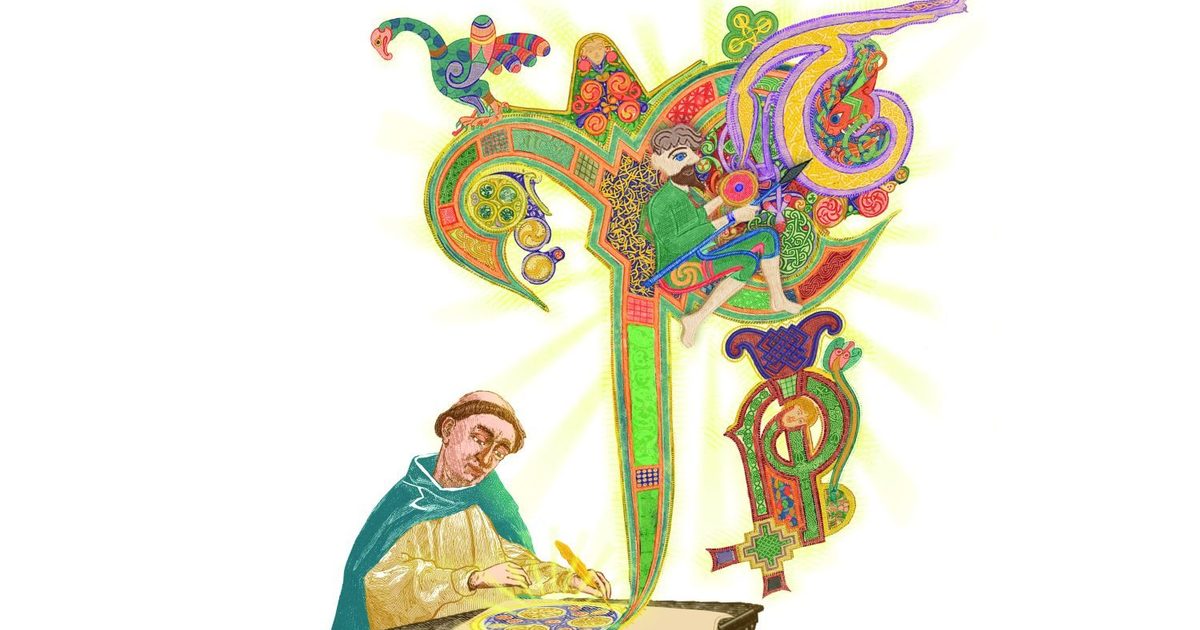
The Book of Kells, one of the greatest pieces of medieval art, is today displayed in the library of Trinity College Dublin. This illuminated gospel book is named after the monastery in County Meath where it was kept in the Middle Ages. It’s a masterwork of medieval calligraphy and painting, with its Celtic knot patterns, scintillating colour, and the staggering intricacies of the display pages and canon tables – all smoky golden magnificence.
An Irish annalist called the book “the great Gospel of Columcille [Columba], the chief relic of the western world”. It may be the work described by the historian Gerald of Wales in the 1180s, in his book on Ireland. “Look more keenly at it and you will penetrate to the very shrine of art,” he wrote. “You will make out intricacies so delicate and so subtle… that you might say that all this were the work of an angel, and not of a man.”
The book survived war, plunder and the English – Cromwell’s troops were once billeted in Kells. In the 19th century, it was a huge influence on the Celtic revival movement in the arts, and today is seen as the pinnacle of the western tradition of illuminated manuscripts.
The book was produced around the end of the eighth century, just at the moment Britain and Ireland were about to be changed forever by the arrival of the Vikings. It was long believed to have been created on Iona. But in The Book of Kells: Unlocking the Enigma, published in October, Victoria Whitworth suggests that it was actually written at the Pictish monastery of Portmahomack on the Moray Firth in north-east Scotland.
This is one of the least known areas of the medieval British Isles. The Pictish monasteries were destroyed in the Viking age, and with them virtually all written records. The kingdom of the Picts became part of the Scottish kingdom of Alba in the ninth century, and gradually the memory of the Picts faded, leaving many unsolved mysteries. One key survival is their stone carving, of which there are brilliant examples in the National Museum of Scotland in Edinburgh. Some, such as the huge memorial slab from Hilton of Cadboll etched with horsemen and hunting dogs, are absolutely stunning.
You can still see these wonderful works of art on the ground when you head up the coast of north-east Scotland. At Aberlemno is a magnificent carving perhaps commemorating the battle of Nechtansmere in 685 at which the Pictish king Bridei defeated and killed the Northumbrian invader King Ecgfrith. And by St Vigeans Church on the outskirts of Arbroath there’s a fascinating museum holding more than 30 pieces of Pictish sculpture.
This Pictish trail leads to Portmahomack, a beautiful spot on the Tarbat peninsula looking across to the distant hills of Sutherland. The origins of Christianity here are still obscure. Bede mentions a saint whom we know as Ninnian, who evangelised in the fifth century. In the sixth century came St Columba, who reached as far north as Moray.
But it was only in the 1990s that the first excavation of a Pictish monastery took place at Portmahomack. Its construction began around 550 – which might fit with a foundation by St Columba – and was probably destroyed in a Viking attack in the early ninth century, though some kind of community hung on after that. It was later dedicated to St Colman of Lindisfarne, who played a famous role in the Synod of Whitby in 664 – the great debate over Celtic and Roman traditions of Easter. Colman then returned to Iona and died in Ireland, but he was still celebrated in later times at Portmahomack.
When excavating the levels burned during the Viking raid, the archaeologist found over 200 fragments of Pictish stone carving in a style very similar to the Book of Kells. This led Dr Whitworth to propose that the most famous of all Irish manuscripts was actually made here. Indeed, finds from the dig included workshops and a room where vellum was prepared, interpreted as a scriptorium – perhaps the very place where the Book of Kells was written?
All of this only underlines how much we still don’t know about the early Middle Ages in the outer reaches of Britain. We don’t even know the site’s original name. As for the Picts themselves – still known today by the name that the late Romans gave them, meaning the ‘painted people’ – their identity eventually merged with the Scots, and their language (probably pre-Indo-European?) became extinct. But recent DNA studies suggest that their legacy endures in the genetic inheritance of people across Scotland. And of course in Trinity College Dublin you can still glimpse the unique, dazzling, colourful vision that infused the astonishing art of the Picti.
This column was first published in the December 2025 issue of BBC History Magazine



Comments (0)