
Remember me




The Bayeux Tapestry is one of the most astonishing artefacts to survive from medieval Europe. It tells the story of the end of Anglo-Saxon rule at the hands of Duke William of Normandy, whose victory in 1066 ushered in the Norman Conquest – one of the most significant turning points in British history.
But beyond recounting the rise of Norman supremacy, what was the Bayeux Tapestry really for? Was it only an extraordinary work of propaganda, designed as a display of righteous power? Or was it intended to have a more specific and purposeful role?
The answer to that latter question is: yes, according to historian Professor Benjamin Pohl of the University of Bristol. He argues that the Bayeux Tapestry was created to be a moral aid viewed by medieval monks while they silently ate their meals in a communal refectory.
What was the Bayeux Tapestry for?Professor Pohl explains his argument in a new article 'Chewing over the Norman Conquest: the Bayeux Tapestry as monastic mealtime reading', in which he makes the case that the embroidery was designed specifically to be hung in the monastic dining hall of St Augustine’s Abbey, Canterbury, where it would have accompanied spoken readings and prompted moral reflection.
Following the rule of St Benedict, which governed monastic life across much of medieval Europe, medieval monks were expected to maintain complete silence while eating, aside from the voice of the reader delivering the day’s text. These readings delivered moral instruction to the diners, in a setting where any visual imagery would have reinforced spoken words and offered a focus for contemplation.

The ruins of St Augustine’s Abbey in Canterbury. Founded in 598 by St Augustine, the abbey became one of the most important centres of early Christianity in England. (Photo by Getty Images)
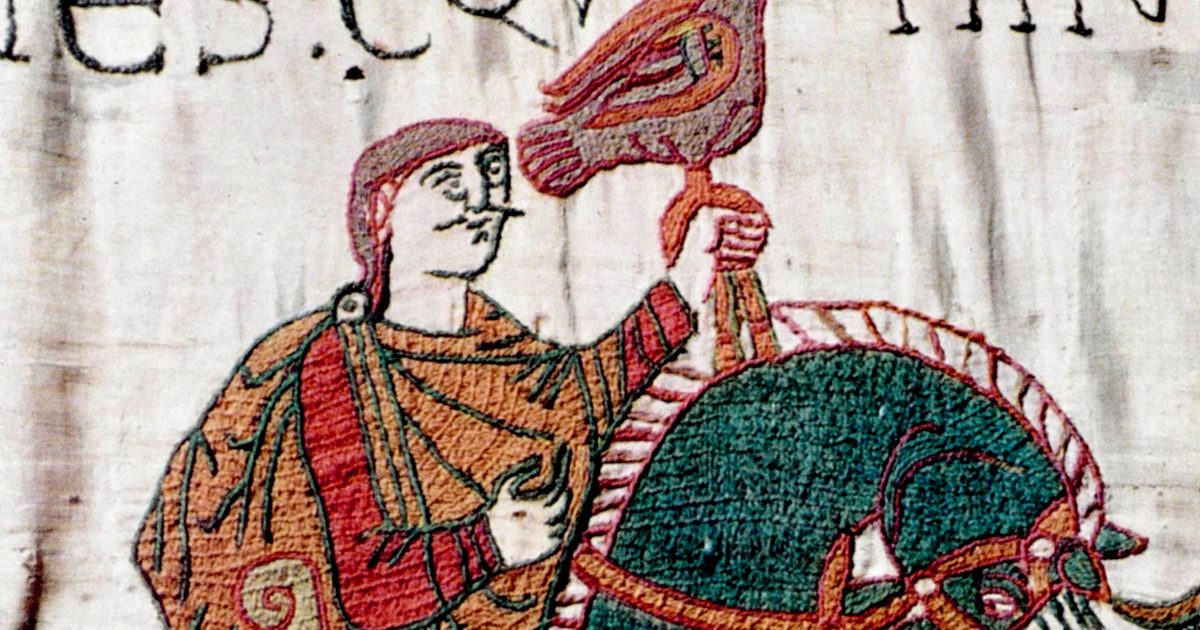
A tapestry made for monksThe Bayeux Tapestry famously depicts the events leading up to the Norman Conquest of England in 1066 through a series of cartoon-style embroidered scenes, accompanied by short Latin captions. Most scholars agree that the embroidery was probably made in, or near, Canterbury in the 11th century. That conclusion rests on similarities in its style and content with illuminated manuscripts that are known to have been held in Canterbury’s monastic libraries at the time.
But Pohl contends that the Tapestry was not only made in Canterbury, but for Canterbury. He argues that it could have been designed to be hung around the walls of the monastic refectory of St Augustine’s Abbey on particular feast days, where it would have illustrated the moral themes of the day’s reading for the monks. He theorises that the embroidery would have been exhibited at head-height around their dining room, and that therefore it would have been “perfectly discernible from the seated position assumed by the monks and their guests during mealtimes in the refectory”.
This followed “the long, pan-European tradition of using illustrated narratives in the form of wall paintings and – of particular interest here – textile hangings in monastic refectories”.
Triumph and propaganda, or a moral warning?At first glance, the Bayeux Tapestry does not appear to be an ideal vehicle for moral instruction.
On a basic level, it is a historical narrative that shows the events leading up to the Norman Conquest. In that, it appears to follow a broadly pro-Norman view of events, where the English King Harold makes, and then breaks, an oath to support Duke William of Normandy’s claim to the crown of England. This seeming act of perjury provides the context for William to muster his invasion fleet and then defeat Harold on the field of Hastings. Read in this way, the embroidery can appear to be a triumphalist account of conquest, leading some scholars to suggest that it was created for display in the great hall of a Norman castle, where warriors might reflect on their success.
1066: The battle for England Member exclusive | The year 1066 is the most famous in English history, but there's a lot more to the story than one bloody battle at Hastings. In this four-part series, medievalist Marc Morris talks David Musgrove through the full story of the Norman Conquest. Watch all episodes now
However, other historians have suggested that the embroidery is more complex than this. Rather than being a celebration of conquest, it might alternatively offer a commentary on the worldly sins – namely the overambition and moral failure – of the people involved in the story. The borders of the embroidery contain scenes that draw on Aesop’s Fables, a body of stories widely used in medieval education to convey ethical lessons. Such imagery lends weight to the idea that the embroidery carried an underlying moralising message, one that would have been particularly suited to a monastic setting, where the rejection of worldly concerns was central to religious life.
Professor Pohl contends that the ideal place for such moral messages to be delivered would have been in silent contemplation over dinner. Though the fabric of the refectory of St Augustine’s does not survive, documentary and archaeological evidence suggests that it was a substantial building, large enough to accommodate the full length of the Tapestry around its walls.
With the tapestry as an illustrative background, the mealtime reader would have talked about a moral theme while the monks ate and looked at the image in question. They would have been aided in this by the very basic Latin captions in the Tapestry, which would have been suitable for an audience of monks who did not all have deep Latin knowledge. Pohl points out that the way that the embroidery is split up into individual narrative scenes would also have allowed for a series of discrete, but interconnected, moral lessons to be taught to the munching monks.
“Each episode is a tale of both good and evil, victory and defeat, damnation and redemption”, he says.

This section of the Bayeux Tapestry shows the Norman army crossing the Channel in 1066, followed by the preparation of food after landing in England. The detail underscores the logistical organisation behind William of Normandy’s invasion. (Photo by Getty Images)
Was the Bayeux Tapestry forgotten?He agrees with the view that Abbot Scolland, who led St Augustine’s Abbey in the years following the Conquest, was a driving force in the creation of the Tapestry (perhaps working with, or for, Bishop Odo of Bayeux, the half-brother of William the Conqueror). He notes that Scolland also instigated the post-conquest building programme that included the construction of a new refectory building for the monks.
Pohl suggests that Scolland commissioned the embroidery specifically for display in the new refectory that he designed. However, Scolland died in 1087, long before it was eventually constructed. Pohl further argues that the Tapestry may never have actually been shown as planned because by the time the dining hall was finally built, Scolland had been dead for half a century and the Tapestry may never have been displayed as intended.
If the Bayeux Tapestry was made, and then stored and never displayed, this could help to explain its remarkably good state of preservation.
It also raises the question of how the Tapestry eventually came to be in Bayeux. By the end of the 15th century, it appears in the inventory of Bayeux Cathedral. Pohl suggests that it may have remained in storage in Canterbury, and stayed broadly forgotten, until the 1420s, when it could have been offered as collateral to settle a monastic debt. From there, it may have passed into the hands of the Duke of Burgundy before ultimately making its way to Bayeux, where it survives today.
Comments (0)