
Remember me
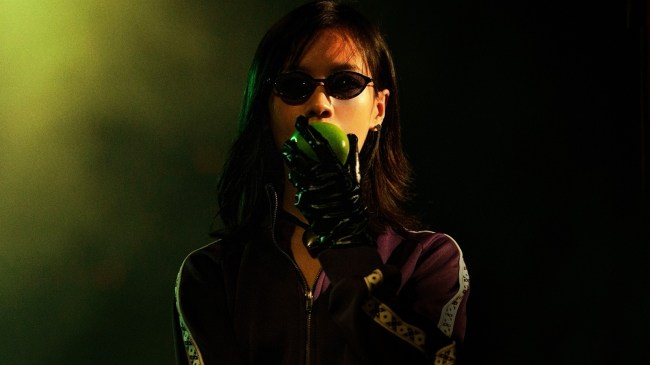

The most beautiful and entrancing animated film I saw this year — a five-minute stop-motion short called “The Dying World,” directed by 27-year-old artist, actress, model, and one-time reality TV star Lauren Tsai — is the story of an idea that no one wants. And it began with an idea that Tsai had always been afraid no one wanted: a vision of herself that didn’t align with the one she was assigned to fulfill.
Like many fans of her work, I first encountered Tsai when she appeared on a Japanese reality show called “Terrace House” in 2016. She jumped out at me for the same basic, screamingly obvious reason that I couldn’t name another cast member from her season with a gun to my head: She was catastrophically miscast.


It’s not that Tsai was boring (which at least might have served the hyper-manufactured coziness of a show that aspired to feel like a gentle and naive riff on “The Real World”), but rather that the self-consciousness of her screen presence threatened to expose the soul-flattening bullshit of everything around her. She embodied the kind of mistake that American TV is too algorithmic to make.
Here was this introverted but vividly intelligent 18-year-old girl who, despite the efforts of Fuji TV’s finest editors to flatten her into an archetype, was so actively engaged in the process of figuring herself out that she was only believable when resisting the artificial demands of her role in the story; to whatever extent it was constructed, a scene in which she criticizes two castmates for pushing her into a one-sided date is raw enough by “Terrace House” standards that it feels like the equivalent of Truman Burbank sailing into the outer walls of Seahaven.
Long enamored by the clarifying fantasy of being spirited away to another world that made sense of everything back at home (which might explain her decision to apply for a Japanese TV program that was filming near the Honolulu neighborhood where her family had lived since she was seven), Tsai was dying to be seen in a house full of young adults who were happy to be watched, and she picked at her own image with a kind of palpably searching purpose that made the rest of the show feel that much faker. Everyone in the cast was preoccupied with what other people thought of them, but Tsai was the only one who seemed equally preoccupied by what she thought of herself; she didn’t know who she was yet, but it seemed like she was already terrified of forgetting.
Needless to say, her time in the Terrace House was short-lived.
 ‘Terrace House: Aloha State’
Born in Massachusetts of Chinese-European descent but already fluent in Japanese, which she had taught herself while visiting the country on summer vacations, Tsai moved to Tokyo in the hopes of leveraging her local fame towards a modeling career (“I always had this idea of Japan as a light in the sky,” she’s said). Despite her immediate and continued success in the fashion world, she quickly discovered how difficult it would be to escape the image that “Terrace House” had locked her inside. Ubiquitous and invisible all at once, Tsai didn’t feel misunderstood so much as minimized, manipulated, and stuck in a trajectory that made her less excited for the future than she was eager to reclaim her unrealized pasts.
Worse, it left Tsai deeply insecure about how to reassert herself. “I found it very difficult to introduce myself to people,” Tsai told me during a recent Zoom call. “A certain identity had been blasted out to the world and stamped onto me,” she said, recalling how the pressures of overnight celebrity were intensified by working at a modeling agency where her body was measured down to her wrist size. “So introducing myself in any other way… I just always had this image in my mind of people thinking ‘She’s not seeing herself correctly. She wants to talk her way into being something that she’s not.’”
What Tsai already was and wanted to talk herself into being was an artist. Drawing was her most reliable source of refuge, as it had been ever since she was an 11-year-old kid who would sketch under her desk at night to process the most difficult emotions she’d experienced that day. For her, the activity was cloaked in shame, and so Tsai kept it hidden like a terrible secret. That made it a natural vehicle through which to explore the parts of herself that she had been taught not to let other people see. “I drew a lot of very emo and very gory artwork,” Tsai said, “so it felt like something I could never share.”
She honed her talents on the internet, learned 3D animation over the summers, and developed a fake online persona — presumably one who didn’t present as a 13-year-old girl — in order to navigate places like YouTube and DeviantArt. For her, it was an innocent way to identify a separate part of herself, and to protect it from being suffocated to death by the various images that other people were already foisting upon her. Those images evolved as Tsai got older, and the drawings she created in response to them evolved in kind. Animal sketches gave way to even more fantastical self-portraits, and the surreal nature of Tsai’s life after “Terrace House” provided the inspiration she needed to place her characters within gorgeously warped environments that span the distance between Tim Burton and Hieronymous Bosch.
 ‘Marlowe and Waking’
And then, one day, Astrid was born. Tsai had been drawing the girl since moving to Japan — a drab and simple figure with sunken eyes, pale skin, and a passing yet imperfect resemblance to her creator. But it wasn’t until one particularly isolating afternoon in her small Meguro apartment that Tsai decided this character needed a name, if only so that she might be able to better crystallize their relationship to one another. If only so that she might give more permanent shape to her most persistent idea, and codify the compartmentalization that had come to define her life as a public figure. “Even as I got older, drawing felt like this separate part of myself,” Tsai told me, “and I think that’s reflected through the creation of this character. Astrid herself can contend with the issues I have around my identity and my body. The feeling of being a mask and the feeling of being a puppet.”
From the beginning, Tsai’s work has always been tenderly haunted by the fragile bond between the artist and their imagination — people and their ideas. One of the first illustrations that came across my feed, caught my eye, and validated my suspicions about how that withdrawn girl from “Terrace House” has an unusually rich inner life is a piece called “Friends for the End,” in which a girlish figure is connected to a ghostly phalanx of disembodied Astrids, Miyazaki-adjacent spirit animals, and a single, unblinking crow by an eely green ribbon that stems from her brain. The girl’s eyes are closed while her “friends” stare back at her with unfulfilled expectation, as if waiting to be erased. Collateral damage, perhaps, of the reality their creator was forced to embrace instead of keeping them alive in her mind.
“I’m very interested in the idea of there being multiple worlds,” Tsai told me. And while she can map at least five of them into the “imaginal kind of space” where much of her work is set, she’s found herself particularly drawn to a place that she’s dubbed “The Dying World,” which she envisions as a “trash dump” for discarded thoughts. A waystation for repressed or forgotten ideas. The last truck stop on the road to oblivion.
 ‘The Dying World’
It’s a place that came to feel like a second home to Tsai as she was fed through the meatgrinder of the modern celebrity ecosystem and pressured to abandon the parts of herself that she recognized from childhood — a place that came to feel more real to her, or at least more honest to who she was, than the life she was inhabiting like an empty shell. “I was interested in someone who might have slipped into being forgotten themselves while they were still alive,” Tsai explained, “so that’s Astrid. And Astrid is able to go between these two realms, although in my mind the Dying World and the real world are all one place.”
A Charon-like character who became capable of ferrying her creator between her real and invented selves, Astrid kicked off a transformative new chapter in Tsai’s life as an artist. Once confined to hidden nooks and private notebooks, her drawings were soon emblazoned onto Nike sneakers and a line of nylon bags designed by Marc Jacobs. Her fantasy-inflected illustrations — Ghibli-esque in their lushly elegiac vision of nature, but also troubled by a streak of gothic romance and rich with the childlike mordancy of awakening into a ruined world — smacked of a pop surrealism that caught the attention of the comic book community as well, making Tsai the rare professional fashion model to moonlight as a cover artist for “West Coast Avengers.”
That was just a few months before her role in the third season of Noah Hawley’s “Legion” made her the only person I can think of who drew for Marvel before starring in one of its adaptations, and paved the way for a nascent acting career that has since gone on to include prominent supporting parts in Amy Poehler’s “Moxie,” Steve Carrell’s upcoming HBO series “Rooster,” and even a special appearance in Hideo Kojima’s recent “Death Stranding 2,” where she played a post-apocalyptic version of herself and gave players the chance to help gather the materials her character needs to keep drawing.
 ‘Death Stranding 2: On the Beach’
It also gave Tsai the opportunity to direct her first piece of animation: a beautiful 2D music video for the boygenius song “Cool About It,” in which a classic Tsai heroine is transformed into a chew toy for her (suddenly humanoid) dog, who proceeds to rip out her stuffing with a tenderness that evokes all of the imagined lifetimes these characters will never get to spend together.
But for all of her success, Tsai could never let Astrid go (and vice-versa). If anything, she only became more inescapable in Tsai’s work. The artist described Astrid to me as “a character who would prefer to give up the future to live in the past,” and as the years went by it began to seem as if Tsai’s alter-ego was pulling her backwards in time. As if Astrid were compelling Tsai to reckon with the lost parts of herself that she had been forced to abandon as the price of making herself understandable to the people staring back at her — the parts of herself that had always felt miscast. They were still alive and living somewhere, if only in the Dying World.
And so Tsai decided to go and rescue them before it was too late. To acknowledge their reality, to explore what happens to the thoughts that people never allow to escape their heads, and to take stock of the conflicted feelings she had about investing so much of herself in them. She decided to make a short film — one that would create a tactile bridge of sorts between the little girl drawing under her desk and the grown woman on the cover of Marie Claire. And after coming across a time-lapse video of a Laika production when she was at a particularly low point in her life in 2022, a time when she felt further removed from her dreams than ever before, Tsai decided that her short film would be made with stop-motion animation, despite the raft of new challenges and insecurities the form would introduce to her creative process.
“The reason for choosing stop-motion,” Tsai said, “is that I wanted to see something visually on the screen that felt like the way I remember a lot of my own memories. I was exposed to ‘Jason and the Argonauts’ and that kind of movement at an early age, but there’s also a texture to memory that’s impossible to put into words. I wanted to figure out what the texture of my own memory might look like.” No other medium so implicitly takes Tsai back in time. “I wanted to use things that felt very childish and inaccessible to contextualize a character who wanted to revert to childhood, and to use those things as a conduit to express the more adult themes that are going on in my life.” Stop-motion was also the perfect form for an artist who was eager to confront her lingering insecurities — to work in a medium that required her to trust in her own two hands and abilities like never before, even as it forced her to welcome other people into her process.
It was the ideal way for Tsai to seize control and let go all at once. Partnering with a stop-motion studio — in this case the London-based Studio Linguini — must have been daunting for someone who fell in love with illustration for its boundlessness and for its privacy, but Tsai was inspired by the restrictions the project imposed upon her. “With drawing, I feel totally free,” she said. “That is the place where I’m at my most confident, because there are no physical constraints. But I wanted Astrid to be physically constrained.”
For Tsai, Astrid was always both an avatar for her artistry as well as an embodiment of why she had to create someone else to contain it for her — a creature of pure fantasy and fear. “I think that making something in three dimensions, non-digitally, put constraints on Astrid that are very necessary to tell her story,” Tsai said by way of explaining why the Astrid model only uses a single facial expression (her other faces weren’t up to snuff, which ultimately works to the film’s advantage while also epitomizing the paradoxical essence of working in a medium that seems to promise total control). “She is a character that’s very, very much stuck within herself, and also an empty vessel at the same time. She’s empty and everything all at once.”
 ‘The Dying World’
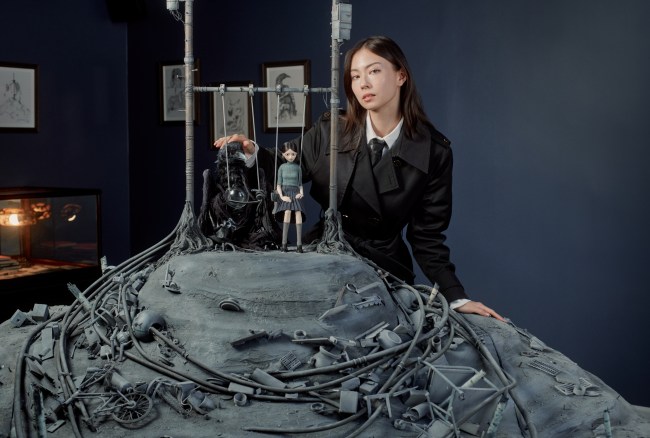
Shot in less than a month towards the end of 2024 (after an extensive pre-production process spearheaded by Studio Linguini’s Nick Cinelli), “The Dying World” begins with a scene right out of “The Matrix.” Astrid sits in a sterile office environment where she’s confronted by a message on her computer screen that reads: “There is an idea no one wants. it waits”.
It waits, but she doesn’t. The girl suddenly races through a doorway to a bedroom modeled after the one in Tsai’s childhood home, where she observes a crude model of a crow and clutches a vial of ink close to her chest. From there, Astrid is spirited out of her window and into the Dying World (a melancholic junkyard that can’t help but remind me of the Midgar slums in “Final Fantasy VII”), where she encounters a much larger and fully sentient version of the crow from her bedroom. She feeds the creature the ink, which compels it to ask her “how much longer do we have?,” the dialogue splayed across the screen like a silent movie intertitle. Not much longer, it turns out.
The short is elusive but exquisitely freighted with meaning, like a dream that Tsai has distilled through the eye of a microscope. Every detail is immaculate, every frame a blue-gray wonder that deserves to exist as a work of art unto itself. Tsai has translated her signature aesthetic into three dimensions with enormous care, the stimuli overload of her illustrated work suffused into a series of void-like spaces — as spare as they are dense with swallowed feeling — and discrete movements that seem all the more real for their heightened expressionism. The crow’s feathers bristle in the cold winds of time as it wonders how much time it has until it’s forgotten, and Astrid jolts upright out of a dilapidated swingset with a speed that swirls around Jim Williams’ transportive score to suggest a mix of guilt, uncertainty, and determination, as if suddenly remembering the lost responsibility that she has to herself. If Tsai fulfills her goal of extrapolating “The Dying World” into a feature-length project, the end result will surely be among the most stunning and ethereal of all stop-motion films.
 ‘The Dying World’
Citing Jane Schoenbrun’s “I Saw the TV Glow” as a recent touchstone for her own fascination with how media — either borrowed or created — can become a catalyst for self-understanding, Tsai described “The Dying World” as a product of her ongoing preoccupation with the life of the mind. “What I’m trying to understand now,” she said, “is the transactionality of ideas. In ‘The Dying World’ and any future iterations of this project, I really want to explore the cost of giving yourself up to an idea… an idea that you’ve perhaps given up too much of your life to… and how the regret and shame that such ideas can invite often exist in tandem with a desire to give more and more of yourself over to them. The fear of your own mortality in the face of something that only survives on the time that you devote to it.” In less than five minutes, “The Dying World” elegantly weighs the cost of investing in an idea against the cost of abandoning it, only to wonder if they might just balance out as equal in the end.
The film is also, of course, an effort to honor and reward the ideas that Tsai has invested so much of her being into over the last 10 years, and maybe even to apologize to them as well. It’s a chance to confer the same air of legitimacy upon them that Tsai has always denied herself, and to materially liberate the parts of herself she once tried to hide or wish away (an effort that Tsai radically expanded upon with her remarkable solo exhibition at the Hollywood Forever Cemetery, which scaled Astrid’s house into a life-sized piece that further blurred the boundaries between where Tsai ends and her inner life begins). Most of all, it’s a chance to push back against the nagging and intrusive notion that she’s never been a “real” anything because she’s a largely self-taught artist whose success hasn’t been achieved in “the right way — a chance to silence the lingering sense that she was somehow miscast in her own reality.
There is no “right way” to become anything, of course, least of all a stop-motion filmmaker. When it comes to a pursuit so laborious and masochistic, there can only be an infinite multitude of wrong ones. And yet, it’s for the same reason that stop-motion is also a uniquely effective tool for painting with time. In “The Dying World,” Tsai emphasizes the temporal dimension of her movie’s chosen form through setting, pace, and detail, all of which compel the viewer to consider the finite nature of creation in regards to the vastness of the oblivion that surrounds it (the short is structured so that individual shots can play on a loop forever, as they did as part of Tsai’s exhibition). “Real” and “unreal” lose their meaning as Tsai’s three-dimensional world paradoxically flattens everything into a shared plain of existence that makes no distinction between people and ideas. The only measure worth taking is that between that which has been forgotten, and that which is still waiting to be remembered.
“The world inside your head is the one you have to live in,” Tsai once said. “The Dying World” is an indelible self-portrait of an artist coming home.
“The Dying World” is available to stream on YouTube, and can also be watched below.