
Remember me




Each “Knives Out” film has a distinct — if distinctly arch — feel to it. There’s the woodsy New England setting for the first film and the bloated Billionaire Island for the second mystery from director Rian Johnson. But for the third entry, composer Nathan Johnson did not want to lean on traditional tropes of church music for “Wake Up Dead Man” — even though much of it takes place inside the bleakest parish church put to screen in some time.
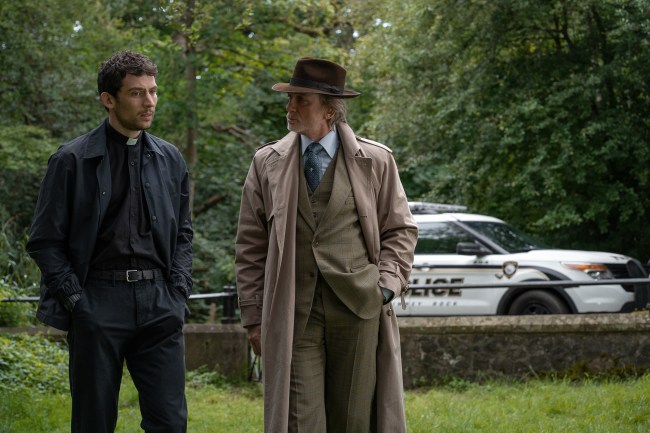
So Nathan Johnson, not so unlike Benoit Blanc (Daniel Craig), while investigating the seemingly impossible murder of Monsignor Jefferson Wicks (Josh Brolin), zagged instead of zigged. “Wake Up Dead Man” does feature a smattering of organ and a little bit of harp, which wouldn’t be out of place under the Gothic arches of Our Lady of Fortitude. But the bulk of the score is sneakier and subtler, leaning on tonal and thematic ideas rather than character-focused melodies. Johnson did this not only to subvert expectations but also to make the music an active force in the conflict at the heart of the story.


“This tug of war between ugliness and beauty, or between darkness and light [is] what this movie feels like to me,” Johnson told IndieWire. “In my mind, it makes me think of money and power in our world today. We see it in religion with this movie, and how that can be twisted really darkly or used really generously and beautifully. To me, that is the balancing act that the whole score plays with, and that this movie is playing with.”
It’s a balance that Johnson had to strike without being too obvious or intrusive when it comes to placing the score. Some of the scenes where the characters show themselves to be at their best (or their worst) happen without a music cue at all. Johnson said he needed almost a Wagnerian “Ring Cycle”-type theme, but one that could go from zero to 60 and then tuck back into the mystery again.
The way to achieve that, for Johnson, was to think about music as coming out of the desires for “Eve’s Apple” and the darkness of Wicks’ preaching, rather than specific characters or plot twists. It also came out of doing a lot of — and this is a technical term — really weird rhythmic stuff.
 ‘Wake Up Dead Man: A Knives Out Mystery’ Courtesy of Netflix
“[We used] what’s called a metric modulation where one rhythm and tempo is introduced on top of a completely different rhythm and tempo. They’re mathematically related, but the effect of it is you feel completely unsettled. It’s almost like conflicting messages,” Johnson said. “It almost represents this idea of hypocrisy and double-speak where people in power are telling us something that feels like it doesn’t ring true,” Johnson said.
The sense of unease, a lack of balance, in the “Wake Up Dead Man” score is designed to keep the viewer as in the dark as idealistic young Father Jud (Josh O’Connor) through the movie’s various twists and turns. Johnson wanted the audience to have that intuitive sense of wrongness and hypocrisy around Wicks and his acolytes, but not quite be able to place it — at least not until it’s too late.
No spoilers, but even in the climactic confrontation between Blanc, Jud, and Wicks’ “Chosen,” Johnson wanted the score to be almost an invisible hand, deepening the emotion of the moment without overwhelming it.
“We really took a while, watching [the scene] on the screen and then saying, like, ‘Let’s try the solo a little bit softer. Let’s try it one more time, but let’s take it down a little bit more.’ We were really fine-tuning that moment, so that there was a softness there,” Johnson said. “The last thing Rian wanted was for us to put a hat on a hat and really underline what everybody needs to be feeling [and] from the first time I saw the movie, I knew I needed to protect that moment. It really is the heart of the movie.”
 ‘Wake Up Dead Man: A Knives Out Mystery’ Courtesy of Netflix
The depth of the emotion that the music is tapping into is what Johnson thinks sets the score for “Wake Up Dead Man” apart from the previous “Knives Out” films. Every Benoit Blanc caper needs music that, well, capers. Johnson has gotten very good at designing music that can dip in and out of many different registers and emotional places while speaking to a large ensemble of characters.
“You’re shifting gears every 30 seconds as we reveal a new thing. Now we lean into the excitement, now we pull back,” Johnson said. “Those sort of end wrap-up moments always end up being the most challenging [to score]. But I think for this one, there is this added layer of deep empathy and emotion. It’s a really fun dance. It has to be a really subtle in and out, and that’s what I hope we keep getting better at.”
“Wake Up Dead Man: A Knives Out Mystery” is streaming on Netflix.
Comments (0)