
Remember me







Every year on Christmas Eve, my Dad settles down with a glass of mulled wine to watch A Christmas Carol. Every year I suggest we watch The Muppet version; every year I am refused. On goes the 1999 Patrick Stewart adaptation. Bah humbug, indeed.
I usually trust my father’s judgement. But on his choice of Christmas film, he is wrong. It is my deep-seated belief that The Muppet Christmas Carol – with its toe-tapping musical numbers, ensemble of rag-tag puppets, and a middle-aged Michael Cain – is the best adaptation of a Dickens novel ever made. And I will die on that hill.
Released in 1992, The Muppet Christmas Carol came into being following a conversation between the puppeteer Jim Henson’s son Brian and the talent agent Bill Haber, shortly after Henson’s death two years earlier. It was Haber’s belief that Dickens’s 1843 novella was the “greatest story of all time” and so, an idea was born. The seasoned Muppets writer, Jerry Juhl, was brought in to do the script. It was Juhl who decided to insert Charles Dickens into the film as the narrator, played of course, by the taxonomically ambiguous Great Gonzo.
Accompanied by Rizzo the Rat, Gonzo slips and slides through Scrooge’s story, complete with verbatim lines from Dickens’s text, with the occasional tweak to account for the film’s ultimate Muppetry (“The Marleys were dead, to begin with” for example, or at the film’s conclusion, “And Tiny Tim, who did not die!”).

Treat yourself or a friend this Christmas to a New Statesman subscription for just £2
One of the primary delights of Dickens’s original text is its witty narration, with its odd digressions and critiques. A Christmas Carol is of course also a gothic novella, and several adaptations have heavily indulged in the ghostly festive horror of Scrooge’s wakeful night. But unlike other films in the Christmas Carol cannon, The Muppets lean into Boz’s funnier side. Gonzo and Rizzo – these oddball American puppets – frequently get sidetracked and distracted by a ridiculous incident, or unfortunate scrape. All the while, the film remains faithful to its precious source material.
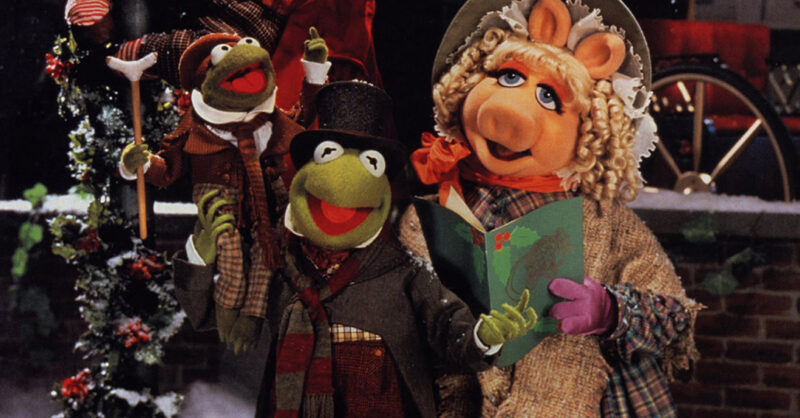
The joy of Dickens comes from his idiosyncratic characters; the caricatures of the waifs and strays of Victorian London. The Muppets too are beloved because they are caricatures. They slip nicely into the assortment of personalities Scrooge meets as he is guided through his past, present and future by three errant spirits. Fozzie Bear, best known in the Muppets for his stand-up comedy, becomes Fozziwig (Fezziwig in the novel) and his usual balcony hecklers, Statler and Waldorf, become Jacob and Robert Marley. The long-suffering Kermit the Frog is Bob Cratchit, while Miss Piggy – his flamboyant, over-protective girlfriend – is Cratchit’s wife. Their performance is as ridiculous as it is merry, and full of the eccentricities of Dickens.
A cast of puppets performing an almost 200-year-old story may not scream high-brow literary adaptation. But The Muppet Christmas Carol deserves critical acclaim. If only I could convince my Dad.
[Further reading: Tom Fletcher: I hope my Paddington songs are bigger than McFly]
Content from our partnersRelated

Comments (0)