
Remember me










Alongside its now annual update of features for the Apple Fitness+ health program, Apple has now also announced how exercise with Apple Watch helps users avoid "Quitter's Day."
Apple Fitness+ gets new workout videos every week, but each January it adds new series, or new features. It's always about using the service and Apple Watch to improve your health, but this time Apple claims to have proof it works.
"Many people give up their New Year's fitness resolutions by the second Friday in January, also known as Quitter's Day," said the company in a statement. "A new analysis of data contributed by approximately 100,000 participants in the Apple Heart and Movement Study over four years identified participants with Apple Watch consistently keep up their exercise levels through Quitter's Day and beyond."
Specifically, Apple claims that in the first two weeks of January over each of the last four years, over 60% of Apple Watch users "increased their daily exercise minutes by over 10%." That's not as great a jump as it appears, since Apple also says that exercise minutes decline every November and December.
However, the study shows more. It says that of the people who increased their exercise minutes for the first two weeks of January, nearly 80% kept it up to the end of the month.
Apple further says that of that group, 90% also maintained "elevated levels through February and March."
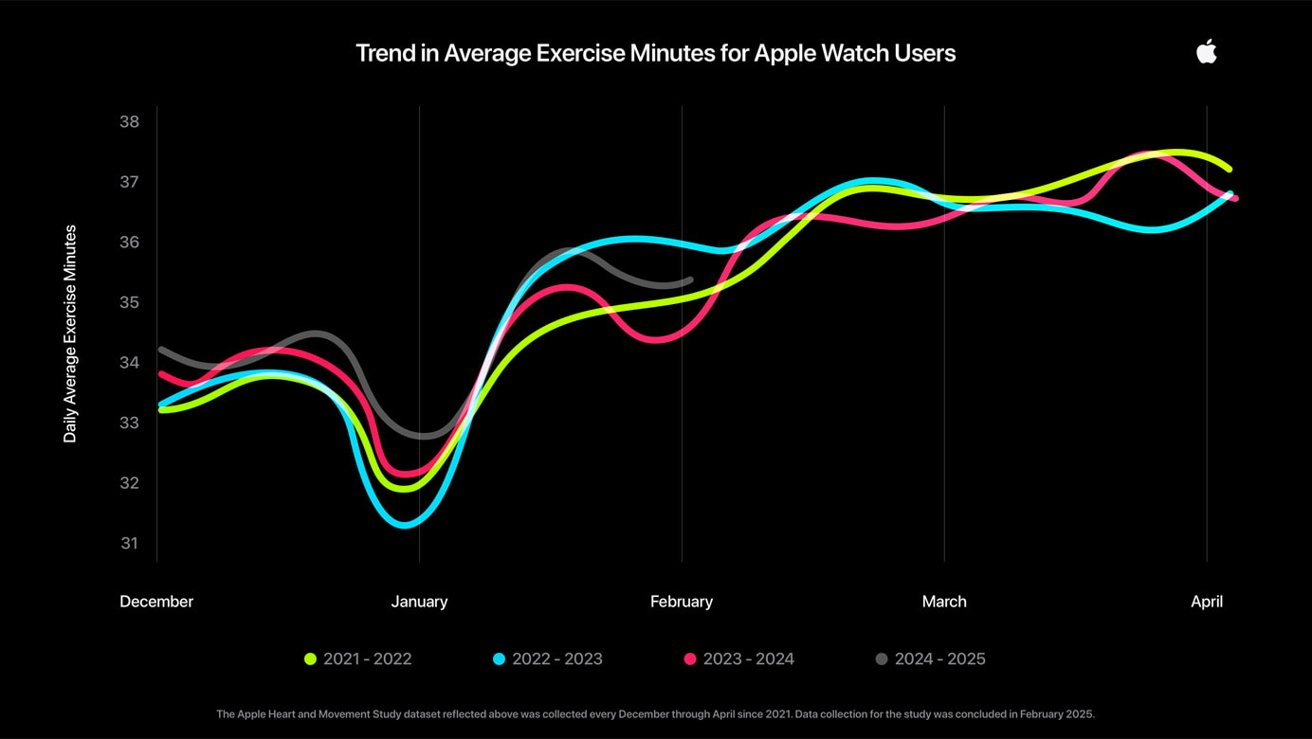
Apple's chart of average daily exercise minutes in its survey — image credit: Apple
No more specific figures are given, so this is a percentage of a percentage of a percentage. However, Apple has released a chart which appears to show a significant drop at the end of each December. Given that the default exercise minute goal for Apple Watch is 30 minutes, it looks as if all 100,000 users studied began with more than the usual anyway. The lowest point is January 2022, which is just over 31 minutes, for instance.
Then by halfway through January each year, the chart shows the average being up to about 36 minutes per day. It does then drop off, as Apple says, but still doesn't go below 34 daily minutes.
The respondents were self-selecting, though, which means they are likely to be people who exercise more than the average anyway.
Adding to Apple Watch and Apple Fitness+Apple has also announced that this year's major additions to Apple Watch and Apple Fitness+ include:
New Artist Spotlight workouts New Time to Walk episodes New January award for closing all Activity rings for seven days in a row "Quit Quitting" challenge with the Strava app Make Your Fitness Comeback exercise program Build a Yoga Habit program Back-to-Back Strength and HIT program Strength Basics programMusic and guestsApple Fitness+ is beginning 2026 with workouts to the music of Grammy Award-winning singer/songwriter KAROL G. Then in February, it will launch more with the Bad Bunny Artist Spotlight.

The new "Back to Strength" workout series on Apple Fitness+ — image credit: Apple
The "Time to Walk" series of motivational talks with celebrities, has a new lineup. Starting shortly there will be actor/producer Penn Badgley, and Spice Girls' Mel B.
Later in 2026, actor Michelle Monaghan will narrate a Time to Walk edition too.
Apple Fitness+ is a paid workout subscription service that costs $9.99 per month or $79.99 per year. It is also included with the Premier tier of the Apple One subscription bundle.