
Remember me







As sure as night follows day, the arrival of snow in Britain leads to an inevitable flurry of pictures and videos of drivers trapped in snow or careening into parked cars.
Storm Goretti, a deep area of low pressure, has been blown in from northern France bringing it with it freezing cold weather, disruptive winds, heavy rain and, yes - snow and ice. And, as ever, Britain's drivers can't cope.
Video footage earlier this week showed a car in Conwy, North Wales, careening down a hill and into a parked car, the driver unable to stop. In Kent, a bus carrying school children skidded off the road into a ditch - fortunately, without any injuries.
With a rare red warning issued for wind and more snow ahead tonight, enough is enough, we say. It's time for some advice on how to drive on snow - from the people who do it a living.
Rally drivers are among some of the most skilled pilots in the world, experts at navigating powerful road-legal cars across tarmac, gravel, dirt and snow alike on public roads and closed, high-speed 'special stages' which have no speed limits.
It turns out there's more in common between flying through the forests of Sweden at 100mph and navigating your way out of a snow-filled side street than you might think.
Three drivers stepped up to help: Swedish World Rally Championship (WRC) driver and WRC2 champion Oliver Solberg, two-time British champion Jonny Milner and motoring journalist Nik Berg, who has rallied across continents and raced on ice.
While their advice is just that - not to be taken as professional tuition - these tips could help Brits in a jam if they find themselves in a tricky spot amidst the cold snap.

A car got into trouble as it skittered out of control on January 2 in Buckinghamshire - eventually bouncing off the white Audi at the side of the road

Drivers are being warned to take particular care on Britain's wintry roads (pictured: a bus which hit black ice and skidded off the road in Ashford, Kent. No injuries were reported)

Locals in Glenmore, in the Scottish Highlands, dig their cars out from snowdrifts. One expert has an alternative idea if you get stuck
Why driving on snow and ice is so differentMotoring journalist Berg, who ru explains, simply: 'The difference? For one thing, there's no friction on ice. Put your hand on ice and it slips. Everything slips. It's why people skid.'
Compacted snow and frictionless ice are the antithesis of British tarmac: tyres don't get up to temperature, leaving the rubber hard and refusing to find grip.
Without grip, tyres will just spin, meaning normal driving manoeuvres like accelerating, braking and steering can't be done as they would in dry weather.
Milner, who piloted a Ford Escort through Sweden in the 1990s and battled snow in Colorado in the early 2000s, says: 'It's literally chalk and cheese, it's that different.
'I know cars have got traction control, and it's better than it ever was in the snow and ice, but the videos that you see are people that unfortunately haven't got a clue.
'They've never been sideways. They've never been locked up on the snow and ice before.'
Many accidents happen when drivers underestimate the difference in conditions - and with fewer wintry days than in the past, there's less chance to practice.
So how do they overcome that?
Fit winter tyresThe experts are firm: the single best thing British drivers can do to tackle snow and ice is fit winter tyres to their cars. They are a legal requirement in several European countries in winter - including in Oliver Solberg's native Sweden.
'Tip one: put on your winter tyres - it's a good start,' he says simply, in a clip filmed exclusively for the Daily Mail on the French Riviera as he tests his 2026 rally car: a snarling Toyota Yaris GR with over 300 horsepower under the bonnet.

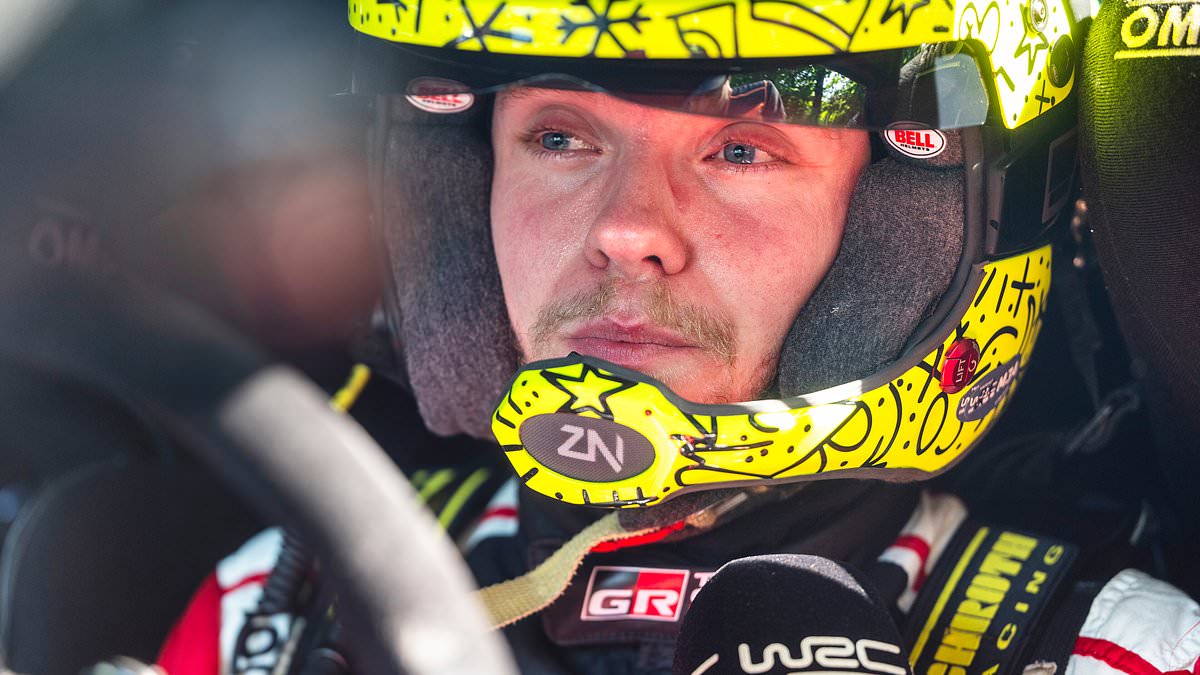
Norwegian-born Swedish rally driver Oliver Solberg has given the Daily Mail top tips on how to drive in snow

Jonny Milner is a two-time British rally champion (seen here in the Rogert Albert Clark Rally last November)

Nik Berg (left) drove with motoring PR executive Tim Bampton from Sweden to Jordan in a Toyota Prius in 2002
There is no law for winter tyres in the UK - and only one in 10 British drivers fits them. Jonny Milner, who now runs the Merlin International garage in the Yorkshire Wolds, says people are soon converted.
'One patch of ice is all it takes', he says, to be convinced of the difference.
'I'm amazed how many customers come in and go: "Absolutely worthwhile doing that, Jonny, it saved me again",' Milner says.
Winter tyres have wider grooves between the treads designed to chew up snow and siping - additional slits in the rubber - designed to improve grip on ice. They're also made of softer rubber specifically designed to work below 7C.
Motoring journalist Nik Berg says: 'It's the best thing you can do to drive safely in winter.'
Nowhere to keep your summer tyres? No problem. Many garages across the UK, including Milner's, offer a 'tyre hotel' service, storing your summer tyres until the mercury rises.
'I've probably got 60 customers that do this and completely agree with changing the tyres when it starts to be that bit colder,' he adds.
Milner is against the halfway house of 'all-season' tyres, too: 'You're never actually, ever on the right tyre at the right time. You're only halfway there with an all-season.'
Go (and stop) gentlyYou can't drive on snow and ice as you do in the dry. Instead, take it easy, take it slow, and take it one step at a time, our experts say.
That means accelerating with a feather-light touch to prevent the wheels spinning, applying gentle steering and braking both gently and sooner, as the stopping distance can be as much as 10 times greater than on dry surfaces in the worst conditions.
WRC driver Oliver says: 'Remember that junctions and roundabouts, where people brake and make a lot of friction, are always much more slippery.
'Keep distance to the driver in front, and go a little slower.'

Oliver Solberg proves his credentials in a Toyota GR Yaris Rally2 during the World Rally Championship Sweden last year - which he won in his category

Jonny Milner snapped up two British Rally Championship titles in a Toyota Corolla WRC (pictured)

Nik Berg is seen putting his Toyota Prius rally car through its paces. Together with his co-driver he covered 5,000 miles driving from Sweden to Jordan
Milner says: 'Literally, do everything in slow motion. Don't stamp on the brakes really hard, because you're going to lock up.
'The rule of thumb I always use is just get early on the brakes, earlier than normal, and gently, and just bring the car to a stop.'
'The more aggressive you are with the accelerator, brakes and steering, the more likely you are to lose grip,' Berg warns.
It's also recommended to drive in as high a gear as the engine will allow: this reduces the risk of wheelspin. In an electric car? Check if your car has a 'snow' mode.
Don't place all of your trust in your safety systems, however: as advanced as traction control and anti-lock braking (ABS) systems are now, it's better to keep control of a car rather than losing it and having to fight back.
Milner adds: 'If you simply stand on the brakes in the snow, you'll find that the car just kicks away through the ABS and you hardly slow down at all. Gently touch the brakes, and you'll be amazed how much quicker you get the car stopped.'
The smooth approach applies to cutting through Swedish snowdrifts in a 500bhp rally car just as much as pulling out of your driveway, he adds.
'In America, where we were on standard road car snow tyres, we were at speeds in excess of 160 miles an hour, and it was the same: you just have to be mindful.
'You got to brake early, and you just got to do it really smooth, really, you know, really gentle, no erratic movements.'

A lorry slid off the road and into an industrial estate on Glaisdale Drive in Nottingham today

The Streetly Gate car park in Sutton Coldfield became an ice rink. A situation like this, our experts say, would demand delicate driving
If the car skids, don't panicEven the best drivers will occasionally be caught out by black ice, or a rogue patch of snow. If this happens, the main thing to do is not panic - guiding the car, calmly, out of harm's way.
Loss of grip normally happens in one of two ways: understeer, when the car's front wheels fail to turn as expected; and oversteer, when the car turns too much, often accompanied by the rear swinging out.
Nik Berg says: 'With understeer, all you can do is gently ease off the accelerator and wait for the grip to come back, which you'll feel through the steering.'
Trying to steer into it, he says, is 'the worst thing you can do' - straightening the steering wheel will give the tyres a chance to find grip too.
Berg adds: 'Look at where you want to go - and hope you get the grip back in time.'
In the event of oversteer, Berg says people should avoid trying to correct the car back into a straight line. Instead, steer into the direction of the skid.
'If it goes out to the left, steer to the left, and vice versa. The key is not to be too aggressive - that's when you see accidents when the car snaps the other way and spins out of control.'
If the worst happens and the car isn't stopping, Jonny Milner suggests checking your environment in case you can find somewhere to ditch the car.
Milner: 'If you're in a position where you actually think, "I'm going too fast, I can't get stopped, I'm on ice", put one of the wheels onto grass at the side of the road if there is some grass. or take it off the icy bit and put it on a bit of snow.
'You'd be amazed how much more grip there is there just to get you slowed down.'
Should you get stuck, Berg has a handy tip to try, if safe: 'If you don’t have a shovel to dig yourself out - who does? - you can use your floor mats to get you unstuck.
'Place them under the driven wheels and gently accelerate. I did this at Eau Rouge [a corner at Spa-Francorchamps circuit in Belgium] in a Range Rover Sport once.'

A bus came off the road in Liverpool, taking out a marble pillar, after it is thought it hit a patch of ice last Tuesday

Jonny Milner (right) soaks his co-driver Nicky Beech with champagne after winning the 2002 Rally Wales. He told the Mail it's important to 'respect the ice'
Overall, respect the iceIt can be easy to forget that you're on a loose surface after a few minutes of incident-free driving - and Jonny Milner has seen it happen.
'The worst thing people do on a hill, get halfway up the hill and then gun the throttle, the thing just spins up, and then they stopped. That's it. They can't go forward. They can't really go backwards.
'They stand on the brakes and the whole thing boggles itself backwards down the hill into cars behind. It's just down to inexperience.
'It's just having a bit of respect: respect for the ice, respect for the road, and doing everything at half the speed.'
Rally drivers themselves practice ice driving out of season, heading out to Scandinavia to race in snow and on frozen lakes.
Closer to home, skid pans can offer a similar experience. Milner thinks they should form part of the mandatory driving test, and recommends them to anyone keen to improve their winter driving skills.
But Berg also recommends that anyone driving in winter asks themselves a vital question: do I really need to go out?
'If it's absolutely necessary, plan a route on main roads because they're more likely to be gritted, and drive as smoothly as possible with every input.
'Also, make sure to thoroughly de-ice your car before setting out and clear snow from the roof as well. It could slide off under braking or acceleration causing problems for you or the car behind.'
Oliver Solberg adds: 'Most importantly, stay safe, be calm, and drive carefully.'