
Remember me







Does John Swinney have a political death wish? I ask because his government’s refusal to change its prison policy following last year’s Supreme Court ruling on sex suggests he is flirting with electoral danger.
Let’s remind ourselves of the law. On April 16, 2025, in a case brought by campaign group For Women Scotland (FWS), the UK’s highest court ruled that, for the purposes of the Equality Act 2010, the terms “sex,” “man,” and “woman” refer to biological sex and not gender identity or sex acquired via a gender recognition certificate (GRC). The ruling also clarified how sex-segregated services and spaces are to be understood under equality law.
So far, so unequivocal. The First Minister himself on April 24 last year told MSPs that he accepted the Supreme Court ruling “unreservedly”, adding: “I have set out that the Scottish Government accepts the judgment of the Supreme Court, which ruled that, in the Equality Act 2010, a woman is defined by biological sex.”
And only last month, in response to a question about prisons policy, Justice Secretary Angela Constance told the Scottish Parliament: “The government has clearly stated that it accepts the ruling from the Supreme Court…”

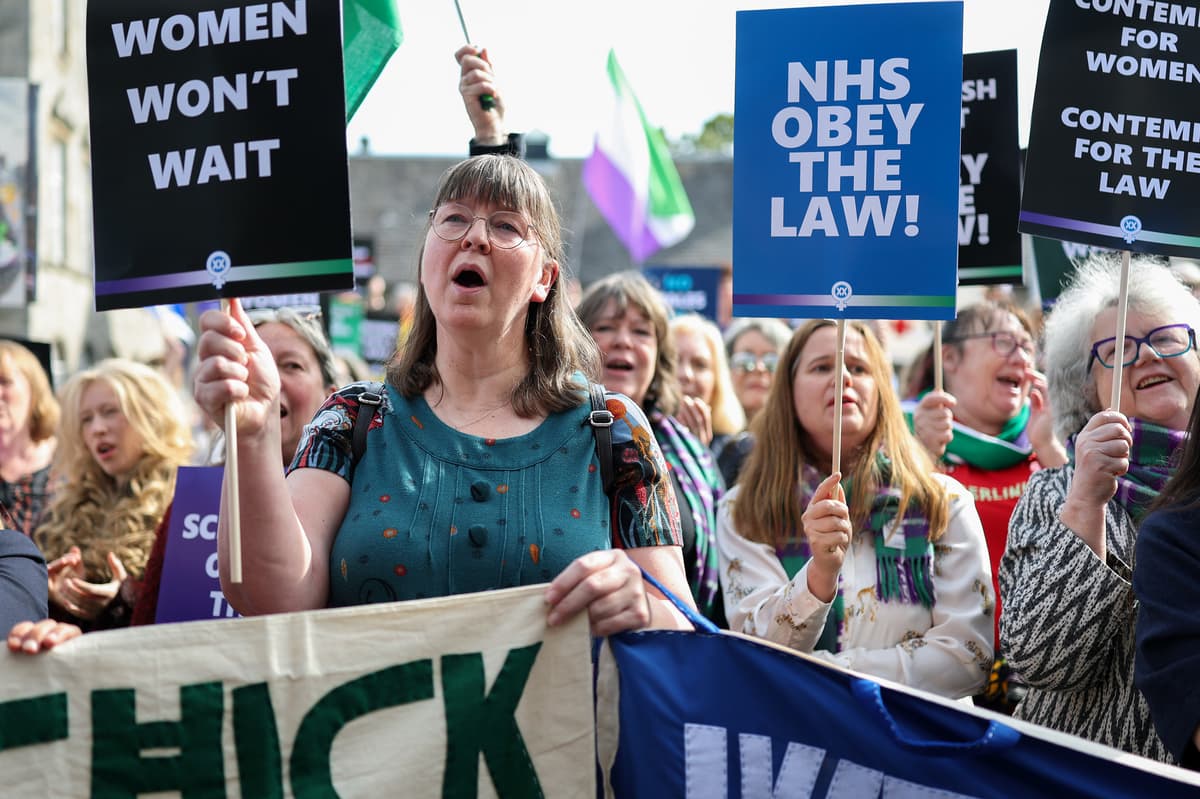
 Protesters call on the Scottish Government to enforce the Supreme Court ruling on gender outside the Scottish Parliament (Picture: Jeff J Mitchell) | Getty Images
Clear defiance of the rules
It seems both Swinney and his hapless Justice Secretary spoke with forked tongue, as it emerged this week that the Scottish Government has no intention of accepting the Supreme Court ruling in relation to its prisons policy, which in clear defiance of the rules, still allows biological males to serve their sentences in the female estate, following a risk assessment.
Not only is the government defending a fresh legal case brought by FWS by arguing that if the current rules are changed, it would be in breach of the European Convention on Human Rights (ECHR), but in November – just weeks before Constance told MSPs she accepted the Supreme Court ruling – the government asked the court to issue a ‘declaration of incompatibility’ in the event it loses the judicial review.
This legal term may seem innocuous, but the ‘declaration’ sought by the Scottish Government is potentially explosive. If it loses against FWS, the government wants Scotland’s top civil court to declare that UK law has breached the human rights of trans prisoners, a move that could result in the 2010 Equality Act itself coming under pressure.
Far from accepting the Supreme Court ruling on sex “unreservedly”, as the First Minister told parliament, his government is doing all it can to blow it up, as it is with the UK’s equalities legislation.
Still a biological male
The question that springs to mind is why? Why are John Swinney and Angela Constance prepared to enter into explosive legal proceedings to defend the human rights of a male offender who identifies as a woman, rather than stand up for the human rights of a female prisoner, who, by the way, is entitled under Scots law to separate accommodation. Rule 126 (1) of the Scottish Prison Rules 2011 states clearly: “Female prisoners must not share the same accommodation as male prisoners.”
A male prisoner who identifies as a woman may wear a wig and a dress. He may even take sex hormones, or have a gender recognition certificate, but he is still a biological male. Research consistently shows that women in prison have complex needs linked to trauma, substance abuse and mental health issues, and a Glasgow University study revealed that almost all the women prisoners interviewed (95 per cent) reported a history of sexual abuse.
It is a fact of life that the overwhelming majority of the women in Scotland’s prisons are vulnerable and in need of protection. The individual rights of a male prisoner, regardless of how he identifies, must surely be seen in the context of the safety and wellbeing of the female prison population.
As Michael Foran, associate professor of law at the University of Oxford, argues, there is no legal scope to allow men who identify as women into a female prison as it would no longer be a single-sex service. He said recently: “… having a mixed-sex prison would almost certainly be discriminatory to women, due to their rights around safety, privacy and dignity.”
‘Rapist’ is not the third sex
It is three years since Nicola Sturgeon’s infamous press conference when she invented a third sex: rapist. Pressed by Tom Gordon, one of Scotland’s leading political reporters, on whether Isla Bryson (Adam Graham), a double rapist who had been initially housed in a female prison following his conviction, was a woman, she said: "She [Bryson] regards herself as a woman. I regard the individual as a rapist.” A few days later, she resigned as First Minister.
Her confusion was echoed by the Scottish Greens co-leader and John Swinney’s potential coalition partner, Ross Greer, earlier this week. During an interview with the BBC’s Nick Robinson, he repeatedly refused to say whether he believed Isla Bryson was a man or a woman. “Isla Bryson is a rapist,” insisted Greer.
In the run-up to the May elections, which promise to be the most febrile in Holyrood’s history, John Swinney is in danger of his own Isla Bryson moment. Following that controversy, the rules were tightened so that a prisoner with a history of violence against women is not eligible to be considered for admission to a women’s prison “unless there is compelling evidence that they do not present an unacceptable risk of harm to those in the women's prison”.
By taking court action to protect a biological male’s ‘human right’ to be housed in a female prison, John Swinney is standing up for the demands of a handful of men against the legal and human rights of women, and flying in the face of public opinion. The First Minister may be about to discover that defending the indefensible is not a vote-winning strategy.