NPR's Steve Inskeep asks Youseph Yazdi, a professor at Johns Hopkins School of Medicine, about his recent visit to Iran, where thousands have been killed in anti-government protests.
STEVE INSKEEP, HOST:
Youseph Yazdi is just back from Iran, and he has a rare first-person account of the protests sweeping that country. Yazdi is a professor at Johns Hopkins University and the son of Iranian parents. As a frequent visitor to Iran, he's seen many waves of protest. As long ago as 2009, he was on this program, talking about the wave of demonstrations back then.
I went back and - just now and listened to the interview. That was a very different time.
YOUSEPH YAZDI: Yes, yes, but in some ways, similar.
INSKEEP: I was having the same thought, even as you spoke those words. I want to play a little clip from that 2009 interview.
(SOUNDBITE OF ARCHIVED NPR CONTENT)
YAZDI: The fact that people are actually expressing their anger and their frustration with the situation they're in is a very positive sign. It shows that the people have reached a point where they've developed a level of maturity and a level of fearlessness that they're willing to really stand up for their rights.
INSKEEP: That was your feeling in 2009. What do you think about when you hear that sound today?
YAZDI: Wow. Such a hopeful time. And now a lot of that has turned to just absolute anger, indignation and almost revulsion. So the feelings have grown a lot stronger over the last 20 years and - because nothing has - you know, the regime has just failed in every way possible.
INSKEEP: Youseph Yazdi visited Iran over the holidays to check on his mother. She lives in Tehran. He quickly felt the country's economic crisis. The currency value slid to a record low, and inflation remained high. His mother's caretaker said people had stopped buying milk to protest the price, and then more serious protests spread into the streets.
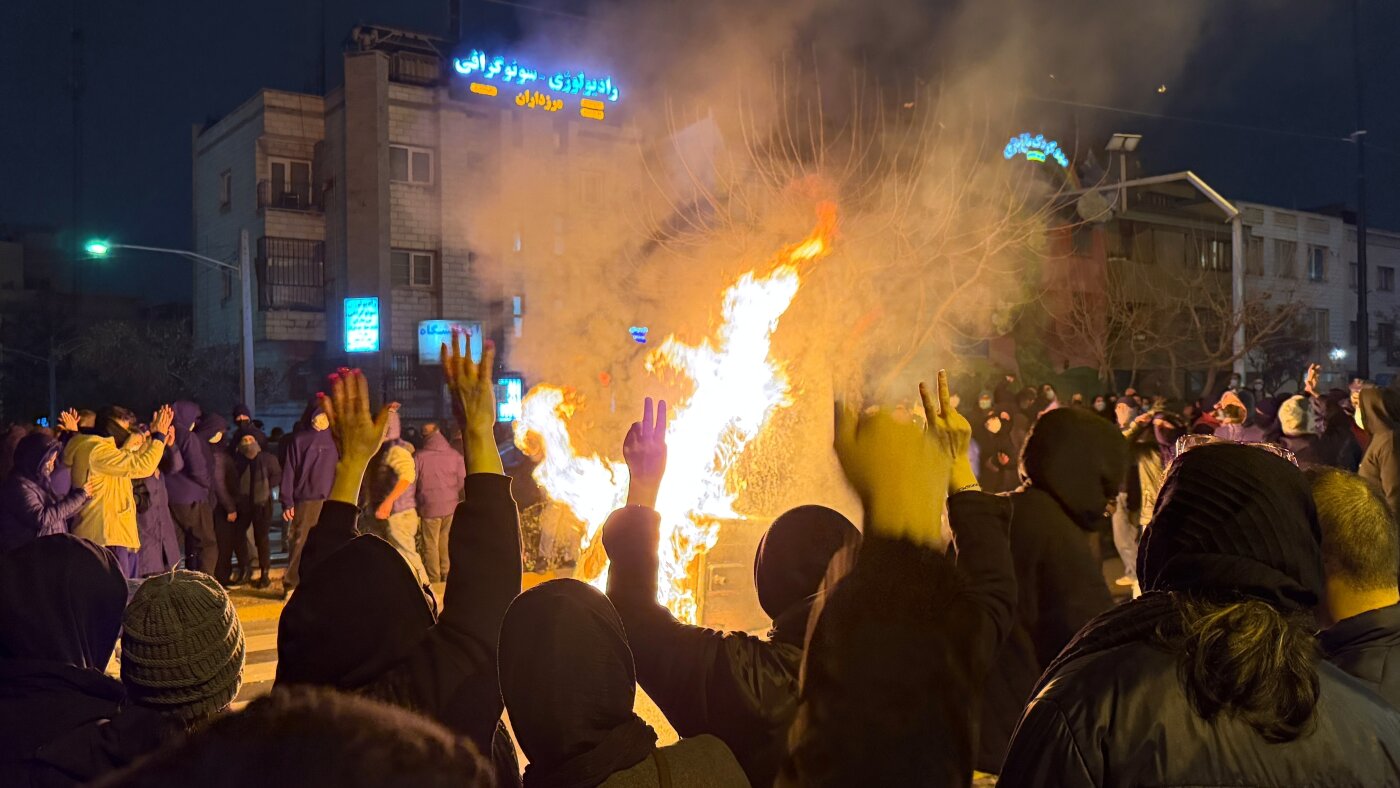
YAZDI: In the neighborhood where my mother's house is, there is a large square there, and a large group were gathering there. I could hear them, and I went out at 8 p.m. on Thursday night to join them and to observe.
INSKEEP: What did you see?
YAZDI: It was about two, 300 young people, mainly, a few older folks like me and then mostly younger people. And they're very peaceful, chanting slogans, mostly, you know, death to the dictator. And there were a few little more mission-driven people, I would say, maybe five people in that crowd that really were trying to lead chants facing the riot police, and they pulled some pavers up from the sidewalk and started throwing him at the riot police, and then the riot police responded with tear gas.
(SOUNDBITE OF ARCHIVED RECORDING)
UNIDENTIFIED PEOPLE: (Yelling in non-English language.)
INSKEEP: You're describing this all very calmly, but it must have been a very tense moment.
YAZDI: It was. It was. They - you know, they first shined the laser - you know, green laser pointers or sights on us. And then, like, one young lady standing next to me was - the laser landed on her shirt, and she was - she thought she had been shot or something. She was freaking out. So that - it was a matter of a lot of fear because these are young people - incredibly fierce, brave, strong, but very naive to this sort of thing, and they're no match for either trained riot police or trained agitators who want to escalate the violence.
INSKEEP: And what weapons or tools do the riot police use when they responded, other than the lasers?
YAZDI: They have batons, and they have tear gas launchers, is their main thing. They have these, you know, CS gas, tear gas canister launchers, and they could fire them hundreds of feet. So they use those a lot. And one of the protesters picked up the tear gas and threw it back. And it's hot because it has projectile, you know, stuff in it like a firecracker to make it fly in the air. So he bravely went up and did that.
INSKEEP: Did you get a face full of this?
YAZDI: Yes, I did. I did. I made the mistake of breathing a bit through my mouth, which you - kids, lesson learned. Never breathe through your mouth if you're experiencing tear gas attack 'cause your throat will burn for days. It's still kind of irritating.
INSKEEP: Having witnessed so many protests before that the current government endured, did you come away feeling that the current government was in any particular danger of falling?
YAZDI: I - you know, I - it seemed like a government that has run out of steam. I couldn't find anybody that has anything nice to say about the way things are being run, whether they're pro-government or anti-government. But the government does have some tools in its arsenal, and one of those is I think they benefit from the escalation of violence. For example, in one of the squares in the city near my mother's house, a major very beautiful mosque was burned down. The square was trashed, and the government just plays those video clips ad nauseam on the state media.
You know, there's a video clip of somebody setting a riot cop on fire, throwing stones. The escalation of violence really plays into their hands, and the government benefits from that because if the protests were nonviolent, I think the crowds would be a hundred times larger, a thousand times larger. But people are hesitant. And I think the hard-liners know that they have pretty much the monopoly on street violence, and they can win that battle. But if it's a nonviolent protest, the government will lose. The power will be more in the hands of the people.
INSKEEP: I'm fascinated by this detail. You clearly seem to have your heart on the side of the protesters, but you're saying you did not agree with the tactics of those who pried up the stones and threw them at police and caused that to become a more and more violent moment.
YAZDI: Yeah. It absolutely does not help. I mean, it's one thing to sit in the United States and encourage Trump or Netanyahu to drop bombs, you know, encourage sanctions. It's another thing when you live in that country and you're going to be the one on the receiving end of the economic troubles or the bombs and you're going to be the collateral damage. I think it's a totally different dynamic. That's why I strongly believe that what Americans should do and the U.S. government should do is support those brave people there in the country who are in prison. There's plenty of leaders, including one who won a Nobel Peace Prize a couple of years ago, who are there bravely speaking out, presenting practical solutions. And they're the ones who I think we should be supporting because people on the outside, there's a natural tendency that if you're far away from the conflict, to just be a little bit higher level of tolerance for violence when you're not the ones getting bombed.
INSKEEP: Youseph Yazdi, thanks very much for your insights. Really appreciate it.
YAZDI: You're quite welcome.
INSKEEP: Youseph Yazdi, Johns Hopkins professor and frequent visitor to Iran. The protest he experienced was on Thursday night, just as a crackdown intensified and the government choked off the internet. Despite that effort at a blackout, a U.S.-based group called the Human Rights Activists News Agency has accumulated information about casualties, and the group says more than 2,400 protesters have been killed in recent days. NPR has not been able to independently verify those numbers.
Copyright © 2026 NPR. All rights reserved. Visit our website terms of use and permissions pages at www.npr.org for further information.
Accuracy and availability of NPR transcripts may vary. Transcript text may be revised to correct errors or match updates to audio. Audio on npr.org may be edited after its original broadcast or publication. The authoritative record of NPR’s programming is the audio record.