There’s lots of talk about “spheres of influence” these days, largely in response to the latest U.S. National Security Strategy, the Trump regime’s recent actions in Venezuela, and its renewed efforts to take over Greenland. The idea that great powers should exercise unchallenged sway in their own “neighborhoods” is also consistent with U.S. President Donald Trump’s belief that strong leaders of strong countries should run the world and cut deals with each other, without worrying about international law, universal moral principles, or other idealistic notions.
Unfortunately, both those who embrace spheres of influence and those who oppose them may not fully grasp their place in world politics. In the real world, they are neither an outmoded practice that can be eliminated nor an effective way to minimize great-power competition. On the contrary, spheres of influence are both an inevitable result of international anarchy and an imperfect solution to the competitive incentives that anarchy creates.
Most objections to the idea of a great-power sphere of influence are normative: Critics maintain that such arrangements are inherently unjust. In a world of sovereign states, where each enjoys equal status under international law (see Article 2 of the U.N. Charter, for example), it is inherently wrong for powerful states to exercise significant control over their weaker neighbors through economic or military coercion. For example, even those who recognize that Russia might have reason to be concerned by Ukraine’s drift toward NATO (including the possibility of full membership at some point in the future) insist that such a decision should be solely up to NATO and Kyiv and not subject to a Russian veto. In this view, it would be equally illegitimate for China to pressure Asian countries to distance themselves from the United States or Taiwan, or for Washington to declare (as the recent National Security Strategy does) that it will “deny non-Hemispheric competitors the ability to position forces or other threatening capabilities, or to own or control strategically vital assets, in our Hemisphere.” For these critics, all states should be free to align as they see fit, and powerful neighbors have no right to tell them whom they can trade with, obtain investment from, or cooperate with militarily.´
It would be nice to live in such a norm-governed world, but this vision isn’t remotely realistic. Spheres of influence are a recurring feature of international politics, and there is little chance of eliminating them completely. One need not embrace White House aide Stephen Miller’s ignorant bombast about supposedly “iron laws” of world politics to recognize that powerful states are invariably sensitive to what is going on near their own territory, and they will use the power at their disposal to shape their surroundings in ways they believe will enhance their security.
Spheres of influence arise for three obvious reasons. First, great powers typically have a greater interest in their immediate surroundings than distant powers do, and they are more willing to run risks and incur costs to prevent adverse trends from gaining momentum close to home than distant powers are in supporting these same trends. As discussed below, although distant powers may have important interests in an area close to another great power, that interest will usually be smaller and their willingness to sacrifice significant resources to defend them will usually be lower. As I argued way back in 2015, this is one reason why efforts to incorporate Ukraine into the Western liberal sphere were risky: Russia cared more than we did (though not more than most Ukrainians) and would therefore be willing to escalate in ways we were not. The same logic explains why backing from Russia, China, or Iran is of little help to Latin American states when the United States is really roused. That fact doesn’t make great-power interference legitimate or moral, but it does help you understand why it happens.
Second, trade still tends to be concentrated regionally, even in an era of globalization, as the European Union, the U.S.-Mexico-Canada trade arrangements, and China’s economic footprint in East Asia all reveal. As a result, the largest economic power within a region typically has considerable (though not infinite) leverage over its neighbors’ choices, because they have to consider the economic consequences of taking steps that might lead the dominant power to deny them access to its markets or to restrict a key export.
Third, because it is easier to project military power closer to home (and harder for distant powers to come to a faraway country’s aid), great powers can more credibly threaten military action against defiant neighbors. For example, it would be well-nigh impossible for Russia to transport and sustain an army of more than half a million soldiers in Latin America, the Middle East, or Africa, but it can and has deployed that many troops in neighboring Ukraine (albeit not without difficulty).
Awareness that spheres of influence are a frequent occurrence in world politics has led some observers to see them as a potentially useful way to organize the world and reduce great-power rivalry. If the great powers acknowledged the others’ respective spheres and agreed to respect them, then potential conflicts of interest would supposedly be reduced, and each great power would be more secure. In theory, once the great powers agreed on where the boundaries lie and committed themselves to “live and let live” within their respective spheres, each would be free to manage its own region as it wanted, and potential points of friction would diminish.
History suggests that we view this prescription with some skepticism. A proponent might point to the Cold War division of Europe as a successful illustration of this approach: After centuries of recurring warfare, Europe was pacified because the United States and the Soviet Union each dominated half of the continent, deterred each other, and kept their clients in line. Because everyone knew that a direct clash between NATO and the Warsaw Pact would be immeasurably destructive, both sides were wary of interfering too much in the other’s sphere.
This example is not as persuasive as it might first appear, however. Not only was Europe the site of recurring crises during the 1950s (and especially before the Berlin Wall was built), but peace rested in good part on the fact that two nuclear-armed superpowers stared each other down across the Iron Curtain. The division of Europe into two rival spheres may have made open war less likely, but the Cold War competition remained intense, and neither side fully accepted the other’s “right” to exercise predominant influence in its sphere. If Americans had done so, President Ronald Reagan would never have given a speech in Berlin telling Soviet leaders to “tear down this wall.”
Furthermore, the earlier history of great-power empires reveals the difficulty of trying to ensure peace by mutual agreement on who gets to exercise dominant influence over different areas. Although the various colonial powers acknowledged the right to create overseas empires and sometimes reached temporary agreements on which parts of the world belonged to whom, these arrangements remained fluid and were sometimes hotly contested. Britain and France fought over who would have dominant influence in North America (in the long run, it was neither) and clashed repeatedly over their respective colonial claims in Africa, the Middle East, South Asia, and the Pacific. If history is any guide, therefore, delineating each great power’s respective sphere by drawing some lines on a map is not going to resolve matters for very long.
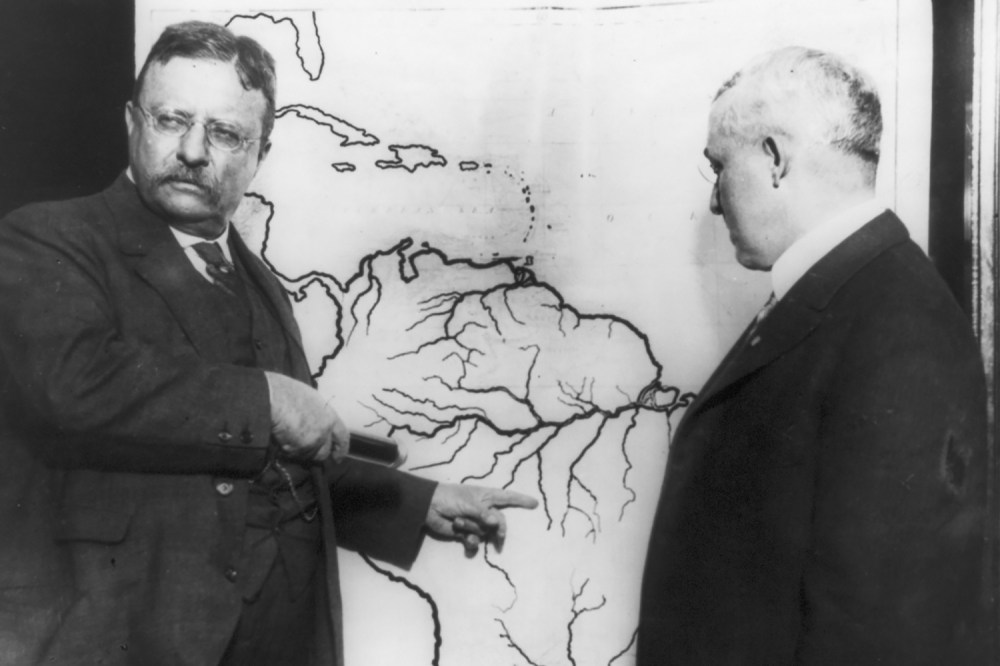
What about today? On the one hand, great powers do have interests, especially close to their home territory, and it would be foolish to ignore this when formulating one’s own strategies. With the benefit of hindsight, U.S. leaders should have heeded the many voices who warned that trying to reshape political alignments in areas adjacent to the former Soviet Union was going to backfire, and asked themselves how they would likely react if some distant great power was doing something similar near the continental United States. To be sensitive to others’ sensitivities isn’t moral abnegation; it’s just prudent statecraft.
But on the other hand, trying to pacify world politics by embracing a spheres-of-influence model won’t bring great-power competition to an end. Here’s why.
For starters, although the great powers do have considerable economic leverage within their own regions, the world economy today is heavily and probably irreversibly globalized, and standards of living around the world depend on complex supply chains for manufactured goods and on raw materials and food resources from all over the world. As a result, different regions cannot be hermetically sealed against outside economic forces (as Stalinist Russia once was) without making everyone substantially poorer. If the United States thinks it can keep Latin America from buying Chinese goods, exporting raw materials and soybeans there, and welcoming much-needed Chinese investment, it will either have to provide equally valuable substitutes or face increasingly angry populations throughout the region. The same principle would apply to a Chinese attempt to impose an economic order in East Asia that excluded outside powers. And this means the influence of rival great powers cannot be eliminated from one’s own sphere without imposing very serious costs.
Furthermore, even if all the major powers acknowledged each sphere in some formal sense, they would continue to eye each other warily and to compete for power and advantage. They would inevitably be tempted to interfere in various ways in other spheres, if only to force potential rivals to devote more attention and resources closer to home. This is the central logic behind America’s recurring efforts to prevent regional hegemons from emerging in Europe or Asia (and to a lesser extent the Persian Gulf), which at times required active U.S. intervention. U.S. leaders understood that a hegemon in Europe or Asia would be unchallenged within its own sphere and freer to intervene around the world—including in the Western Hemisphere—and that this possibility would reduce the “free security” that the United States had long enjoyed. As soon as rival great powers start meddling in each other’s spheres—even if only in limited ways—each is likely to take alarm and push back. Agreements to live and let live and leave one’s rivals’ spheres alone are likely to prove exceedingly fragile, therefore, especially as the balance of power shifts and creates tempting new opportunities.
Moreover, as the Soviet experience in Eastern Europe and the history of U.S. relations with Latin America suggest, some of the weak states within a great power’s sphere of influence will resent its dominance and look for ways to reduce it, which will give distant great-power rivals additional opportunities to intrude and to cast the dominant power in an unflattering light. The United States did little to help rebellious members of the Warsaw Pact in 1953, 1956, or 1968, for example, and except for the 1962 Cuban missile crisis, the Soviet Union never ran big risks to help Fidel Castro’s Cuba or the Sandinistas. Instead, both sides mostly tried to score propaganda points by highlighting their rival’s heavy-handed interference in its weaker neighbors, and delegitimating efforts of this sort are bound to occur whenever a great power must crack down on dissident forces within its own orbit.
This situation also reminds us that spheres of influence work best when they are barely visible, the dominant power doesn’t need to do much to keep its neighbors in line, and when it can portray its role as essentially benevolent. Among other things, that is why the Trump administration’s aggressive boasts about imposing its will on “our” hemisphere, while openly declaring the desire to control resources and/or territory that belongs to others, is diplomatic malpractice that will foster greater resentment within the hemisphere and give great-power rivals ample ammunition for their efforts to portray the United States as a dangerous rogue.
Lastly, even if China, the United States, Russia, and perhaps one or two others acknowledged each other’s spheres and promised to respect them, Africa and the Middle East currently lie outside any great power’s sphere. There are plenty of places, therefore, where the great powers can still compete for wealth, power, and influence, and competition in one geographic area tends to bleed over into other regions as well, as each power tries to establish secure lines of communication to the contested areas and deny such access to others.
The bottom line is that as long as the world is divided into independent states with vastly different capabilities, spheres of influence will be both an unavoidable feature of the international landscape and an unreliable method for promoting peace. If you want to foster a more tranquil and prosperous world, therefore, you could start by recognizing that challenging another great power’s sphere of influence is a dangerous endeavor. But don’t stop there: Creating stable peace depends on a lot more than having a handful of world leaders get out their maps and decide who gets what where. Even if they somehow managed to agree today, it won’t stop them from competing for advantage in the future, including subtle and not-so-subtle efforts to challenge each other’s claims to regional suzerainty.




Comments (0)