
Remember me







The cries of “build the wall” that accompanied Donald Trump’s first term seem almost quaint now: that, at least, was border enforcement that took place at the actual US border. More terrifying for the rest of us even than events in Minneapolis is the belligerent turn in American foreign policy. The dangers of Trumpism now stretch far beyond US soil.
The year was barely two days old when the administration brought its military might to bear in the kidnapping a foreign president, Venezuela’s Nicolás Maduro, not to mention his wife: the rules of diplomacy have always stated that, even with dodgy leaders you don’t much like, this is very much not done. The act was soon followed with unnerving noises concerning Cuba, Colombia, Canada, yet again. It was only after several days of discussion in European capitals about how Nato should respond in the event of a US invasion of Denmark that Trump clarified that, though he might long for Greenland, he would not be taking it by force. Since this concession was offered in the same tone with which a gangster said they would be very sorry to see anyone get hurt, however, that was of pretty limited consolation. At least the wall was only trying to keep people out. How much more unnerving to threaten to aggressively pull people in.
It would be comforting to tell ourselves this is some kind of aberration. For decades, even if we can all list plenty of times the US failed to live up to its own stated values (or at least, covertly funded somebody else to overthrow them), Washington has been guarantor of a global security architecture with national self-determination at its heart. Actually, though, there is no shortage of examples from history that rhyme with all of this.
Take foreign interference first. The Monroe Doctrine was originally conceived by the eponymous fifth president as a way of guaranteeing the status of the various newborn Latin American states which had recently declared their independence from Spain. In conception, it was not a million miles from Nato’s Article Five: an attack on them, went the theory, is an attack on us.

New year, new read. Save 40% off an annual subscription this January.
In 1823, of course, it’s not clear the US had the power to enforce any such policy. By time it did – at the end of the 19th century, when the US intervened in the Cuban War of Independence – a significant chunk of the American elites had adopted an attitude that can be best summed up as “if you can’t beat them, join them”. Following the Spanish American war, the US held Cuba for years, and the Philippines for decades; Puerto Rico and Guam it holds to this day. It is not immediately obvious how this differs from the way the European empires had been grabbing territory off one another for centuries.
The more flagrant example of American imperialist conquest, though, was surely much closer to home. The young country expanded its territory in a variety of ways: buying enough land to make a dozen new states from France in 1803, and Alaska from Russia in 1867; acquiring Florida and Pacific North West through treaty negotiations, with Spain (1819) and Britain (1846) respectively. It attempted to do the same with Greenland after both world wars, too.
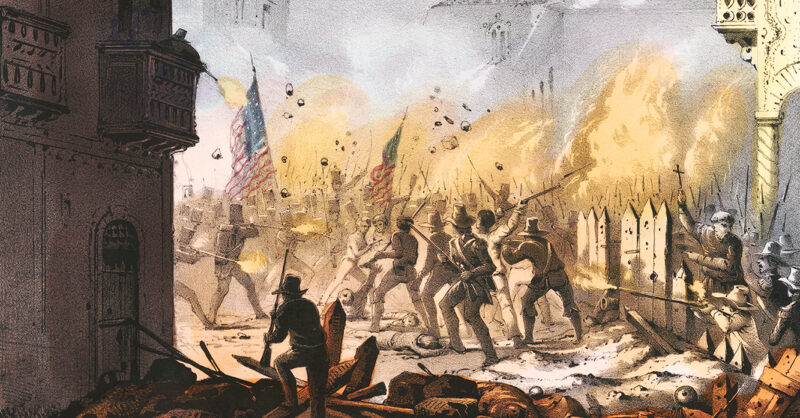
The west, though, came into US possession through a rather different route. Everything from Texas to the Pacific Coast was, until the 1840s, a part of Mexico. Then, following the Mexican-American War of 1846-8, suddenly it wasn’t. There were always those in Washington who questioned the theory of “manifest destiny” – the belief that continental expansion was an inevitability, so help me god – used to justify this. But those guys lost the argument.
All of which means that nearly a third of the lower 48 states was taken through the military conquest of what had previously been rather more than half of Mexico: one of the great ironies of the “build the wall” policy is that those trying to cross Rio Grande were trying to reach territory that had once been Mexican anyway.
The Republicans’ line on Maduro, incidentally, seems to be that, because his election was illegitimate, the US did not in fact remove a foreign leader. This, because there is nothing new under the sun, is exactly the argument used during the 1989 trial of deposed Panamanian dictator Manuel Noriega, too.
Donald Trump, of course, didn’t bother with such niceties: he just said wanted the oil. The terrifying thing about the “Donroe doctrine” is not that it is some breach with US history, because it isn’t. It’s that it’s not a doctrine – constraining, predictable, in exactly the manner that Trump could never accept – at all. It’s no more and no less than the belief that, what American can take, America should have.
[Further reading: How Nicki Minaj became Maga’s queen]
Content from our partnersRelated



Comments (0)