Tesla has stressed a future focus on autonomous tech, Cybercab and its robotics business, after confirming it has no current plans to expand its vehicle range.
The company's latest financial results for Q4 saw a 3% drop in revenues to $24.9 billion (£18.2bn), while the business also saw a 61% year-over-year decline in net profit to $840 million (£613m) driven by increased competition and lower vehicle deliveries.
The indication from this latest earnings call from Tesla shows that it is moving away from expanding its retail model line-up to compete with competition from Chinese manufacturers directly and betting on market leadership with robotaxis instead.
The only exception to this will be the Tesla Roadster, which is due to be revealed in the spring. However, this new lifestyle halo model will not be a volume challenger like the Model 3 or Model Y.
Elon Musk, Tesla chief executive, spoke about how the business is continuing to focus on its autonomous vehicle technology and robotics plans, with production capacity for the Model S and X (which have not been sold in the UK for some time anyway), making way for the capacity to build millions of the company's Optimus robots instead.
Tesla has always been an outlier in the UK, choosing to forgo building relationships with experienced retailers and creating an owned network of showroom locations instead.
The brand's move away from retail sales will slowly erode Tesla's position as a direct competitor to franchised dealerships.
However, the tech-giant's focus will be competing for customers in a different way as it expects an increasing volume of customers to move away from traditional car ownership.
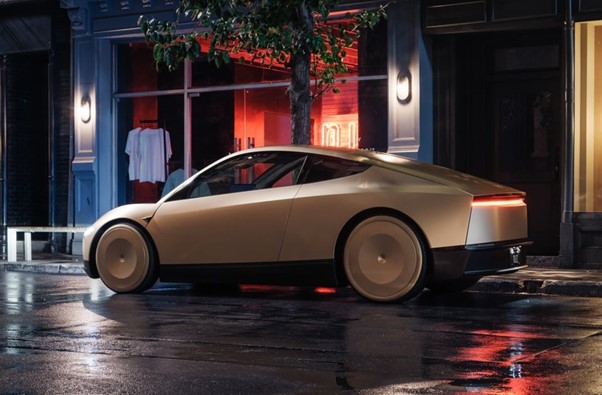
Tesla to build more Cybercabs than all its other models combined
Musk confirmed that the Cybercab is being designed without a steering wheel or pedals, so there will be no driver needed at any time. Tesla has already started testing prototype models on public roads in Austin, Texas.
He said: “There's no fallback mechanism here. Either the car drives itself or it does not drive.
“We expect to start Cybercab production in April. We expect to make far more Cybercabs over time than all our other vehicles combined.”
Musk is convinced that the vast majority of vehicle journeys will be fully autonomous in the future, so competing to produce vehicles driven by people is no longer relevant as a measure for future growth for the business.