Europe’s predicament from China’s perspective
The EU’s reluctant but apparent readiness to stand up to Washington on Greenland and potentially deploy the Anti-Coercion Instrument seems to have caught the Chinese experts partially by surprise, prompting comments about European countries “repositioning their role in the competition of great powers.”
But the overall dependence argument will likely continue to shape Chinese expectations that Europe’s room for geopolitical maneuver will remain narrow and malleable. Many point out that the EU’s ambition for strategic autonomy – which continues to be discussed in China almost exclusively as autonomy from the US -and geopolitical agency continues to be constrained by overdependence on the US in the areas of security, tech and the economy. For instance, Zhang Jian (Vice-President of CICIR) assessed that so far the EU “dares not to speak up,” even in the face of “the US’ highly rough and humiliating treatment.”
But some, like He Zhigao (Researcher at the Institute of European Studies, Chinese Academy of Social Sciences) argue that the EU should know by now that it is useless to try to “curry favor with the Trump administration by sacrificing interests in relations with China,” a likely reference to Brussels’ attempts to cooperate with Washington for instance on rare-earths dependencies throughout last year. Because US pressures on Europe have continued unabated despite its continued outreach to the US President, there is then supposedly little to lose in engaging Beijing (though this may later be reassessed in view of Washington’s pressure on Canada over its re-engagement with China).
Consequently, they believe the EU may now be open to intensifying engagement with China. As Cui Hongjian (Professor at Beijing Foreign Studies University and long time Europe observer) puts it, transatlantic fracture and American “resource imperialism” that was visible over the Greenland question means that the EU and China could cooperate on rebuking the US by “jointly advancing the green transition and achieving resource independence, and jointly resisting hegemony in the resource domain.” Similar proposals tend to overlook the significant trust gap that persists in EU-China relations.
Re-engagement and abandoning de-risking
Several Chinese experts point to the economy-focused re-engagement between China and Canada and China and South Korea in recent weeks as an example of how Trump’s volatility could facilitate a shift in EU-China relations.
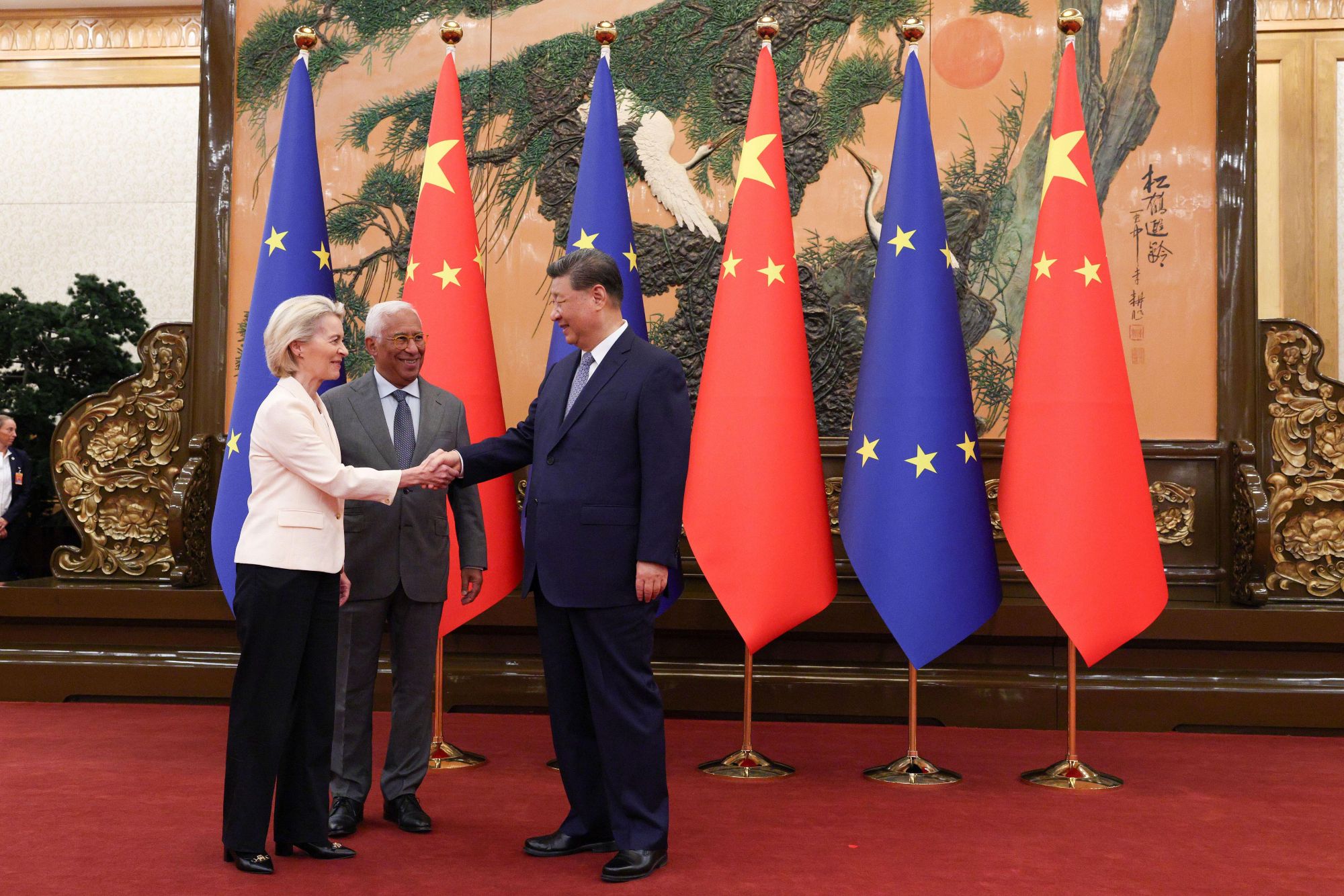
French President Emmanuel Macron’s statement at the World Economic Forum in January in Davos are another case in point: “China is welcome, but what we need is more Chinese foreign direct investments in Europe, in some key sectors, to contribute to our growth, to transfer some technologies, and not just to export towards Europe.” This came on top of his calls to rebalance trade relations during his visit to China in December, one of several high-profile China trips by European leaders in the recent weeks.
However, implied in the analyses, op-eds and media interviews of most of the Chinese experts is that such a re-engagement should have a price tag. The prescription in the Chinese debate is that a reset requires Europe to loosen or abandon de-risking.
China has routinely criticized the policy, which aims to make the EU less vulnerable to economic dependencies and national security risks stemming from China. The Chinese experts tend to portray de-risking as an illogical over-securitization that harms Europe’s competitiveness, raises costs, and slows the green and digital transitions by forcing the replacement of cost-effective Chinese products in European supply chains. Chinese nationalistic media’s English-language Global Times concluded in an editorial that “what European policymakers call ‘de-risk’ has devolved into ‘de-development’” and that is a policy that “Brussels is gradually tightening under pressure from the US”.
Implications for the EU
EU decision-makers should read these debates as an approximation of Beijing’s assumptions and likely bargaining posture. For example, the argument that frictions over Greenland mean Europe should pursue autonomy by loosening constraints on China, especially de-risking.
Beijing is therefore likely to test whether Europe’s transatlantic shock translates into regulatory and political flexibility and to treat Europe’s search for investment as leverage. The sense of Europe’s desperation means Beijing is unlikely to offer tangible concessions, but will rather likely lead to softened rhetoric.
Also, there remain blind spots on China’s side. The narratives tend to overlook or underappreciate that de-risking policy is a result of the EU’s own assessment of relations with China, and the fact that many of the EU’s concerns about China are systemic or structural in nature, as is the case for instance in tensions between the EU’s competition-focused and China’s state-guided economic setups. They also have little appreciation for the EU’s assessment of the threat posed by Russia. Some commentators have even urged the EU to normalize relations with Russia.
The EU must avoid excessive issue linkage that trades resilience for short-term stabilization, as may be the case with China offering investments in exchange for lifting security-related restrictions. A limited agenda for cooperation on global-system stabilization may be possible when interests align – as proven by past collaboration during the first Trump administration when the EU cooperated with China to keep the WTO appellate body, JCPOA or Paris Agreement operational despite US withdrawal. But such initiatives are unlikely to alter structural disputes over economic models or approaches to global governance. Tactical re-engagement between the EU and China should not cloud the EU’s thinking about the long-game in which limiting dependencies and boosting domestic competitiveness is key.
Takeaways for the EUChina continues to interpret its relationship with the EU through the lens of the EU’s relationship with the US. It discounts that the EU makes its own assessment of this relationship, informed by structural and systemic differences.China underestimates the significance of the threat from Russia for Europe’s readiness to re-engage with China.Beijing is likely to see Europe as eager to revitalize bilateral relations and expect concessions. The EU should not expect major offers from China beyond symbolic or isolated gestures.It is paramount for the EU to ensure that the search for new investment avenues does not erode de-risking policies. Showing resolve and assertiveness can improve the EU’s bargaining power. In that context, China will take note of how Europe manages Greenland and other tensions with the US as a test of the EU’s commitment to assertiveness.
Read more:



Comments (0)