
Remember me


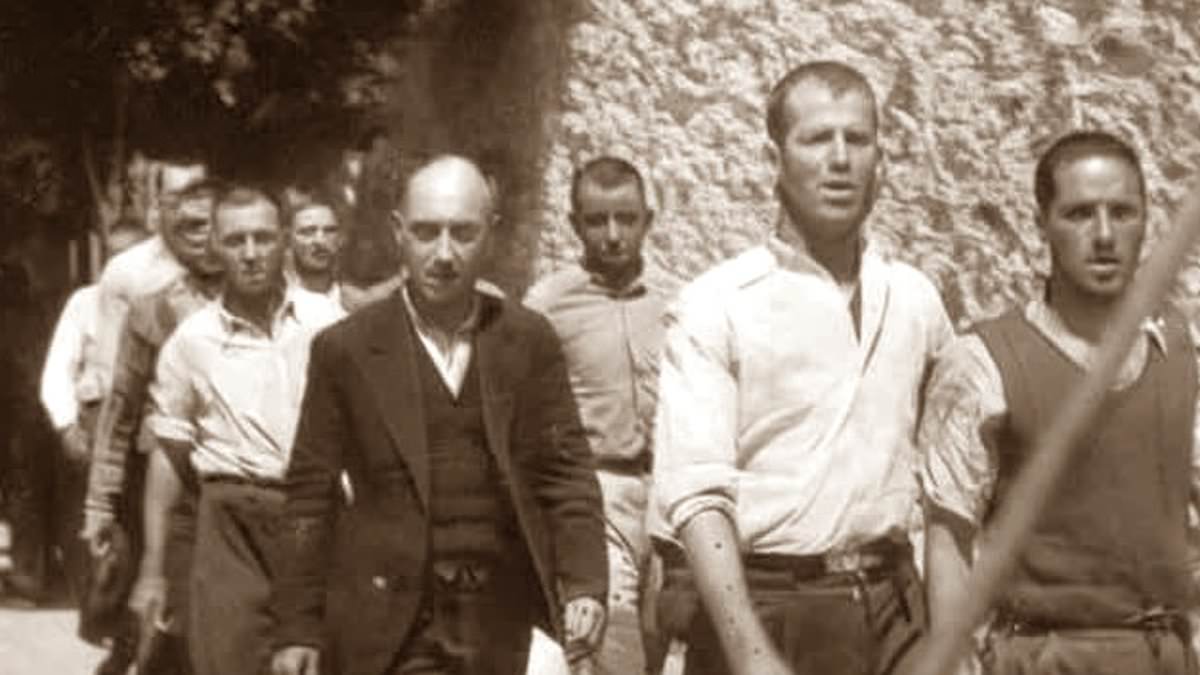
The Germans seemed to delight in their own brutality, that summer morning in Athens. As the men were hustled down from the trucks and herded to the place of execution, a photographer was on hand to record each step of the path to death.
Over the next four hours, in a valley on the edge of the city, firing squads despatched the victims in batches of 20. By the end, blood lay in pools on the sunbaked earth and 200 resistance members were dead in one of the worst atrocities of the German Occupation of Greece.
The memory of that morning – May 1, 1944 – has been dramatically rekindled with the appearance of a series of 12 photographs controversially put up for sale on eBay by a collector specialising in Third Reich memorabilia.
The images are a reminder, if any was needed, of the appalling savagery of German military methods. But they also carry a more uplifting message.
Anyone looking at the pictures of the column of the doomed marching to their rendezvous with death at a firing range at Kaisariani in the eastern suburbs of Athens will surely be struck by their pride and defiance. Their shoulders are straight and their demeanour calm and dignified.
As they wait for the bullets to strike, one stands with arms held stiffly by his side as if on the parade ground. Another raises his clenched fist in a salute to his comrades and the cause. For most of these men were communists, imprisoned by their own government before the Germans invaded.
The story of the Kaisariani Massacre is as much about the courage and defiance of the anti-Nazi resistance as it is about the crimes of Hitlerdom. The atrocity is seared into the nation's memory but, though it is well-documented by eyewitness accounts, until now there has been no visual evidence to illustrate its horrors.
The victims were prisoners in the SS-run Haidari concentration camp in north-west Athens. It served as a transit facility for Jews, most of whom would end up in Auschwitz. But it also held about 600 political prisoners, nearly half of them communists who had been imprisoned by the authoritarian regime of General Ioannis Metaxas.

Victims of the Kaisariani Massacre shortly before being executed by the Nazis

One haunting image that's been put up for sale shows the Greek men being lined up at a firing range
When the Germans invaded Greece in the spring of 1941 the prisoners were handed over to the occupiers to serve as ready-made hostages along with lists of other political undesirables.
By 1944 the Germans were battling a highly effective nationwide guerrilla campaign fought by the communist-led Greek People's Liberation Army (ELAS), sometimes in partnership with British teams from the Special Operations Executive. They controlled large swathes of the countryside, attacking troops and sabotaging installations.
German countermeasures targeted the civilians who sustained the partisans. By the end of the war, about 90,000 Greeks had been murdered and 1,600 villages and towns destroyed. In addition, all but 10,000 of the more than 70,000 pre-war Jewish population had been deported to death camps.
On April 27, 1944, an ELAS platoon ambushed Major General Franz Krech, commander of the Wehrmacht's 41st Fortress Division, in the mountainous southern Peloponnese peninsula, killing him and three other officers.
The response was predictable and in keeping with the Germans' long-established practice in all the countries they occupied of mass killings of captives, especially communists, in reprisal for the assassination of any of their own.
A list was drawn up by Gestapo headquarters in Athens of 200 prisoners marked for death. Most of them had been imprisoned on the peninsula of Akronafplia before being moved to Haidari after the occupation.
Among them were teachers, engineers, bakers, agronomists and trade union leaders who had spent years behind bars for their political beliefs. When news of the assassination reached the camp the inmates had little doubt of what was coming next.
On the evening of April 30, the SS commandant Captain Karl Fischer informed the prisoners' representatives that a large group of them were to be moved to a different camp the following day.

The site has been turned into a memorial to honour the 200 men who were executed

Among the men were teachers, engineers, bakers, agronomists and trade union leaders who had spent years behind bars for their political beliefs
Nobody was fooled. But instead of despair, the news was met with unwavering courage. In Cell Block 3, to the astonishment of their captors, those who were about to die danced to the music of two guitars and a violin and sang folk songs and revolutionary anthems.
Early the following morning came another remarkable display of fortitude and defiance. Among those selected for execution was Napoleon Soukatzidis, a 35-year-old accountant and trade unionist who had been arrested in 1936 and never saw freedom again.
He was a phenomenal polyglot, speaking six languages including German, which made him invaluable to his captors as a translator.
It fell to him to deliver the roll call of the condemned. When he came to his own name the camp commandant Captain Karl Fischer was reluctant to lose such a valuable human resource and intervened to spare him. Soukatzidis asked him: 'If I am saved, will one fewer be executed, or will someone else take my place?' Fischer confirmed that the quota would still have to be filled. Soukatzidis then stepped forward and took his place in the line of the condemned.
In a hasty farewell note left for his father, he wrote: 'Dad, I'm going to the firing squad. Be proud of your only son.'
Another prisoner, Antonis Vartholomaios, was also told he could be allowed to live on account of his status as the camp elder. He, too, refused the offer.
As they waited for the lorries that would take them to the killing zone, witnesses reported that the men sang the national anthem and the Dance Of Zalongo, a traditional song commemorating the 1803 mass suicide of Greek women and children who jumped off Mount Zalongo to avoid capture by the Ottomans.
The prisoners were driven in ten trucks across Athens to a rifle range at Kaisariani on the eastern edge of the city. Along the way the doomed men threw out messages scrawled on scraps of paper to their families, which were collected by locals and passed on.

As they waited for the lorries that would take them to the killing zone, witnesses reported that the men sang the national anthem

Flowers laid at a memorial to the resistance fighters, along with photographs and a drawing of the men
A lawyer called Mitsos Remboutsikas wrote: 'My death should not sadden you but steel you even more for the struggle you are waging.'
The firing range was in a wooded valley overlooked by Mount Hymettus. The victims were lined up in their groups of 20 then gunned down. Each succeeding batch was forced to load the dead onto the lorries that had brought them, before taking their place in front of the firing squad.
The massacre was witnessed by local people watching horrified from the surrounding slopes. In their last moments, the victims gave clenched fist salutes, shouted 'Long live Greece' and 'Long live freedom!' and sang the communist Internationale anthem.
A well-known poet Rita Boumi-Pappa who lived close by recorded that the slaughter, which lasted four hours, was too much even for some of the executioners. 'The Austrians of the first firing squad could not stand it any more and sometimes fainted,' she wrote. 'This enraged the head German officer who twice replaced them with more composed soldiers.'
The dead were carted off in lorries dripping with blood to a cemetery in Athens. Gravediggers later reported that some of the bodies showed signs of life but that the Germans forced them to bury them anyway in pits they had prepared the night before.
The Nazis refused to release the names of their victims and families had to identify their loved ones by looking through piles of bullet-torn clothing dumped at the offices of the Greek Orthodox archdiocese in Athens.
The appearance of the photos has led to the tentative identification of more victims. A tall man in a white shirt seen walking into the shooting range has been named as Vasilis N. Papadimas, an engineer arrested in August 1941.
Today, the atrocity is etched in the Greek national consciousness. Memories of the war are sensitive still, given the vicious civil war that erupted in 1946 between royalist Greek government forces and the communists and ended three years later with victory for the monarchists.
Although communists had made up by far the largest and most effective anti-Nazi force, they were categorised as traitors rather than patriots. Up to 5,000 Leftists were tried in military courts and executed while only a handful of Nazi collaborators faced justice.
It was only in 1982 that the government officially recognised the crucial role played by ELAS and granted its survivors full veterans' rights. Since then the debt has been increasingly acknowledged. The shooting range is now the site of the Altar of Freedom, set in leafy parkland, dedicated to the heroes who fought for the nation's independence, where services of remembrance are held each year.
The appearance of the photographs for sale last week will further advance the rehabilitation process. The Greek Ministry of Culture declared the archive a protected national monument of exceptional historical value. It is now negotiating to acquire it for the state.
The seller, Crain's Militaria, is owned by Belgian collector and historian Tim de Craene and specialises in Third Reich memorabilia and Second World War artefacts.
The episode has also shone a light on the disturbing trade in violent imagery. Along with documents and coins, the website offers photographs taken by German military personnel for their own pleasure.
Germany was a world leader in high-quality compact cameras and most soldiers carried one. The regime encouraged it and saw it as a means of connecting the troops with the folk at home.
The memories they wanted to preserve of their service reveal much about the nature of Hitler's Germany.
Many of the photographs featured on the website are gruesome, showing burned and mangled enemy soldiers and murdered Russian and Polish male and female civilians strung up on makeshift scaffolds and the branches of trees. All have been stamped 'sold'.
The Kaisariani images are said to have come from the album of Sergeant Hermann Heuer, or Höyer, who served in one of the Fortress Division's battalions, which records show was in the area at the time. However, they are professionally shot, almost certainly taken by Günther Heysing, a journalist attached to a unit working for Nazi propaganda chief Joseph Goebbels.
After the war he published a newsletter called Die Wildente (The Wild Duck) which served as a network for those who served in 'propagandakompanies' and reproduced their work. This was most likely the provenance of the Kaisariani series.
Heysing's purpose was no doubt to proclaim the deadly revenge the Germans would wreak on anyone who dared to stand up to them.
Instead his pictures show something very different. The images capture the duality of human nature, its darkness and its light.
Yes, they are a testimony to the black bestiality of the regime that Heysing glorified. But more importantly they serve as a memorial to courage and a shining nobility that Nazi evil could never extinguish.