
Remember me


Enemy searchlights raked the sky and shells exploded around us: the cockpit was filled with blinding light, so I could see nothing ahead and was forced to fly on instruments.
These bastards were intent on our destruction.
It was night-time, September 1944. Navigator Doug Redmond and I had just bombed Hanover, a major industrial city about 180 miles west of Berlin.
This was our first taste of war and so far, we’d encountered hardly any anti-aircraft fire.
With the optimism of a 23-year-old, I had begun to think this job might not be so bad.
I hadn’t bargained on terror prompting the kind of stupid mistakes which made a crew’s first few raids so dangerous.
Doug was easily the best navigator in the squadron, but he had somehow ended up routing us over a German naval base. Now they were onto us.
Our aeroplane shuddered as a shell detonated nearby and next it was my turn to make an error. Panicking, I slammed the throttle open and threw us into a vertical dive.

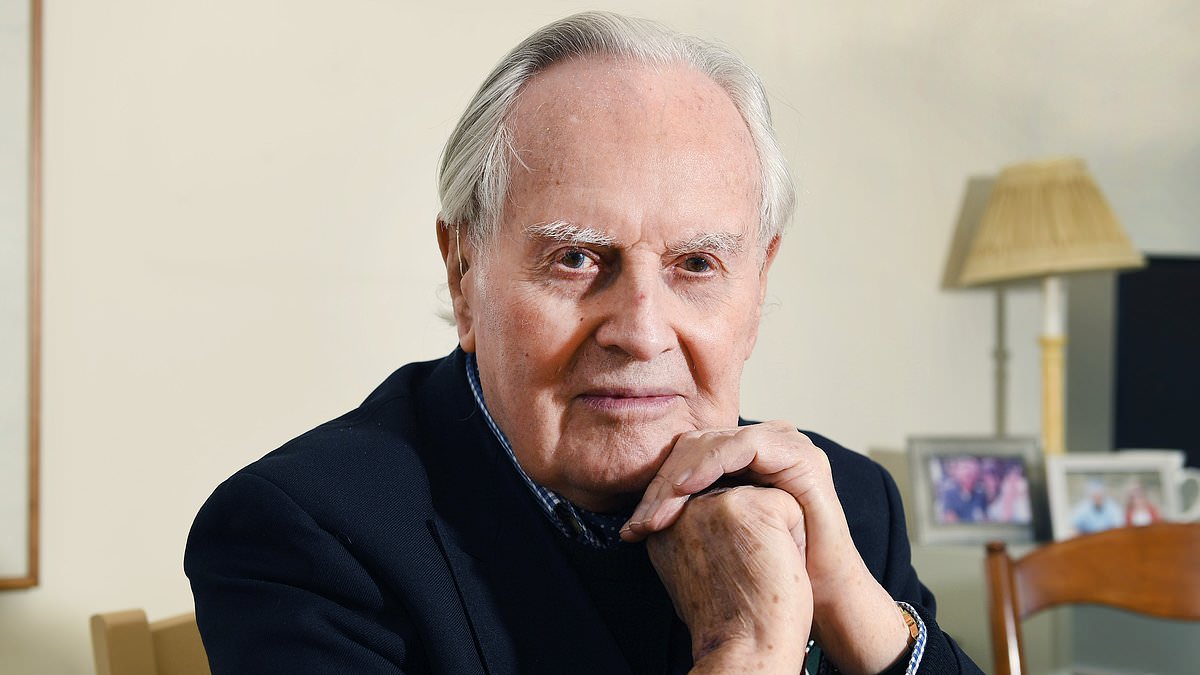
Former WW2 fighter pilot Colin Bell DFC pictured celebrating his 100th birthday at his home in Goudhurst, Kent

Mr Bell is pictured as a child with his dog at Lakeland and will be celebrating his 105th birthday next week
It got us out of the searchlight’s beam, so I could see again, but now the earth was hurtling towards us at colossal speed.
Closing the throttle, I tried to ease back on the control column. It didn’t move. Our speed and rate of descent were increasing.
I pulled hard on the stick with all my strength. Still nothing.
Now it was a question of which would come first: the plane breaking up, or hitting the ground?
The roar of the slipstream filled the cockpit. Instinctively, I reached for the trim wheel, which fine-tuned the position of the nose.
Winding it back as far as I could, I hauled again on the stick.
Slowly and gratefully, we came back into level flight.
‘Turn 50 degrees starboard.’ His voice icily calm, Doug was back on the case.

Mr Bell, pictured in RAF uniform, was 23 years old when he had his 'first taste of war'
‘Fifty degrees starboard,’ I said with equal calm – though I didn’t feel it – as I banked right.
We sat in silence as we climbed back up to operational height.
‘You know what?’ I said eventually. ‘I’m beginning to think that this business might be a bit bloody dangerous after all.’
The aeroplane I had the good fortune to be flying that night was a de Havilland DH98 Mosquito.
Known as the Wooden Wonder, it was then the world’s fastest operational aircraft.
It still seems incredible that you could create something so strong and durable from a mixture of wood and glue, and that this structure could carry a pair of Rolls-Royce Merlin engines producing upwards of 1,300 horsepower each. Yet it worked brilliantly.
Flying one was like flying a Ferrari.

A de Havilland DH98 Mosquito, an aeroplane Mr Bell flew, is pictured on a photo/reconnaisance mission in 1942
I’m 105 next week – one of only a handful of Bomber Command still living – and I still remember the tremendous punch in the back you got from the speed as it hurtled down the runway.
It may seem surprising that I am only now putting my wartime experience down on paper, but I led a busy professional life as a chartered surveyor until I retired at the age of 98.
I think it’s worth recalling now as it’s important to remind ourselves what we were fighting for during the Second World War.
You have to stand up to bullies. Despots attack weak nations and democracies, and it feels now that those same evil forces are abroad once again.
The Mosquitos used by the Light Night Striking Force (LNSF), of which we were part, had no ordnance other than four 500lb bombs, which allowed them to achieve a top speed of 420mph.
The Messerschmitt Me 109, our most frequent opponent, was 40mph slower, and German pilots who succeeded in taking down a Mosquito were awarded not just one but two kills.
That gives you an idea of the enemy’s respect for the aeroplane.
Not that bombing raids in the Mosquito were exactly hazard- free. On your bombing run, you had to hold a steady course and, for roughly the last 10 miles, take whatever they were throwing at you.

WW2 veteran Mr Bell described flying a De Havilland DH98 Mosquito as 'flying a ferrari'
Slowed to 200mph, this translated into about three minutes of running the gauntlet. Not long if you are waiting for a bus, but a bloody lifetime when you know that you are in somebody’s sights.
Apart from worrying about the reception we would receive from the Germans, we also knew our station commander had refused the manufacturer’s request to ground our planes for six weeks to rectify a potential engine fault.
‘This is an operational squadron,’ he said. ‘There can be no question of grounding aircraft. Not for six days, let alone for six weeks.’
When someone then asked what we were supposed to do if our engines failed on take-off, his reply was unequivocal. ‘You die like an officer and a gentleman.’
Die you certainly would.
A fully bombed and fuelled-up Mosquito stood no chance of recovery if it lost an engine on take-off, as happened to one of our Canadian pilots.
Of the 30-odd aircrew I shared the mess with during my six months with 608 Squadron, a unit within the LNSF, 13 were dead by the time I left.
When the war broke out, I was living at home with my parents in London, having just begun my training as a chartered surveyor.

Mr Bell has been married to his wife Kath for more than 70 years, who is pictured here shortly after the couple's engagement
Aged 18, I went almost immediately to the local recruiting office to volunteer for the RAF.
I’d dreamed of learning to fly since my father, a civil servant, took me and my elder brother Kenneth to Croydon Airport to watch the arrival of Charles A. Lindbergh in the Spirit of St. Louis following his successful solo crossing of the Atlantic.
This was in May 1927 and I was six at the time. Could I be the last person alive to have been there on that day? I suppose I might be.
With my application to become a pilot accepted, I was desperate to get to grips with the enemy.
But instead, I was sent to the US as part of a scheme to train British military aircrew alongside their American counterparts.
I was ordered to stay on as a flying instructor, so it wasn’t until September 1944 that I finally joined 608 Squadron at RAF Downham Market in Norfolk.
Our mission was to conduct frequent, low-impact but high-value raids on Germany. As junior officers, we were housed in freezing Nissen huts, 12 of us in each. At 7.30am, we were woken with a pint mug of tea.
After breakfast, you learned whether you were going on a raid that night. Mornings were spent inspecting our planes and afternoons whiled away gambling on dice games, or playing rugby, football and cricket.

Mr Bell, pictured while in the RAF, said aged 18 he 'almost immediately' went to volunteer for the RAF
I always flew with Doug as my navigator and bomb-aimer. Five years older than me, he was a Canadian who’d worked as a lumberjack before the war, and he was somewhat solitary with little sense of humour.
What mattered to me was that he was good at his job.
A typical night sortie took off at around 9pm. Just before we were picked up from the mess, the squadron leader appeared to wish us good luck.
There was little talk in the lorry taking us to dispersal – the odd bawdy remark, but nothing about what lay ahead.
En route, we stopped at the store to collect our parachutes, helmets and a snack for the trip – cocoa in a thermos and some sandwiches.
‘Not bloody spam again!’ was the invariable cry as we headed towards our Mosquitos. The planes were short on creature comforts.
Even getting into the cramped cockpit was difficult, especially when encumbered by your Mae West life jacket (named after the voluptuous film star of the era because, when inflated, it made you look as buxom as she).
People often ask whether I carried a mascot, a teddy bear or something. Yes, I did. My mascot was a Smith & Wesson revolver with 20 rounds of ammunition.

Mr Bell said he had 'dreamed of flying' since his father took him and his elder brother Kenneth to watch the arrival of Charles A. Lindbergh in the Spirit of St. Louis following his successful solo crossing of the Atlantic
At this time, Hitler and Goebbels were encouraging the German population to lynch downed airmen.
My intention, if caught, was to shoot at least half a dozen members of any approaching mob before blowing my brains out.
This is the hard reality of war.
There are many now who say they have reservations about the kind of bombing we were involved with under the direction of Sir Arthur ‘Bomber’ Harris, commander-in- chief of RAF Bomber Command – which targeted Germany’s industrial capability and tried to destroy the morale of its civilian workforce by bombing cities.
Now there is certainly an argument to be had about this, but I do often wonder how that argument would go if we had lost the war.
People might be expressing reservations about living as slave labourers under a Nazi regime, with concentration camps set up in every city for its opponents.
So, when people say, ‘What about Dresden?’ I reply that Dresden was indeed horrific.
But so too was the blitzing of London, Coventry, Plymouth, Exeter, Liverpool and Southampton, to name but a few.

Mr Webb is pictured at 102 years old at The RAF Benevolent Fund Garden at RHS Chelsea Flower Show, London, in 2022
What people tend to forget is that, between 1939 and 1945, we were in conflict with the entire German nation, the most industrious, tractable, inventive, fierce and martial race in the world.
I do not mean that the German people themselves were evil. Not at all. But those ruling them at the time undoubtedly were.
As to the ethics of our ‘area bombing’, Harris’s insight was that, from the perspective of prosecuting war, there was no moral difference between the chap who drove the tank and the chap – or chappess – who built it.
Both were intent on our destruction. As a result of his bombing campaign, vast numbers of people and huge quantities of equipment were locked down and kept from the front line.
As for us pilots, you could turn down a mission if you had doubts about the aeroplane – something not working, for example – or if you had a medical condition, like a cold, but to refuse too often would see you accused of LMF: lack of moral fibre.
This was a serious matter, which could lead to demotion, loss of your wings and your service records being stamped with a large red W for ‘waverer’.
This was the warning given to one pilot who had twice ducked out of going up and was in a terrible funk on the night of his next scheduled mission.
‘I’m not coming back tonight,’ he kept saying. ‘I just know I’m not coming back.’

Mr Webb married his wife Kath (pictured) in July 1943 and had their daughter Vivienne in September 1944
We did our best to tell him otherwise, but he was clearly in the grip of terrible fear.
That night, he crashed on landing back at the airbase, killing both himself and his navigator. It was almost as if he wanted to prove that his worries had been justified. Every sortie was thoroughly unnerving.
There is nothing good that can be said about being shot at. It isn’t exhilarating, exciting or fun in any way. Just ask any bloody pheasant.
Some of the worst anti-aircraft fire we took was on our seventh raid, over Berlin. It must have missed knocking us out of the sky by inches and hurled us at least a hundred feet upwards.
The cockpit filled with the stench of cordite and then both engines lost power. ‘JESUS!’ bellowed Doug. ‘What do we do now?’
As the propellers windmilled silently, we rapidly lost height. Six months seemed to pass when, without so much as a cough... Hallelujah! The reassuring thrum of the engines as they came back to life.
At once, I put the aeroplane into a steep, diving turn to escape a searchlight’s conical beam.
‘You weren’t frightened, were you, Doug?’ I asked.

Mr Webb described a 'typical night sortie' as taking off around 9pm, after being wished good luck by his squadron leader
‘No,’ he said. ‘I wasn’t frightened... I was bloody terrified.’ So was I. And we’d have been a lot more frightened still had we been aware of the damage to the plane.
The next morning, as I surveyed the fuselage, a mass of holes and splinters resembling a colander, one of the fitters held out two slivers of shrapnel, each several inches long.
‘They were embedded in the parachute you were sitting on, sir.’
My cushion, in other words – and uncomfortably close to my vital assets. Of course, every raid was just as awful for my wife, Kath.
We married in July 1943 and our daughter Vivienne was born in September 1944, during my first ops with 608 Squadron.
By then, I’d persuaded the authorities that I should be allowed to live off-station and found us a top-floor flat with a small window looking directly onto the main runway.
Peering nervously out as our planes came back, Kath just had to hope that I was among them.
Neither of us knew then that we would be married for more than 70 years.

Mr Bell is pictured at The RAF Benevolent Fund VE Day Tea Party on May 8 2025
The waiting and the uncertainty must have been hell.
My penultimate raid, in March 1945, was on Berlin and it contained without question the most alarming 15 minutes of my whole time with Bomber Command.
For several weeks there had been reports of a new machine in the Luftwaffe’s inventory.
We didn’t know much about the Me 262 jet fighter, just that it had at least 100mph on us and attacked when you were most vulnerable, during your bombing run, when you were doing your damnedest to follow your navigator’s instructions and could easily overlook the little white light that would come on when your radar equipment detected an enemy intercept.
Now I was lining up. ‘BOMBS GONE! Bombs gone!’ I said, before closing the doors.
Maintaining height, I banked away sharply. Now home! But that white light... It was on! Not flashing. Unambiguously on.
‘CHRIST!’ yelled Doug, startled, as I stood the aeroplane on its wing and shoved the nose down. ‘What’s that all about?’
‘INTERCEPT! INTERCEPT!’ I shouted as I threw us into a steep descent.

Mr Webb is pictured in a soft RAF flight cap and described himself as 'desperate to get to grips with the enemy'
If it was a Focke-Wulf 190, he would have only one chance of hitting us. He’d aim to dive below and behind, then fire as he zoomed up.
That gave him a two-second window.
If it was a jet, it was a different story. You had to hope, because he was going so fast, he’d overshoot.
The light went out. But, hang on! It was on again! It was an Me 262, for sure.
Only one option: a banking dive as low as I dared go. Jets were thirsty at low level, so my idea was to drag him down while weaving in tight, high-speed turns until he ran short of fuel.
Down we went. The light went out. Seconds ticked by. In the end he must have decided to go home rather than risk putting down somewhere in the dark.
My last raid, again on Berlin, took place on March 3, 1945, just before my 24th birthday.
Two days later, the Mosquito we had flown that night was shot down. Both crew members were killed.
Those losses – and many others – remind me every day of just how bloody lucky I was.
From Bloody Dangerous by Colin Bell (Abacus, £22), to be published on March 5. Order a copy for £19.80 (valid to 15/03/26; UK P&P free on orders over £25) at www.mailshop.co.uk/books or call 020 3176 2937.
Watch an interview with Colin Bell at DailyMail.co.uk