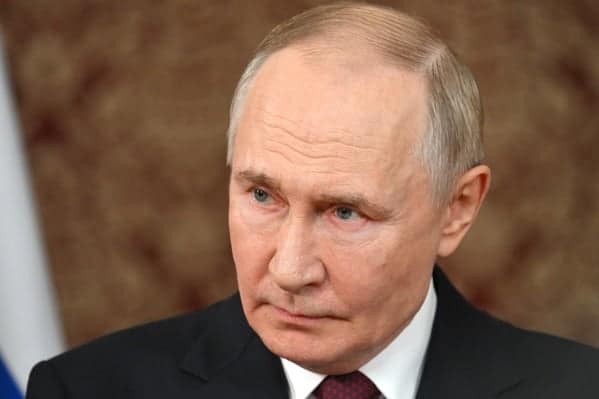
In a strong public statement, Vladimir Putin has condemned the killing of Ali Khamenei, the Supreme Leader of Iran, asserting that the actions taken by the United States and Israel constitute a grave violation of international law.
This firm stance aims to reassure the audience that Russia views such acts as serious threats to global stability and norms, fostering a sense of shared concern among those interested in international affairs.
Putin highlighted that the military strikes leading to Khamenei’s death were executed in “cynical violation of all norms of human morality and international law,” underscoring his view that the actions display a blatant disregard for ethical standards in international relations.
This choice of words signals a significant escalation in rhetoric, suggesting strong disapproval of the methods employed by Western powers in pursuing their geopolitical objectives in the region.
In his statements, Putin also took the opportunity to recognise and honour Khamenei’s pivotal role in strengthening the strategic alliance between Moscow and Tehran.
He articulated that Khamenei would be remembered in Russia not only as a leader but as an “outstanding statesman” whose diplomatic efforts played a crucial role in enhancing bilateral relations.
This recognition underscores Russia’s interest in maintaining and expanding its influence in Iran and the broader Middle East, highlighting the importance of its strategic partnership in regional geopolitics.
The condemnation issued by Putin comes at a complex time, as Russia is deeply entrenched in its ongoing war against Ukraine, which has now reached a critical fifth year. Compounding the tension is Putin’s current predicament with the International Criminal Court (ICC), which has issued an arrest warrant for him in connection with allegations of the unlawful deportation and transfer of Ukrainian children to Russia. These simultaneous issues underline the intricate and often fraught nature of Russia’s current geopolitical landscape.
The assassination of Khamenei has not only heightened tensions between Iranian and Western powers but has also intensified diplomatic friction on a global scale. In light of these developments, Moscow has positioned itself as a vocal critic of Western military actions and policies. Analysts suggest that Russia’s vehement response reflects a broader strategic alignment with Tehran against the security policies assertively pursued by the United States and Israel. This situation signals a potential realignment of alliances and an escalation in global tensions, contributing to an increasingly complex and volatile world order.




Comments (0)