
Remember me

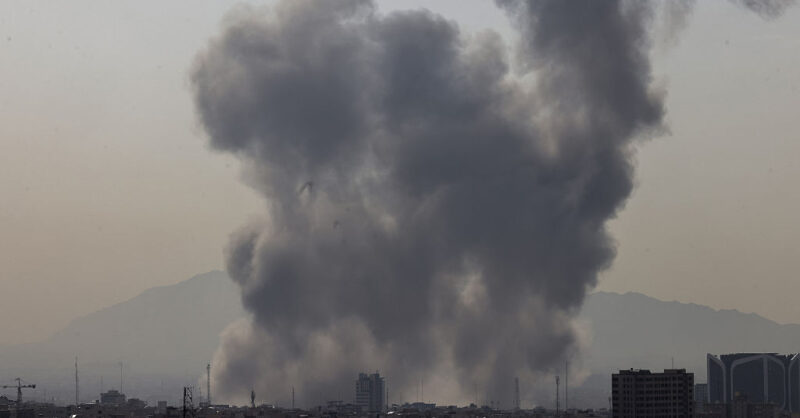

What does the most powerful man in the world think he’s up to now? President Trump launching strikes on Iran on the morning of 28 February should not have come as a shock to anyone. During my time in Tehran as UK ambassador, the US leader, then in his first term, took everyone by surprise in similar fashion on more than one occasion. A sudden decision by the White House to attack IRGC targets in Syria, for instance, raised concerns about the safety of my staff at the British embassy. In the absence of any US diplomatic presence in Tehran, the UK was at risk of being a lightening conductor for any local reaction. I had to lock down the embassy for a few days until it blew over and received a head-scrubbing from the Ministry of Foreign Affairs for the UK political support publicly given to the US action.
In the present situation, pressure has been building towards military action for months. There was the 12 Day War between Israel and Iran last June, which the United States brought to an end with a clinical attack on Iran’s nuclear enrichment facilities. That was followed by popular protests that challenged the Islamic regime from the end of last year, until they were brutally put down with the massacre of thousands in January. The recent massive – and expensive – build-up of US military fire power close to Iran meant the president needed to be able to declare either a diplomatic or military victory.
In recent weeks three rounds of negotiations had taken place between US and Iran. A further round was scheduled for the coming days. So, why has the US, in coordination with Israel, decided to strike now? Especially when – at least according to the impressive and usually reticent Omani Foreign Minister, who has been mediating the negotiations – a “breakthrough” deal, far better than anything President Obama achieved with his Joint Comprehensive Plan Of Action (JCPOA) in 2015, was within reach? The breakthrough would apparently have involved concessions by Iran that met the US objective of ensuring the Islamic Republic would never have a nuclear weapon.
The president has chosen to bring the Islamic regime to heel through the exercise of overwhelming military superiority. Military strikes clearly signify a failure of diplomacy. What has become increasingly evident is that the terms of a deal offered by the White House were never likely to persuade Tehran to capitulate. The US demanded that Iran give up not only its ability to enrich any uranium – whether for a bomb or civil purposes – but also its considerable missile capability.

Subscribe to the New Statesman today for only £1 a week.
Some might question whether Steve Witkoff and Jared Kushner, representing President Trump, were negotiating in good faith. They have been in talks with Foreign Minister Abbas Araghchi – a tough but professional diplomat, as I experienced myself on many occasions. As recently as 26 February, the US team seems to have still been insisting on a one-way deal where Iran gave up everything. In return, the US would simply agree not to impose new sanctions, without offering meaningful sanctions relief which might allow the Iranian economy to recover from its desperate state. That was never a credible bargain, not really a “deal” at all. The Islamic Republic may have concluded that, in the circumstances, it might be better off looking to weather a limited military conflict than continuing the ongoing death by a thousand cuts, which accepting the US offer would have confirmed.
If that was Tehran’s logic, how likely is it that the Islamic regime will be able to survive the onslaught of the world’s most sophisticated military power? After the emasculation of Iran’s “Axis of Resistance” proxy forces – Hezbollah, Hamas – and the loss of a key ally in the region following the fall of the Assad regime in Syria, Iran’s military capability was reduced largely to its ballistic missiles. President Trump talks about destroying the Iranian navy, but in reality beyond the IRGC’s small, fast boats, Iran’s navy is derisory.
Likewise, Iran’s air defences were destroyed by Israel last year and its airforce is antique and no match for any of its neighbours, let alone Israel equipped with state-of-the-art US fighters. Iran has developed impressive drone capability in recent years, which it shared with Russia to use in Ukraine as part of an opportunistic military pact between two globally isolated countries. Yet, as is already becoming evident from Iran’s initial retaliation in the new conflict, it now relies almost exclusively on its missiles to project military force. It has done this towards US targets in Bahrain, Jordan, Kuwait, Saudi Arabia and Qatar; and caused damage at least in Israel and the UAE. That feels very different from the limited symbolic regime retaliation in previous exchanges with Israel and from the performative attack on the Al Udeid US airbase in Qatar last June.
Now that the US and Israel have ignited the latest conflict, it is rapidly escalating towards what risks becoming a regional war. Worryingly, it is far from clear that the US has defined its military objectives or has a plan for the endgame or an offramp should Iran prove capable of sustaining retaliation for more than a few days. Netanyahu is uncompromising on Israel’s objective: a change of regime in Iran which would guarantee Israel’s own security. President Trump, however, has moved from talking up the importance and prospects for a negotiated deal to calling on the Iranian people to rise up, take control of the country and achieve a “prosperous and glorious future”.
Leaving aside for a moment the likelihood of that happening – and those who have visited Iran know what a big, diverse, sophisticated and complex place it is – there is an extraordinary level of uncertainty outside Iran about what is now happening. The legal base for US military action is opaque. Also, there must be some doubt whether the US public – including those in positions of power – have the appetite for a prolonged conflict. After all, President Trump was elected on the promise of ending, not starting, wars. Congress – not just Democratic politicians – seems reluctant to grant President Trump the war powers needed for a long campaign. US allies, including the UK, other Europeans and the Gulf countries, have all made clear their strong preference for diplomacy and a new US-Iran deal rather than military action. They will be dismayed and apprehensive at the turn in events.
Crystal ball-gazing, it is possible to identify several scenarios unfolding. But, as years of involvement with Iran have taught me, it would be foolish to predict an outcome. The risk of regional destabilisation has already become a reality, but it could get significantly worse, especially if the conflict goes on for more than a few days and develops into a full-blown war. It is not inconceivable that the Islamic Republic will stop retaliating, either because capability is totally degraded, or through choice hoping – perhaps rather optimistically at this stage – for last ditch diplomacy to save the regime. It is even possible that the US will succeed in decapitating the Islamic regime – Israel managed to do that to an extent with targeted killing of military and regime leaders last year. However, the Islamic regime is not Venezuela, and its power structures resemble a many-headed Hydra, less dependent on a single individual such as the Supreme Leader or even the top IRGC hierarchy.
Amid all this, there is one point of clarity: whether or not Iranian citizens heed President Trump’s call to rise up, the coming period is full of peril and risk for the region and beyond. Unfortunately, a glorious future for the Iranian people appears far from certain or imminent.
[Further reading: What is the endgame in Iran?]
Content from our partnersRelated
Comments (0)