
Remember me

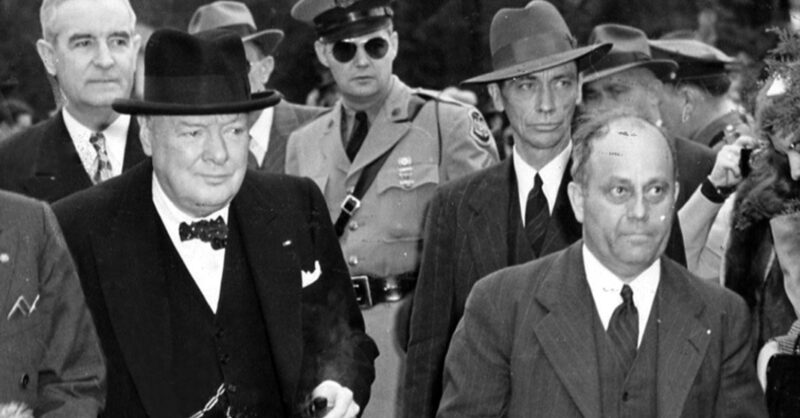


Eighty years ago today, on 5 March 1946, Winston Churchill made a speech at Fulton, Missouri, and spoke of an “iron curtain” falling across Europe. In his first major intervention since losing office, Churchill set out to sound the alarm about the Soviet threat and called for the US to defend Europe. His immortal line about a descending “Soviet sphere” and a hardening East-West divide helped ignite the Cold War. But while remembered as an augur of conflict, the speech, called “The Sinews of Peace”, was also a vision of co-creation and peace, delivered by a part-American and primarily to move an American audience. He called for an Anglo-American combination to guard against the double scourge of war and tyranny. As anti-totalitarian he denounced the increasing Soviet grip over satellite states, yet he also craved the role of peacemaker among great powers. Combined Anglo-American strength would enable the West to settle with Moscow from a position of strength. If the victorious and ascendant US would accept the baton of primacy in Europe, Britain would buttress the new order with its residual power, hard-won wisdom and far-flung bases.
Looking back, Fulton and its spirit of collaboration might seem a world away. After all, the early postwar era of American internationalism called forth the Truman Doctrine, Nato and the Marshall Plan. The America of presidents Franklin Roosevelt and Harry Truman might look antithetical to today’s order of president, Donald Trump, and the coercive, extortionate statecraft of “America First”. Europe reels from Washington’s punitive tariffs, its contempt for Nato, its repudiation of “global leadership”, its hostility to Europe, its predatory threats to north Atlantic allies Canada and Denmark, and its asset-stripping demands in Ukraine. In March 1946, Britain and American could still exult in its victory over the barbaric Axis regimes. Under today’s darkening sky, Churchill’s speech might seem a monument to greater, bolder days.
Yet that narrative is mistaken. It reads history backwards in its yearning for a simpler time of moral clarity, when the relationship was “special”. The eventual triumph of that era, the building of a new security architecture and US hegemony in Europe by invitation, should not blind us to the dangerous fluidity of the moment, when the Anglo-American relationship was still inchoate. In Fulton, Churchill stood on treacherous ground. The very title of his address borrowed from Cicero’s quip about money being the sinews of war. He visited the US as leader of the opposition partly to advance the government’s request for fresh loans, then at the whim of a volatile Congress. America was not a friend but a ruthless great power doing business. On recent form, it could help but would exact a heavy price: revising economic arrangements in its favour, strong-arming allies into lopsided agreements, or attaching strict conditions to aid. By re-examining that speech and its context, we can see both the dangers of a geopolitical crisis – but also its opportunities.
By March 1946, Britain, via Churchill, came to Washington as a financial supplicant. This was not just because of the privations of war. From the moment Britain entered the conflict, Washington exploited British dependency to strengthen itself at London’s expense, despite a common language and shared adversaries. It was as hard-nosed as Britain had been for centuries. At the outset of the war, Britain had a black belt in realpolitik. Its intelligence services forged and planted maps to convince President Roosevelt that Nazi Germany had designs on their hemisphere by dividing South and Central America into five vassal states, a map Roosevelt revealed in his Navy and Total Defence Day address of July 1941. Initially, British delegations also outmanoeuvred their allies’ staff in joint conferences.

Subscribe to the New Statesman today for only £1 a week.
But the US learned to play the game hard. Churchill knew first-hand that the men who ruled Washington might wax lyrical about high principle by night but were often cold-blooded by day. Prime Minister Churchill’s wartime correspondence with Roosevelt, with its mix of affection and competitive demand, was itself a front in the wider war. After the Dunkirk evacuation of May-June 1940, Britain was desperate to replenish its depleted fleet of destroyers. It received decrepit, ageing ships in exchange for American leasing of bases from Newfoundland to British Guiana, effectively ceding Britain’s presence in the West Atlantic.
To facilitate the sale of arms and materiel, Roosevelt made Britain transfer its gold and negotiable securities to its vaults and forced the sale of British investments in North America at knockdown rates. Roosevelt even proposed that Britain relocate the Royal Navy to the US if the Nazi threat looked overwhelming. In an unsent cable, Churchill grieved that America’s demands “wear the aspect of a sheriff collecting the assets of a helpless debtor”, and sharply warned that “if you are not able to stand by us in all measures apart from war, we cannot guarantee to beat the Nazi tyranny and gain you the time you require for your rearmament”. A message for our day: if America wants Europe to buffer its adversaries, Europe will need time.
Then, as the Allies’ balance of power shifted to Britain’s disfavour and as American bargaining power grew, Washington moved into UK-dominated markets. Just as during the First World War, the US took the chance to intrude on Britain’s oil interests in Iran. Washington took dead aim at the economic foundations of Britain’s position. It dismantled the Sterling bloc and imperial preference system. The 1941 Lend-Lease Agreement, remembered as a symbol of American economic solidarity with the war effort, also was truly an instrument of coercion. Article VII of the agreement imposed an obligation to endorse non-discriminatory economic practices, limits on foreign exchange and gold reserves, and restrictions on British exports. At Bretton Woods, in 1944, the US went further and made Britain’s postwar loan conditional on acceptance of the International Monetary Fund, an institution headquartered in Washington and designed on American terms.
After victory, the American colossus did not simply step forth as an altruistic world-builder, seeing further beyond transactional diplomacy. It could scrap agreements and terminate help. The same Truman who acclaimed Churchill at Fulton had, in August 1945, abruptly terminated Lend-Lease assistance to the UK, moving Britain to seek a loan. In August 1946, with Truman’s assent, Congress cancelled the nuclear cooperation Churchill had negotiated as prime minister in the wartime Quebec and Hyde Park agreements. Cutting Britain down to size while keeping it strong enough was a balancing act. Truman inadvertently plunged Britain into a fiscal crisis by creating sterling-dollar convertibility.
Not only was the new superpower jealously ambivalent towards the old European powers. It entered the stage from “over there” – and could just as easily depart. Churchill feared that having helped liberate the continent, Washington would leave, with few buffers in its place, just as it had abandoned the task of order-building in 1919-20. As Churchill remarked privately at the British embassy in Washington in May 1943, the US might well cease to garrison a shattered Europe beyond one or two election cycles. This in turn would leave a dangerous vacuum of power with nothing standing between “Russia” and “England”. European self-strengthening was not yet an obvious alternative choice. German rearmament was a controversial proposition.
Churchill was right to fear US disengagement. Presidents from Roosevelt to Dwight Eisenhower initially assumed that the US would retain a presence in Europe only impermanently. The war itself generated the idea of America becoming benign hegemon of Europe and leader of the world, and it took time to accept the up-front cost of such a strategy, with a permanent military presence over Europe, extending a protective wing to assure and pacify the once warlike continent as much as to contain Soviet power. Even the proposition of a vast struggle to contain Soviet expansion was still in uncertain infancy. It would take galvanising, contingent events like the Korean War in 1950 to mobilise a consensus around a long twilight struggle against the Red Menace. All that lay in an unknown future.
When Churchill took the stage in 1946, he therefore knew that American public and elite sentiment did not naturally lean to a transatlantic alliance. Even in the victorious United States, America’s relationship with Europe remained divisive. Churchill therefore offered a “strategic concept” as Europe lay in “awful ruin” and as the clock was ticking dangerously towards disarray and the squandering of an “absolute victory in arms”. Urgency was needed. “Time may be short,” he said. “Do not let us take the course of allowing events to drift along until it is too late.” He invoked Anglo-American fraternity, a common language and shared heritage of constitutional liberty, along with a support structure of shared planning, military base-sharing, nuclear collaboration and cooperating commands. But these ideas – axioms of Britain’s diplomatic position ever since – proved contentious. Lord Halifax, the British ambassador, expected it to trigger a “violent argument”. The speech aggravated disputes about US commitments and triggered widespread disquiet that Churchill was proposing an alliance. As the Wall Street Journal insisted, the US “wants no alliance, or anything that resembles an alliance, with any other nation”. Afterwards, Churchill felt compelled to deny that he had even proposed one.
Truman’s wily behaviour around the speech underscored the fragility of the relationship. Walking a careful line between a general embrace and hard commitment, he worked to keep the White House at arm’s length from the forthcoming address during Churchill’s visit, taking care not to read any draft of the speech, though his advisors did, and to make this publicly known. Truman sensed that a Churchill-backed bid for Anglo-American partnership at this volatile moment could weaken his ability to craft a foreign policy. He treated it as a useful trial balloon, to gauge what policy could carry opinion.
In March 1946, then, the whole transatlantic relationship was up for grabs. Europe was weakened. America was in the ascendancy. And there was a large enemy, a totalitarian peer competitor at the doorstep. In response, the US could have turned itself into a hemispheric fortress, leaving Europe’s earth scorched. Churchill’s appeal, though divisive, ultimately energised the argument for a more prudent, forward-leaning strategy, staying to facilitate Europe’s rebirth and thereby maintain a favourable balance of power. America staying, even on hard-nosed terms, was still better than Britain standing alone.
Today, Western states again face an unwritten future that their choices will shape, along with structural realities they cannot ignore. Asia’s wealth, China’s rise and the formation of a Eurasian axis with Russia, Iran and North Korea stretches America’s relative power, making it hard to achieve concentration. In 1946, the Soviet Union was the principal adversary, Europe the primary theatre. In 2026, China is the main competitor, with an economy many times the size of its partner Russia. Domestically, there are hard ceilings on America’s capacity to generate added power. There are limits on public appetite for further sacrifices. There are fiscal constraints, with larger demands on the state from social security to infrastructure than in Truman’s day. Whoever governs the US, the pressure to prioritise commitments will be strong, so that America can apply the full weight of its power in the primary theatre when it counts. It cannot be strong everywhere.
Whoever leads the US, the expectation will grow that Europe must lead Europe’s defence, shouldering most of the burden. It is the timing, form and conditions of prioritisation that is on the table, less a matter of principles than of dates. If a major burden shift is likely, the UK and its neighbours can try to negotiate a Fulton-in-reverse, receiving back the baton, but in an orderly, stable and gradual way, creating a less American, not a post-American Europe. A hard-headed strategic bargain is needed.
There may be a bargaining space opening up. To be sure, at times under Trump, the US has turned predatory. Yet his officials, such as Elbridge Colby and Marco Rubio, signal that a more constructive negotiation is possible. And from its own policies and statements, Washington still senses Russia needs some containing, and that while Europe is secondary, it is not a backwater. It is therefore objectively in its interests to allow more time for the burden shift, in exchange for a stronger Europe, rather than an accelerated withdrawal, leaving behind a weaker buffer and potentially drawing America back in.
Great powers under strain, history suggests, can be capricious in a world where abandonment is possible. But allies can nudge them in a more prudent direction. And some leaders of second-tier and “middle powers” have identified this tectonic shift, realising the world has changed. The Canadian prime minister, Mark Carney, at Davos, and Prime Minister Keir Starmer in Munich, warn that nothing can ever be the same. Hard power is once again the reserve currency of international politics. The US works to be the strongest state, but not the world policeman, and no longer a hegemon in Europe.
This recognition, though, is only the beginning. It will take more than increased European cooperation, closer ties with the single market, or increased defence spending. It will take hard sacrifices at the expense of major government priorities, whether in the form of new taxes, reduced welfare provision, or ambitious “net zero” schemes. Preparation for war, in order to deter it, is a capital-intensive business, requiring industrial capacity and cheap energy. It will require clear-eyed realism about the need for coalitions within Nato, given the disparity among Europeans in willingness to defend the north Atlantic.
Above all, there is an urgent diplomatic task. To rebuild a European-led defence will require a material commodity that the US can provide or withhold: time. It is in its interests to allow more time for the burden shift, in exchange for a stronger Europe. Washington could make the shift unilateral and chaotic. It is also capable, as Churchill hoped, of realising it needs strong allies to take the torch. So a return to Churchill’s speech, now that his fears have become ours, can help Europe and the US renegotiate their relationship now. In the turbulence of March 1946, Churchill’s bid was worth making. Let us bid again.
[Further reading: The fall of Ayatollah Khamenei]
Content from our partnersRelated


Comments (0)