
Remember me








Borne out of that frustration, MacKenzie last month published a landmark study into Scotland’s finances alongside two of the country’s other leading economists: Professor Graeme Roy, the chair of the Scottish Fiscal Commission, and Sandy Stewart, the now-retired head of national accounts for the Scottish Government.
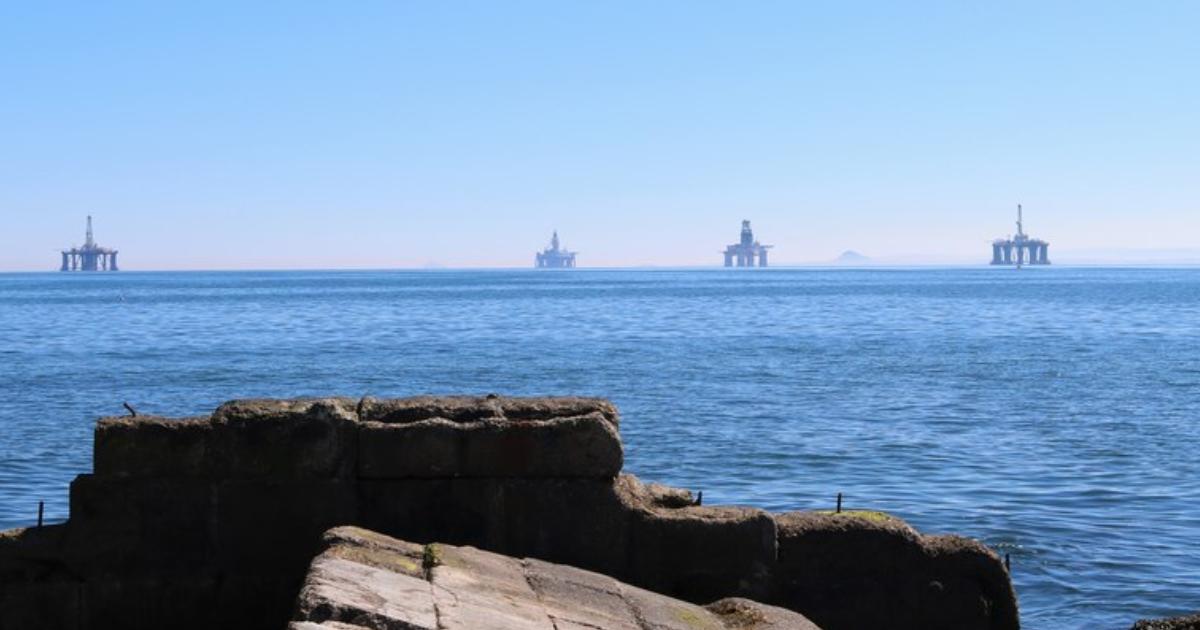
Years in the making, the three’s report covered 1948-2018 and found that the North Sea oil and gas boom had added almost £1 trillion in today’s prices onto the Scottish economy.
READ MORE: 'Missed chance': John Swinney responds to landmark £1 trillion Scottish oil report
However, MacKenzie told the Sunday National it was “not counted” in Scotland’s economic performance – with the UK Government instead classifying it under a separate “offshore” region – and may not have benefitted Scots in the way it could.
“Every other country we've compared ends up in a better position than Scotland, even from a worse starting point,” the professor said. “Ireland was worse than us, Iceland was worse than us, Norway was worse than us, Finland was worse than us. They all end up better off than us.
“That is staggering. That's something that people should be looking at and going, what did we get out of this?”
MacKenzie, the head of the University of Strathclyde’s Hunter Centre for Entrepreneurship, Strategy and Innovation, pointed to a table from the study showing the ratio of Scottish GVA per capita to UK GVA per capita (Gross Value Added – the difference between the value of goods and services produced and the cost of raw materials and other inputs) alongside some comparable European neighbours.

It shows that in 1951, Ireland’s GVA per capita was half the UK’s (0.5). Finland’s was 0.64, and Norway’s 0.8. By 2018, Ireland’s had trebled to 150% of the UK’s (1.5). Finland had caught up with and then overtaken the UK (to 1.02), while Norway’s had “taken off” and hit 2.19. Scotland’s onshore GVA, meanwhile, basically flatlined, clocking in at 0.91 in both 1951 and 2018.
MacKenzie said that he and his co-authors had initially resisted including such international comparisons as they did not want the work to become politicised. But during the triple-blind peer-review process, other experts insisted it should be included.
“When we did these comparisons, it was quite surprising to us,” the professor said. “You look at these other countries, Finland almost doubles. Iceland almost doubles. Norway trebles, almost. Ireland trebles.
“Given what [Scotland was] windfalled with, why are we only just doing OK? Why are we only just kind of scraping by?
READ MORE: SNP want 'immediate' end to windfall tax on oil and gas. But is now the right time?
“When you look at almost £1 trillion that was generated in value from North Sea oil and gas, the question you can ask yourself is, if you look around Scotland, where's the evidence of that benefitting Scotland?”
Norway and the UK's oil and gasTHE University of Strathclyde expert said that Norway provided a “counterfactual”, given that it also discovered oil and gas reserves in the North Sea at around the same time as the UK.
“The Norwegian government mandated by law that any North Sea oil and gas extraction activity had to have a majority Norwegian ownership,” he explained. “That was making sure that the money came back into Norway and they had control over the process.
“In the UK, we had a rapid extraction approach, where basically we wanted to get the stuff out of the ground as quickly as we could. That was in part because the UK Government recognised this was a huge windfall they could then use to resolve things like the balance of payments problem.

“It’s not an easy comparison, as in like-for-like, but certainly the lessons you'd look to draw are that the Norwegians established a sovereign wealth fund, we didn't. Look at the difference between the two. The Norwegians have economic stability; they've got significant investments around the world, which are paying them significant dividends. We don't have any of those things.
“If we had a sovereign wealth fund worth £1 trillion like the Norwegians have, I think we'd be doing OK.”
Why Westminster split Scotland from its oilMACKENZIE said that the reason the work to understand the full picture of Scotland’s economy – including offshore and onshore together – had not been completed before was that the Westminster Government had deliberately counted oil and gas separately.
“They didn't want this sitting as a Scottish asset, they wanted it as a UK asset,” he said, pointing to a quote from former chancellor Denis Healey, who in 2013 told Holyrood magazine: “I think we did underplay the value of the oil to the country because of the threat of nationalism.”
“They were very concerned about how Scotland might decide to take its ball and go play elsewhere,” MacKenzie went on.
“A lot of it's about power. It's where power resides, how political power is exercised, and it was exercised in such a way that they decided to sign [offshore oil and gas] into an extra region, and that allowed them to do various things without more scrutiny than they would have got if they put it into Scottish accounts.”

The result, MacKenzie and his colleagues calculated, was that “18% of Scottish economic and industrial activity is not counted”.
“When you get told [one-fifth] of your economic activity is irrelevant, that's like someone telling you one day a week doesn't count. Monday to Friday, see your Friday, we're not counting it,” the professor added.
But although that 18% was left off official Scottish figures, it “definitely” had an impact on the rest of the country’s economy, MacKenzie said.
“You've got this big industrial activity going on, literally and figuratively on your doorstep, and you're being told it's nothing to do with you, and it doesn't count towards your economic performance.
“But it has this knock-on effect … You have to service this. You have to provide people for this industry, so they leave other industries, which get really squeezed. Manufacturing goes from being 30, 35% of the Scottish economy to like 10%.
READ MORE: What would Scotland look like if Scots saw the McCrone Report?
“It's a huge drop, and it's over quite a short period, and during that time you're seeing widespread, industrial closures … huge industrial dislocation, and that ultimately creates in some places generational unemployment.”
MacKenzie further argued that “perception is really, really important”, as Scottish economic statistics that did not factor in oil and gas had been used “to justify all sorts of policies and changes in the economy”.
He added: “And that's not just a North Sea oil story, by the way, that's the whole shebang. It’s about the stewardship of resources, it's about the stewardship of the economy, it's about what we do with these resources and how we construct appropriate structures to take decisions that are either in the interest or not in the interest.”
But now, thanks to the work of MacKenzie, Roy, and Stewart, the full historic picture of Scotland’s economy exists, and is “robust as it can be in terms of academic quality”.
“We would like this to be national statistics,” MacKenzie said. “That's what this work is.
“You provide the evidence, you provide the data, and people decide from there.”
You can read or download the full study for free at doi.org/10.1111/ehr.70098