
Remember me


In this article, you will learn six practical frameworks you can use to give AI agents persistent memory for better context, recall, and personalization.
Topics we will cover include:
What “agent memory” means and why it matters for real-world assistants. Six frameworks for long-term memory, retrieval, and context management. Practical project ideas to get hands-on experience with agent memory.Let’s get right to it.
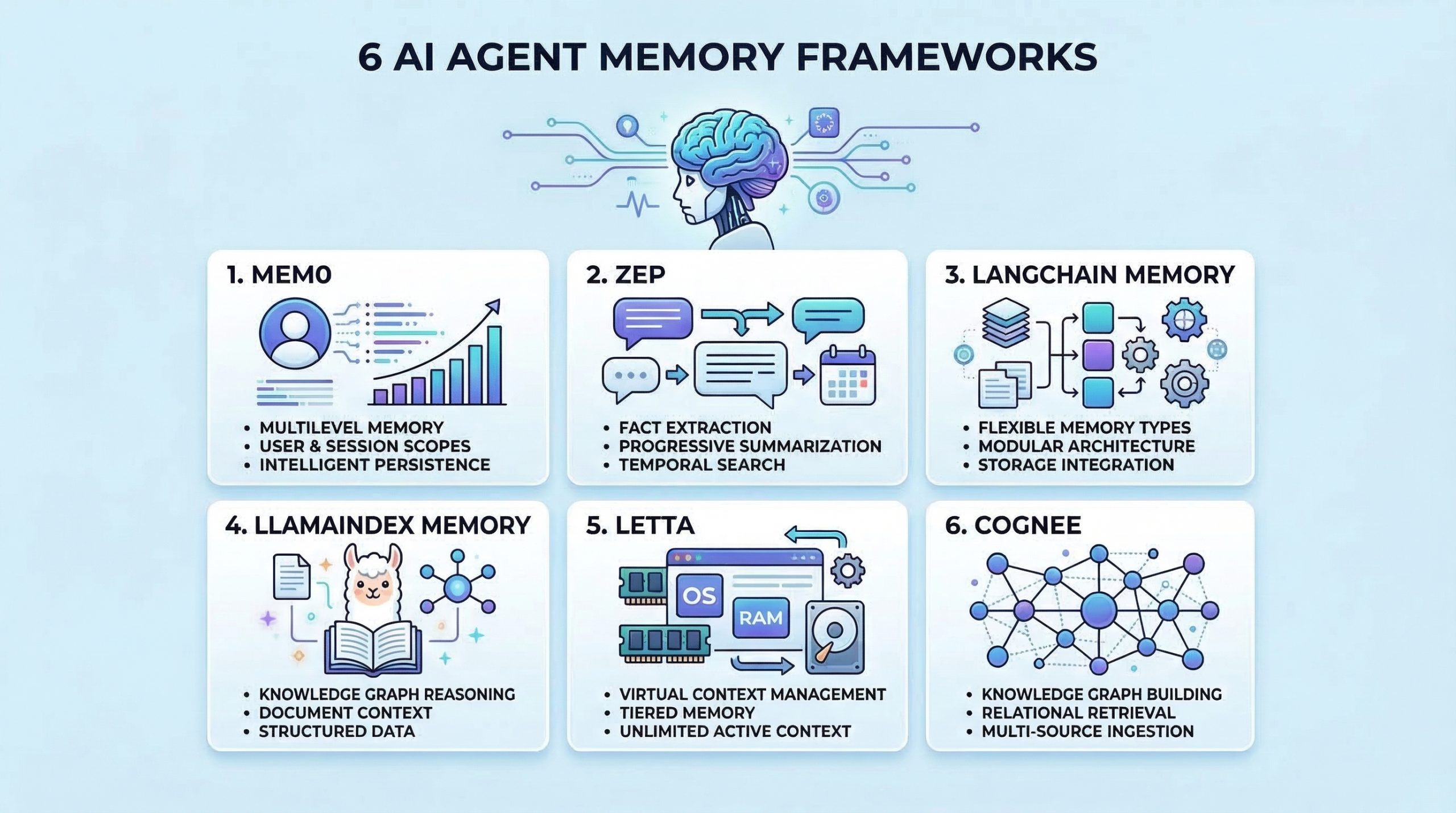
The 6 Best AI Agent Memory Frameworks You Should Try in 2026
Image by Editor
Memory helps AI agents evolve from stateless tools into intelligent assistants that learn and adapt. Without memory, agents cannot learn from past interactions, maintain context across sessions, or build knowledge over time. Implementing effective memory systems is also complex because you need to handle storage, retrieval, summarization, and context management.
As an AI engineer building agents, you need frameworks that go beyond simple conversation history. The right memory framework enables your agents to remember facts, recall past experiences, learn user preferences, and retrieve relevant context when needed. In this article, we’ll explore AI agent memory frameworks that are useful for:
Storing and retrieving conversation history Managing long-term factual knowledge Implementing semantic memory search Handling context windows effectively Personalizing agent behavior based on past interactionsLet’s explore each framework.
⚠️ Note: This article is not an exhaustive list, but rather an overview of top frameworks in the space, presented in no particular ranked order.
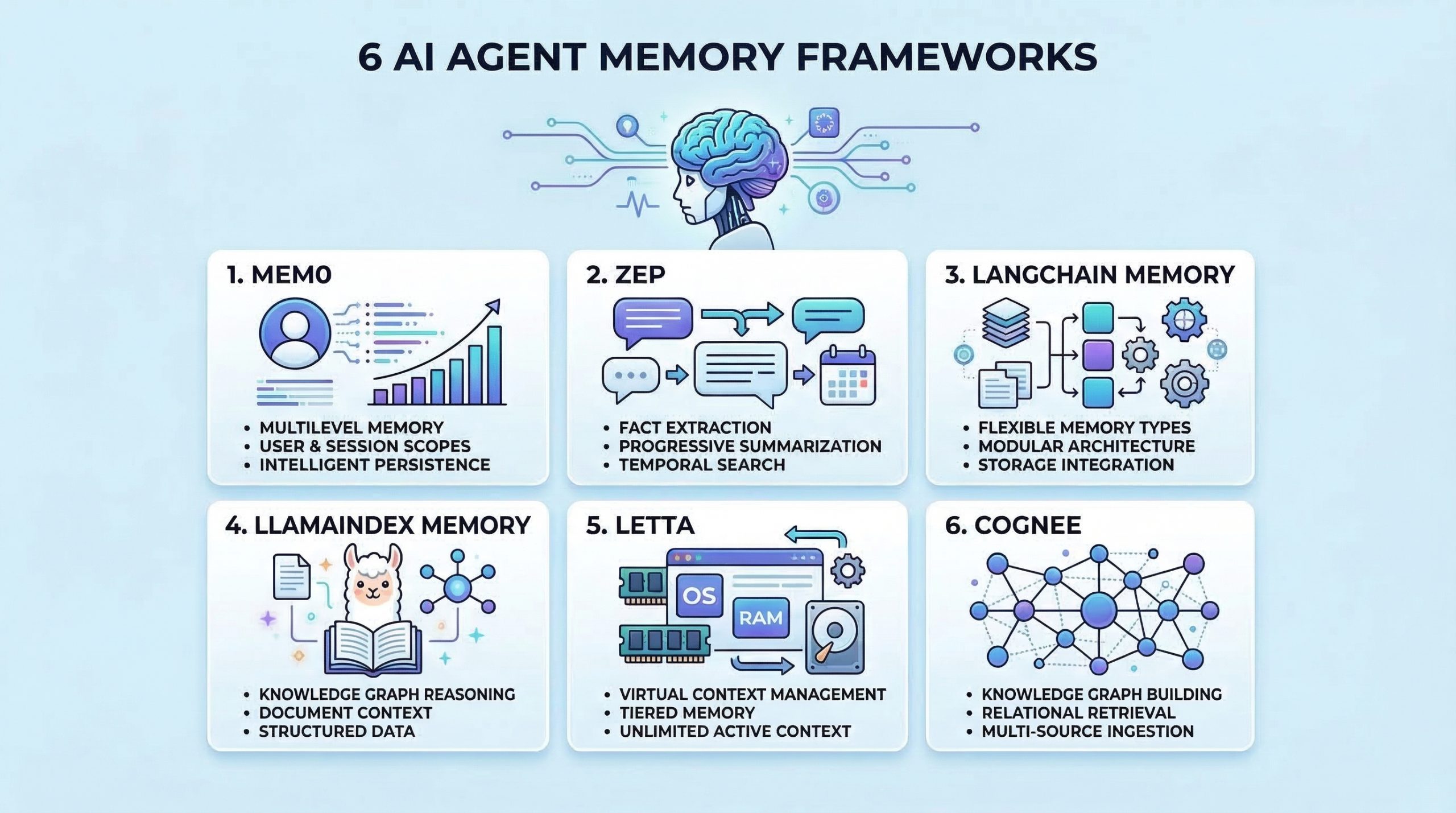
1. Mem0Mem0 is a dedicated memory layer for AI applications that provides intelligent, personalized memory capabilities. It is designed specifically to give agents long-term memory that persists across sessions and evolves over time.
Here’s why Mem0 stands out for agent memory:
Extracts and stores relevant facts from conversations Provides multi-level memory supporting user-level, session-level, and agent-level memory scopes Uses vector search combined with metadata filtering for hybrid memory retrieval that is both semantic and precise Includes built-in memory management features and version control for memoriesStart with the Quickstart Guide to Mem0, then explore Memory Types and Memory Filters in Mem0.
2. ZepZep is a long-term memory store designed specifically for conversational AI applications. It focuses on extracting facts, summarizing conversations, and providing relevant context to agents efficiently.
What makes Zep excellent for conversational memory:
Extracts entities, intents, and facts from conversations and stores them in a structured format Provides progressive summarization that condenses long conversation histories while preserving key information Offers both semantic and temporal search, allowing agents to find memories based on meaning or time Supports session management with automatic context building, providing agents with relevant memories for each interactionStart with the Quick Start Guide and then refer to the Zep Cookbook page for practical examples.
3. LangChain MemoryLangChain includes a comprehensive memory module that provides various memory types and strategies for different use cases. It’s highly flexible and integrates seamlessly with the broader LangChain ecosystem.
Here’s why LangChain Memory is valuable for agent applications:
Offers multiple memory types including conversation buffer, summary, entity, and knowledge graph memory for different scenarios Supports memory backed by various storage options, from simple in-memory stores to vector databases and traditional databases Provides memory classes that can be easily swapped and combined to create hybrid memory systems Integrates natively with chains, agents, and other LangChain components for consistent memory handlingMemory overview – Docs by LangChain has everything you need to get started.
4. LlamaIndex MemoryLlamaIndex provides memory capabilities integrated with its data framework. This makes it particularly strong for agents that need to remember and reason over structured information and documents.
What makes LlamaIndex Memory useful for knowledge-intensive agents:
Combines chat history with document context, allowing agents to remember both conversations and referenced information Provides composable memory modules that work seamlessly with LlamaIndex’s query engines and data structures Supports memory with vector stores, enabling semantic search over past conversations and retrieved documents Handles context window management, condensing or retrieving relevant history as neededMemory in LlamaIndex is a comprehensive overview of short and long-term memory in LlamaIndex.
5. LettaLetta takes inspiration from operating systems to manage LLM context, implementing a virtual context management system that intelligently moves information between immediate context and long-term storage. It’s one of the most unique approaches to solving the memory problem for AI agents.
What makes Letta work great for context management:
Uses a tiered memory architecture mimicking OS memory hierarchy, with main context as RAM and external storage as disk Allows agents to control their memory through function calls for reading, writing, and archiving information Handles context window limitations by intelligently swapping information in and out of the active context Enables agents to maintain effectively unlimited memory despite fixed context window constraints, making it ideal for long-running conversational agentsIntro to Letta is a good starting point. You can then look at Core Concepts and LLMs as Operating Systems: Agent Memory by DeepLearning.AI.
6. CogneeCognee is an open-source memory and knowledge graph layer for AI applications that structures, connects, and retrieves information with precision. It is designed to give agents a dynamic, queryable understanding of data — not just stored text, but interconnected knowledge.
Here’s why Cognee stands out for agent memory:
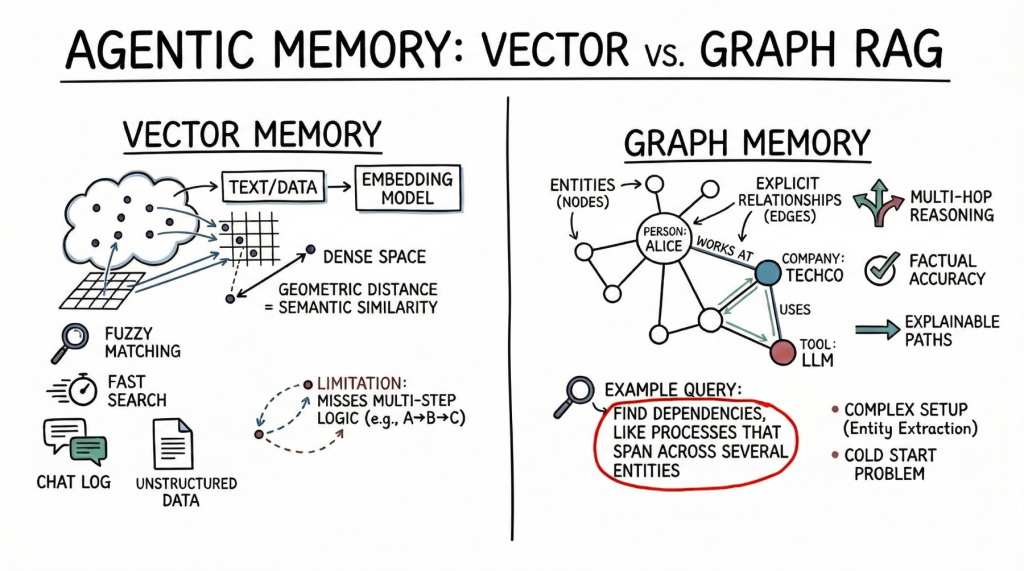
Builds knowledge graphs from unstructured data, enabling agents to reason over relationships rather than only retrieve isolated facts Supports multi-source ingestion including documents, conversations, and external data, unifying memory across diverse inputs Combines graph traversal with vector search for retrieval that understands how concepts relate, not just how similar they are Includes pipelines for continuous memory updates, letting knowledge evolve as new information flows inStart with the Quickstart Guide and then move to Setup Configuration to get started.
Wrapping UpThe frameworks covered here provide different approaches to solving the memory challenge. To gain practical experience with agent memory, consider building some of these projects:
Create a personal assistant with Mem0 that learns your preferences and recalls past conversations across sessions Build a customer service agent with Zep that remembers customer history and provides personalized support Develop a research agent with LangChain or LlamaIndex Memory that remembers both conversations and analyzed documents Design a long-context agent with Letta that handles conversations exceeding standard context windows Build a persistent customer intelligence agent with Cognee that constructs and evolves a structured memory graph of each user’s history, preferences, interactions, and behavioral patterns to deliver highly personalized, context-aware support across long-term conversationsHappy building!
 About Bala Priya C
Bala Priya C is a developer and technical writer from India. She likes working at the intersection of math, programming, data science, and content creation. Her areas of interest and expertise include DevOps, data science, and natural language processing. She enjoys reading, writing, coding, and coffee! Currently, she's working on learning and sharing her knowledge with the developer community by authoring tutorials, how-to guides, opinion pieces, and more. Bala also creates engaging resource overviews and coding tutorials.
About Bala Priya C
Bala Priya C is a developer and technical writer from India. She likes working at the intersection of math, programming, data science, and content creation. Her areas of interest and expertise include DevOps, data science, and natural language processing. She enjoys reading, writing, coding, and coffee! Currently, she's working on learning and sharing her knowledge with the developer community by authoring tutorials, how-to guides, opinion pieces, and more. Bala also creates engaging resource overviews and coding tutorials.
Comments (0)