
Remember me




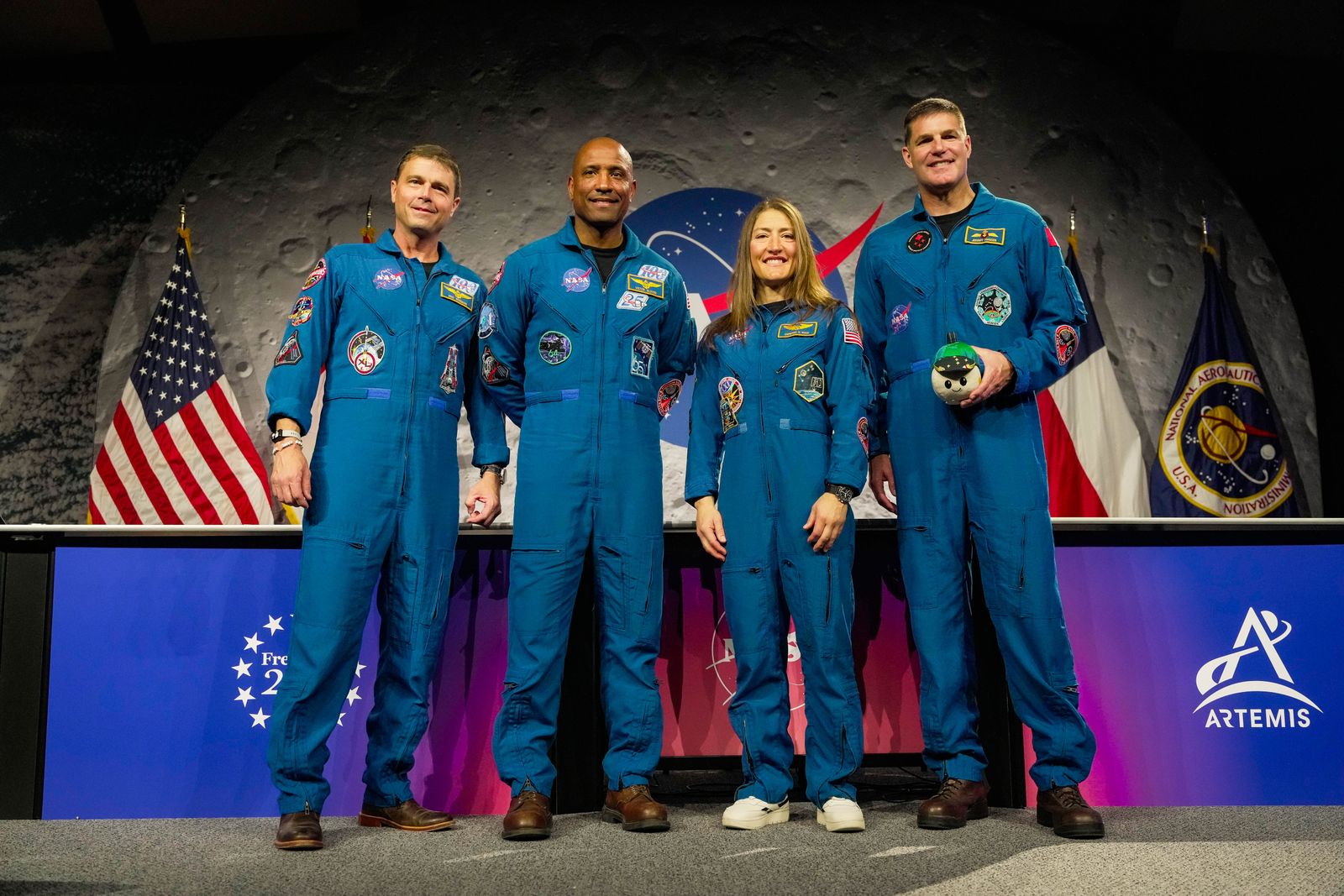
:focal(2450x1657:2451x1658)/https://tf-cmsv2-smithsonianmag-media.s3.amazonaws.com/filer_public/b1/0a/b10ac134-2600-4634-9053-872a6b1d7f4a/gettyimages-2271711331.jpg) On Thursday, Artemis 2 astronauts Reid Wiseman, Victor Glover, Christina Koch and Jeremy Hansen gave their first press conference since splashing down. Here, Hansen holds Rise, the crew’s mascot and zero-gravity indicator, which visually demonstrated when they had entered space.
Raquel Natalicchio / Houston Chronicle via Getty Images
On Thursday, Artemis 2 astronauts Reid Wiseman, Victor Glover, Christina Koch and Jeremy Hansen gave their first press conference since splashing down. Here, Hansen holds Rise, the crew’s mascot and zero-gravity indicator, which visually demonstrated when they had entered space.
Raquel Natalicchio / Houston Chronicle via Getty Images
For her first few mornings after coming back from the moon, NASA astronaut Christina Koch would wake up thinking she was floating. “I had to convince myself I wasn’t,” she said on Thursday at the Artemis 2 crew’s first press conference since their return from microgravity.
“Even after 328 days in space on my previous mission, I never did the thing where you think something will float in front of you. I’ve done that on this return for some reason. I put a shirt in the air, and it went shoop,” she said, gesturing to demonstrate it falling to the floor.
After splashing down off the coast of San Diego last Friday, the Artemis 2 astronauts are still processing what they experienced on their lunar flyby, they told reporters at NASA’s Johnson Space Center in Houston. The crew rounded Earth’s natural satellite in a ten-day journey, became the first humans to enter the moon’s vicinity since 1972 and set a record for the farthest anyone has ever been from our planet. They spotted micrometeoroids pelting the lunar surface, witnessed a solar eclipse, captured breathtaking photographs of Earth and the moon and got views of features on the moon’s far side that had never been seen with human eyes.
“It’s very hard to fully grasp what we just went through,” mission commander Reid Wiseman said at the conference, citing a week of medical tests that hasn’t given them much time to decompress or reflect since their return. But the eclipse, in particular, stood out to him: “It was otherworldly, and it was amazing.”
The team is also beginning to comprehend what their mission meant to the world. Artemis 2 pilot Victor Glover said he’s been trying to stay off social media for the last week, but the idea that “we did what we said we would do” is sinking in. On a video call, Koch’s husband told her, “‘No really, you’ve made a difference,’” she said. “It brought tears to my eyes. I said, ‘That’s all we ever wanted.’”
/https://tf-cmsv2-smithsonianmag-media.s3.amazonaws.com/filer_public/67/7e/677e3d34-8a9e-4a78-8a23-7eadebe4867c/art002e009301large.jpg) The moon eclipses the sun, as seen by the crew of Artemis 2 during their lunar flyby on April 6. The astronauts experienced nearly 54 minutes of totality.
NASA
The moon eclipses the sun, as seen by the crew of Artemis 2 during their lunar flyby on April 6. The astronauts experienced nearly 54 minutes of totality.
NASA
/https://tf-cmsv2-smithsonianmag-media.s3.amazonaws.com/filer_public/3f/73/3f7346a2-a0c3-4080-98ae-bd1ccf2e8481/art002e012093large.jpg) Vavilov crater, seen toward the lower left of this image and identifiable by its central peak, was often described by the Artemis 2 crew as they rounded the moon.
NASA
Vavilov crater, seen toward the lower left of this image and identifiable by its central peak, was often described by the Artemis 2 crew as they rounded the moon.
NASA
Artemis 2 was the second mission in NASA’s new lunar program, which aims to ultimately land humans on the moon’s surface and establish a long-term presence in space. The four astronauts did not land on the moon for this mission, but it marked the first time the Orion spacecraft, initially tested during Artemis 1, flew with human occupants. Koch became the first woman to travel around the moon, Glover the first Black person and Canadian Space Agency astronaut Jeremy Hansen the first non-American.
NASA plans to accelerate the launch schedule for its Artemis program and is now targeting next year for Artemis 3, a mission to low-Earth orbit that will practice docking with lunar landers. The agency is eyeing 2028 for Artemis 4, which will finally bring humans back to lunar soil.
At the conference, Wiseman said a moon landing is within reach. Once his crew was around the moon, if they had only had a lunar lander, he said, they could have gone down and touched it themselves.
“It’s not the leap I thought it was,” Wiseman said. “It’s going to be extremely technically challenging, but … it is absolutely doable, and it’s doable soon.”
The astronauts talked about the Orion spacecraft’s heat shield, which drew attention after it sustained damage on the Artemis 1 mission. After re-entry, the Artemis 2 astronauts got a chance to look at the heat shield, and Wiseman said there was “a bit of char loss” where the shield meets the structure of the spacecraft. But overall, “It looked wonderful to us,” he said, adding that engineers will examine this heat shield with a “fine-toothed comb.”
Quick facts: Artemis 2 re-entry The Orion capsule was traveling 35 times the speed of sound when it reached Earth’s atmosphere. As the Artemis 2 astronauts re-entered, they experienced a planned, roughly six-minute communications blackout with NASA teams on the ground. That’s because hot, ionized gas called plasma built up around their spacecraft, which experienced temperatures up to 5,000 degrees Fahrenheit.Thinking about space—and traveling through it—can make a person feel insignificant. “The sense I had was this sense of fragility and feeling infinitesimally small,” Hansen said. But at the same time, he had “this very powerful feeling as a human being, like as a group,” he added. “I saw it in all these sights, over and over again. … Small and powerless but yet powerful together.”
That sense of unity was a theme for the crew, who became a close-knit team over the course of the mission. They relied on each other and shared space in the Orion capsule, which has a living area that’s only about the size of two minivans. “We are bonded forever,” Wiseman said. “That’s the closest four humans can be and not be a family.” On the astronauts’ first night in space, when they spread out into their own beds, spaced about eight feet apart, “It felt way too far,” Koch said.
/https://tf-cmsv2-smithsonianmag-media.s3.amazonaws.com/filer_public/d2/5b/d25b890c-93fd-4e8c-8e50-868e2cd3fb2a/art002e013367large.jpg) The crew of Artemis 2 group hugged as their spacecraft traveled back to Earth on April 7.
NASA
The crew of Artemis 2 group hugged as their spacecraft traveled back to Earth on April 7.
NASA
/https://tf-cmsv2-smithsonianmag-media.s3.amazonaws.com/filer_public/d8/0a/d80adf68-90cd-4b2d-98b1-6de399cca1da/art002e000192.jpg) Earth, seen from the Artemis 2 mission as the astronauts traveled toward the moon.
NASA
Earth, seen from the Artemis 2 mission as the astronauts traveled toward the moon.
NASA
But while they praised each other and their support teams, the crew also expressed thanks to all of humanity. The astronauts’ achievements, they repeatedly stated, belong not just to them and to the people that worked on the mission. They belong to the world.
“We did this,” Glover said. “Not we as a crew—we as countries and as humans did this.”
“We took your hearts with us, and your hearts lifted our hearts,” Koch said.
The day after launch, Wiseman looked back and captured a picture of our planet—it seems to be shining as it eclipses the sun, and the green glow of two auroras is visible in its atmosphere. That photograph, featuring Earth alone, is the one Glover would choose to sum up the whole mission.
“That represents how far we were,” Glover said, “but it shows you.”
Get the latest stories in your inbox every weekday.
Comments (0)