
Remember me
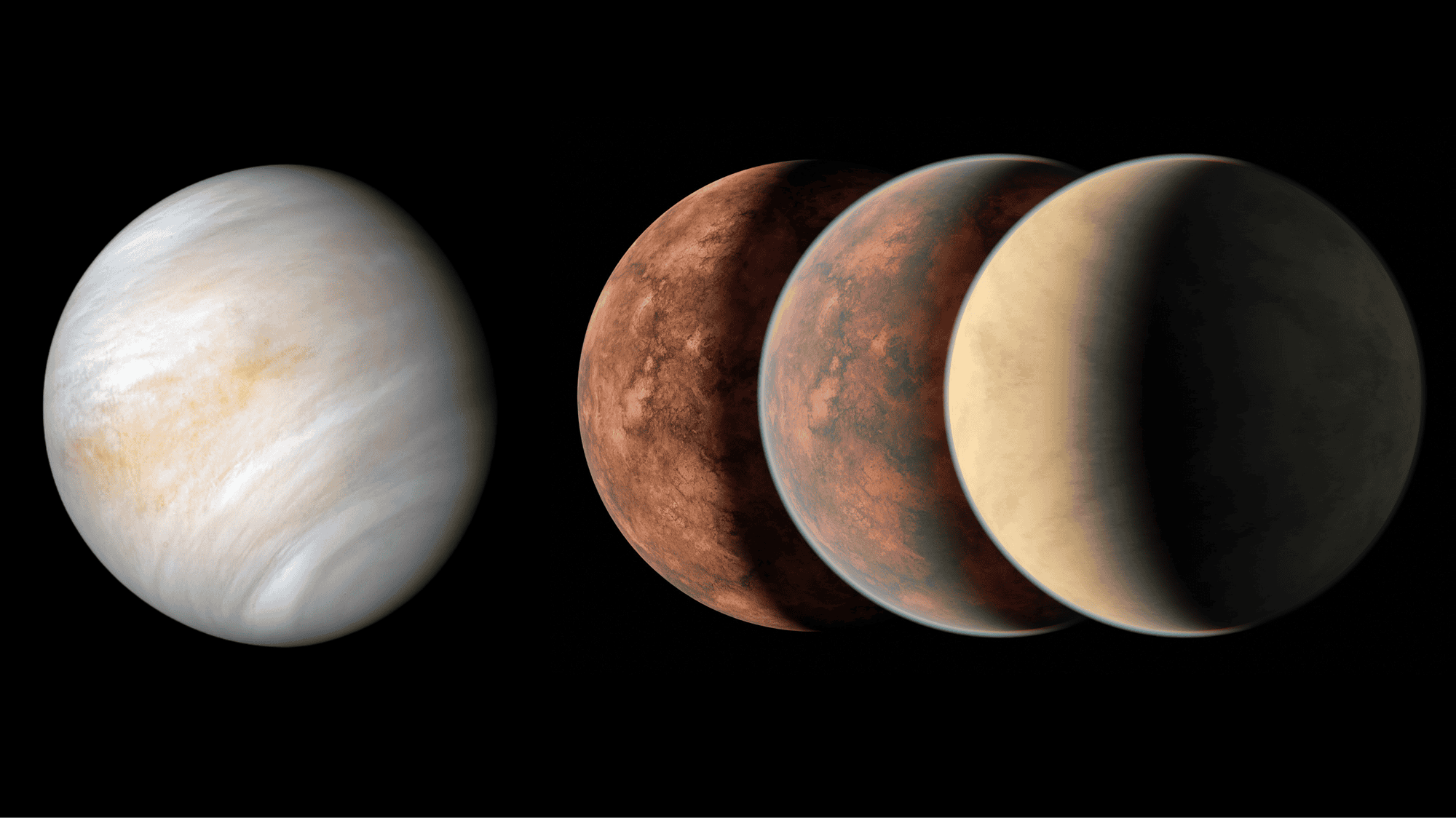







 This image of Venus taken by NASA’s Mariner 10 spacecraft (left) is paired with an artist’s depiction of three possible atmospheres on a recently discovered exoplanet, Gliese 12b. Credit: NASA/JPL-Caltech/R. Hurt (Caltech-IPAC)
The search for life beyond Earth has followed a familiar logic: find a rocky planet orbiting in the habitable zone, where temperatures could allow liquid water, and you may have a world worth watching. However, now a new study from the University of Washington suggests that standard may be too loose. A planet may need far more water than scientists once thought to remain truly habitable.
The research, published in The Planetary Science Journal, found that Earth-sized rocky planets likely need at least 20% to 50% of the water in Earth’s oceans to keep surface water stable over long spans of time. Below that range, the study suggests, a planet’s climate can begin to spiral in the wrong direction.
“We were interested in arid planets with very limited surface water inventory — far less than one Earth ocean,” said lead author Haskelle White-Gianella, a doctoral student at UW. “Many of these planets are in the habitable zone of their star, but we weren’t sure if they could actually be habitable.”
Scientists have now confirmed more than 6,000 exoplanets, and many orbit in the so-called habitable zone, the region around a star where liquid water could exist on a planet’s surface. But being in the right orbit does not guarantee a hospitable world.
Arid planets have often remained in the broader conversation about habitability. This is partly because they can still sit in the right temperature range around their stars. The question was whether or not a planet with only a modest supply of water could hold onto a stable climate for geologic timescales. According to the team’s simulations, the answer is often no.
The reason comes down to the geologic carbon cycle, one of the slow mechanisms that helps regulate Earth’s climate. On Earth, volcanoes release carbon dioxide into the atmosphere. Rainwater reacts with exposed rock, helping remove that carbon dioxide over time and lock it away in sediments and ocean crust. Tectonic activity later returns some of that carbon to the atmosphere through volcanism. The cycle acts as a long-term thermostat, but it depends on water.
Take too much water out of the system and that thermostat begins to fail. With too little rain and weathering, carbon dioxide can build up in the atmosphere. That traps more heat, raising temperatures and causing what surface water remains to evaporate faster. The planet can drift away from habitability even if it began in the habitable zone. Rather than an expected gentle desert world, you get a world edging toward climactic collapse.
“These sophisticated, mechanistic models of the carbon cycle have emerged from people trying to understand how Earth’s thermostat has worked — or hasn’t — to regulate temperature through time,” said senior author Joshua Krissanen-Totton, a UW assistant professor of Earth and space sciences.
×
Thank you! One more thing...Please check your inbox and confirm your subscription.
An example close to homeThe study points to a cautionary example much nearer our Pale Blue Dot than exoplanets: Venus. Similar in size to Earth, Venus may once have had conditions far more temperate than the furnace-like planet we see now. The researchers suggest that even slight differences in early water inventory or starting conditions may have pushed Venus down a very different path, one where the carbon cycle could no longer keep climate in check.
Upcoming missions will be heading to Venus in the coming years to study how the planet turned into the hellscape we see today. What they learn there could help scientists understand faraway planets too.
“It’s very unlikely that we will land something on the surface of an exoplanet in our lifetime, but Venus — our nextdoor neighbor — is arguably the best exoplanet analog,” White-Gianella said.
That idea gives the research a practical edge. Scientists will not be landing instruments on exoplanets anytime soon, but Venus offers a nearby world where some of these questions about planetary evolution may be tested more directly. Data from future missions to our neighbor could help researchers judge whether the new model holds up.
The result is not that dry planets are impossible homes for life in every case. It is that they may be much weaker candidates than astronomers had once hoped for. In a search defined by limited telescope time and a growing catalog of distant worlds, that kind of filter is a concern to many. The universe may be full of rocky planets in the right place. This study argues that many of them still may not have enough water to keep life’s door open.


Comments (0)