
Remember me
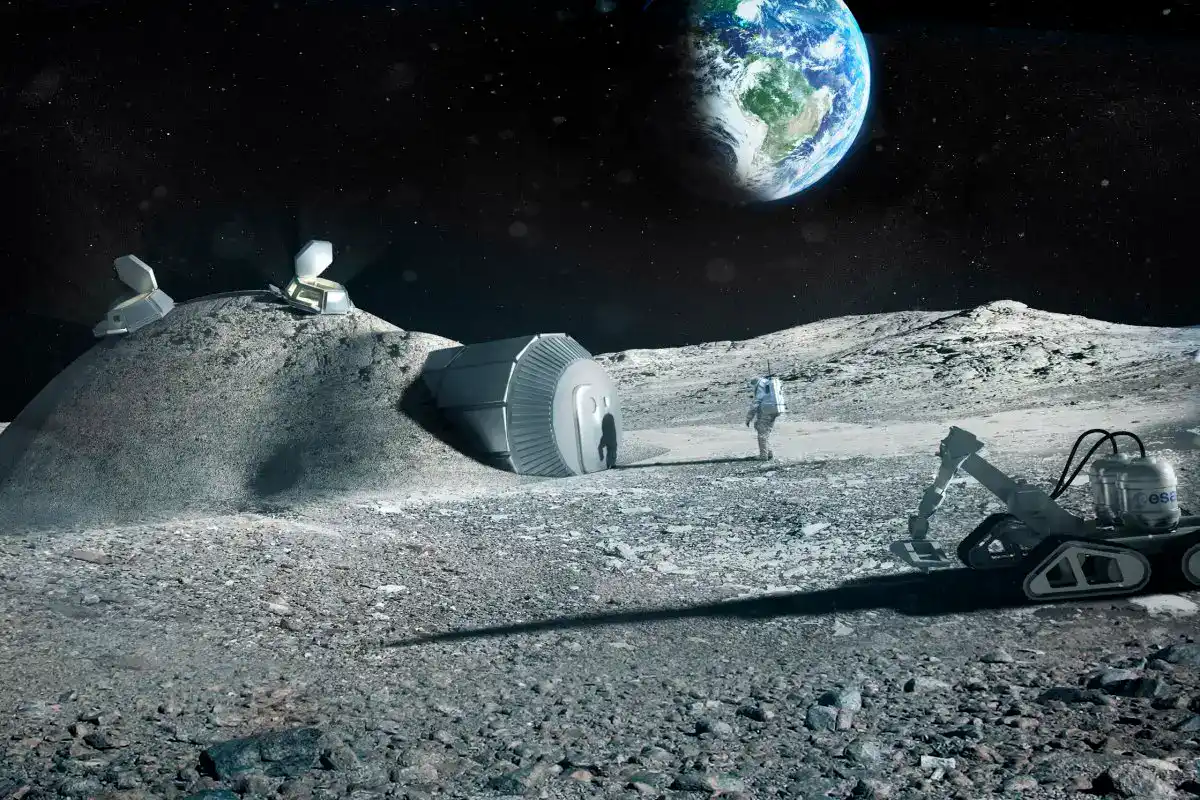








 What a moon base might look like. Credit: ESA/Foster + Partners.
NASA is finally getting serious about staying on the moon. Less than two weeks after the historic splashdown of the Artemis II crew, the space agency has ripped up its old playbook. For years, the agency has been timid about its plans for the moon.
Now, a radical overhaul is underway. Gone is the sprawling, over-budget lunar space station known as the Gateway. In its place is a lean, aggressive $20 billion roadmap to build a permanent Moon Base at the lunar south pole by 2032.
To this aim, the agency plans an astonishing 73 lunar landings over the next decade. NASA will lean heavily on commercial rockets and embrace a high-risk, high-reward mentality unseen since the Apollo era. NASA Administrator Jared Isaacman summarized the new philosophy at the Space Symposium on April 14, noting that the agency operates best when “undertaking and achieving the near impossible.”
“We want to land lots of stuff, and it’s okay if some of it breaks,” Isaacman added. “We’re going to learn.”
A Three-Phase Assault on the MoonThe details were shared by NASA in its recently published “Moon Base User’s Guide.” The document breaks NASA’s plans for expansion on the moon into three distinct phases.
Phase 1 focuses entirely on establishing high-rate, reliable surface access. By 2029, NASA plans to execute 25 launches and 21 landings. These early robotic missions will drop roughly 4,000 kilograms of payload per trip onto the lunar dirt. The goal is to map landing sites, establish ground truth, and test commercial landers capable of delivering five metric tons.
Phase 2, scheduled between 2029 and 2032, introduces humans to the base. Across 27 launches and 24 landings, commercial providers will haul up to 60,000 kilograms of hardware. Astronauts will execute semiannual crewed missions to deploy initial surface infrastructure, manipulate lunar regolith, and prepare the site for permanent habitation.
Phase 3 transitions the base to continuous human occupation. Starting in 2032, NASA aims for 29 launches and 28 landings, targeting massive 150,000-kilogram payload deliveries.
×
Thank you! One more thing...Please check your inbox and confirm your subscription.
This breakneck cadence requires a total paradigm shift for a NASA that has been previously criticized for its numerous launch postponements and budget overspending. “This revised, step-by-step approach to learn, to build muscle memory, to bring down risk and gain confidence is exactly how NASA achieved the near impossible in the 1960s,” Isaacman told contractors at NASA Headquarters on March 24. “But this time, the goal is not flags and footprints. This time, the goal is to stay.”
Scrapping the Gateway to Focus on the Surface Illustration of now scraped Gateway orbital space station around the moon. Credit: NASA
To afford this relentless launch schedule, NASA had to kill its sacred cow. For years, the Artemis program relied on building the Gateway, a small outpost in a highly elliptical lunar orbit. Crews were supposed to fly to the Gateway in the Orion capsule, dock, and then transfer to a separate lander.
Isaacman is officially pausing the Gateway program. Future Orion astronauts will bypass the orbital way-station entirely and transfer directly to commercial landers waiting in lunar orbit.
“It should not really surprise anyone that we are pausing Gateway in its current form and focusing on infrastructure that supports sustained operations on the lunar surface,” Isaacman stated. “Despite some of the very real hardware and schedule challenges, we can repurpose equipment and international partner commitments to support surface and other program objectives.”
This pivot reflects the growing power of commercial spaceflight. By shifting away from the government-owned SLS rocket, NASA can buy rides from competitive companies like SpaceX and Blue Origin.
“Today, we are providing a demand for frequent crewed missions,” Isaacman noted. “We intend to work with no fewer than two launch providers with the aim of crewed landings every six months, with additional opportunities for new entrants in the years ahead. America will never again give up the moon.”
Surviving the Harsh Lunar Night NASA Administrator Jared Isaacman outlined a bold new plan to build a moon base near the lunar south pole at a cost of $20 billion over the next seven years. Credit: NASA TV
The lunar south pole, where NASA plans to erect its first lunar base, is prime real estate because its permanently shadowed craters hold massive reserves of frozen water. However, the exact features that make the region valuable also make it an engineering nightmare.
The agency does not sugarcoat the danger. “The Moon Base elements and development will occur in the lunar South Pole region, which has an incredibly different lighting environment than the equatorial maria and highlands visited by Apollo,” NASA wrote in its user guide. “At the Moon Base, the Sun will remain low on the horizon, casting dramatic shadows that hinder solar electricity generation and subject systems to prolonged periods of extreme cold and dark.”
To survive 120-hour stretches of darkness, Phase 1 missions must successfully demonstrate 5-kilowatt power generation systems and test radioisotope thermal generators — essentially nuclear batteries that supply continuous heat and electricity.
Then there is the dust. Lunar dirt is razor-sharp and highly electrostatic. NASA desperately needs new technology to keep this abrasive material from destroying solar panels, electrical connections, and pressurized rovers. Furthermore, the agency must solve the “plume-surface interaction” problem. When 73 landers fire their engines near the same outpost, they risk kicking up high-velocity debris that could shred nearby habitats.
Looking Toward Mars with SkyfallThis lunar south pole outpost is the ultimate proving ground for Mars. By shifting focus to the surface, the agency can test Earth-independent operations, closed-loop life support, and long-term astronaut health protocols.
But NASA is not waiting for the moon base to be finished before making moves toward the Red Planet. In tandem with the lunar announcements, the agency revealed the Skyfall mission, slated for 2028.
Skyfall will send a nuclear-powered deep-space vehicle to Mars. The spacecraft, powered by Space Reactor 1 (SR-1) Freedom, actually repurposes the power and propulsion element originally intended for the canceled Gateway station. SR-1 will use nuclear-electric propulsion to ferry three small robotic helicopters to the Martian atmosphere, where they will scout future human landing zones.
Racing China on a Tight BudgetThe elephant in the room is the cost. The Artemis program has already burned through nearly $100 billion. Worse, the White House released a budget plan on April 3 calling for a massive 23 percent cut to the agency, slashing roughly $5.6 billion from the ledger.
Yet, Isaacman insists NASA can build this $20 billion base without needing a massive influx of new cash. His strategy relies on trimming bureaucratic waste, fostering a commercial logistics marketplace, and ending underperforming programs.
But a lunar base and no fewer than 73 lunar landings, all in that tight budget? Consider me skeptical.
“A lot of people ask us, you know, how are you going to be able to do all this within the resource you have available?” Isaacman said. “And I continue to tell them NASA does not necessarily have a top-line problem. We get a lot of resources. We may not always allocate them that efficiently.”
NASA has no choice but to work faster. A new space race is well underway, and China plans to land its own astronauts on the moon before 2030. Both superpower nations are eyeing the exact same ice-rich craters at the lunar south pole.
NASA knows it cannot afford another decade of delays and cost overruns. Failure to execute this new plan could have unpredictable geopolitical consequences.
“Should we fail, and should we look on as our rivals achieve their lunar goals ahead of our own, we are not going to celebrate our adherence to excess requirements, policy or bureaucratic process,” Isaacman warned. “Expect uncomfortable action if that is what it takes, because the public has invested over $100 billion and has been very patient with respect to America’s return to the moon. Expectations are rightfully very high.”


Comments (0)