
Remember me


/https://tf-cmsv2-smithsonianmag-media.s3.amazonaws.com/accounts/headshot/Sonja_headshot.png)
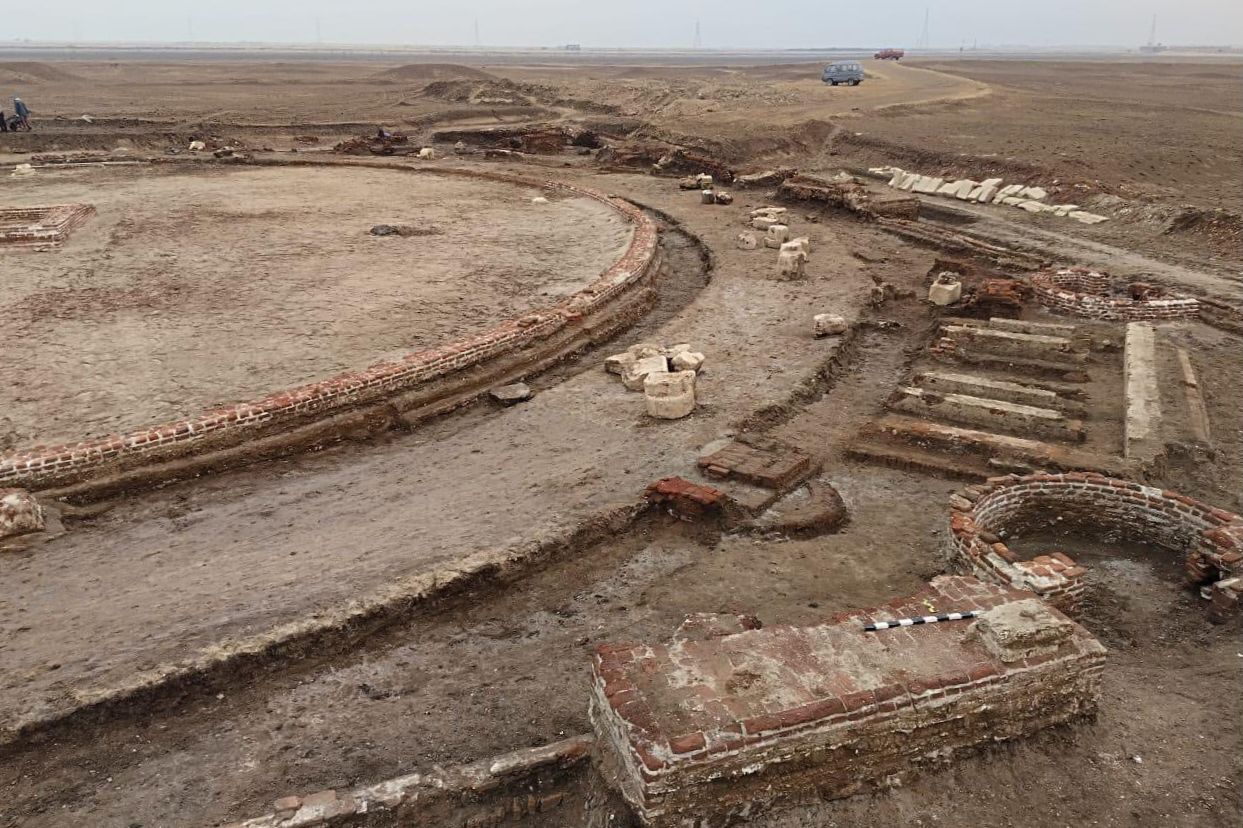
:focal(622x414:623x415)/https://tf-cmsv2-smithsonianmag-media.s3.amazonaws.com/filer_public/64/34/64343c99-d995-4690-b189-7f85a77fb252/668902634_1361513572676852_2842786792514138907_n.jpeg) The temple is composed of a circular basin 115 feet wide.
Egypt’s Ministry of Tourism and Antiquities
The temple is composed of a circular basin 115 feet wide.
Egypt’s Ministry of Tourism and Antiquities
Archaeologists think a circular basin unearthed in Egypt is a temple connected to a mysterious ancient river god. Found in the ruins of Pelusium, the unique temple was once filled with the Nile’s fertile silt, and it reflects an era of blended Egyptian, Greek and Roman cultures.
Researchers have studied the temple for years, says Hesham Hussein, undersecretary for Lower Egypt and Sinai archaeology, in a translated statement. While excavating the site Tell el-Farama in 2019, researchers uncovered a curving, red brick wall that they initially thought was part of Pelusium’s senate building.
“Ongoing excavation and comparative studies have completely changed our understanding,” Hussein says in the statement, per the Art Newspaper’s Hadani Ditmars. “We now know this was a sacred water installation used in religious rituals, not a political structure.”
/https://tf-cmsv2-smithsonianmag-media.s3.amazonaws.com/filer_public/57/f4/57f4be65-f909-4a52-a2f8-c2560fe83a2f/669079652_1361513579343518_1574827584751490836_n.jpeg) The temple is surrounded by channels and cisterns.
Egypt’s Ministry of Tourism and Antiquities
The temple is surrounded by channels and cisterns.
Egypt’s Ministry of Tourism and Antiquities
Ancient Egypt depended on the Nile River. Its seasonal floods fertilized and watered farmland. Its current transported people and building materials. As Greek historian Herodotus wrote in the fifth century B.C.E., “any sensible person” knew Lower Egypt was a “gift of the river.” Ancient Egyptians even assigned the river its own god: Hapi.
And they captured and diverted its water for practical purposes. “It is obviously challenging if the land on which you have built your home and grow your food gets flooded by a river every August and September, as the Nile used to do,” historian Arthur Goldschmidt, Jr. told History’s Patrick J. Kiger in 2021. “Creating dikes, channels and basins to move and store some of the Nile waters required ingenuity and probably much trial-and-error experimentation for the ancient Egyptians.”
/https://tf-cmsv2-smithsonianmag-media.s3.amazonaws.com/filer_public/e3/cc/e3ccc91d-35a2-4dcd-bc59-ceb058b2e632/668982328_1361513536010189_532196990738000213_n.jpeg) Egyptians built structures to hold water from the Nile rRver.
Egypt’s Ministry of Tourism and Antiquities
Egyptians built structures to hold water from the Nile rRver.
Egypt’s Ministry of Tourism and Antiquities
Now, new research suggests ancient Egyptians may have also engineered river water for religious reasons. Silty water from the Nile once flowed into and filled the Pelusium temple. Its brick walls enclose a circular courtyard or basin about 115 feet across surrounded by channels and cisterns. At the basin’s center, a square pedestal perhaps once supported a large statue of the god Pelusius, whose name means “mud” or “silt” in ancient Greek.
The port city of Pelusium was built sometime before the sixth century B.C.E. at the eastern edge of the Nile Delta, where Egypt’s massive river splits into tributaries that empty into the Mediterranean Sea. The city’s location made it a hub of cultural exchange. Egyptians built it as a fortress. Persians and Greeks besieged it. Ptolemaic rulers used it as a customs station. The Roman Empire later absorbed it.
“The amalgam of Greek and Egyptian culture has been evident since the late-fourth-century-B.C.E. Greek conquest of Egypt by Alexander the Great,” Hector Williams, an archaeologist at the University of British Columbia, tells the Art Newspaper.
/https://tf-cmsv2-smithsonianmag-media.s3.amazonaws.com/filer_public/34/25/342528a6-e1f5-4b1e-a8a2-65d0cd74b30c/669391498_1361513546010188_2346977859708148252_n.jpeg) Researchers first uncovered the brick wall in 2019.
Egypt’s Ministry of Tourism and Antiquities
Researchers first uncovered the brick wall in 2019.
Egypt’s Ministry of Tourism and Antiquities
The newly discovered temple’s unique design reflects this era of Hellenistic influence, says Hisham El-Leithy, secretary general of the Supreme Council of Antiquities, in the statement. Archaeological layers indicate the structure was used continuously from the second century B.C.E. until the sixth century C.E.
Egypt’s era of Hellenistic influence saw the introduction of new gods. For example, Ptolemy I Soter—a general who served Alexander the Great before becoming king of Egypt in 323 B.C.E.—introduced Serapis, a deity of fertility, healing and the afterlife who was an amalgamation of Egyptian gods Osiris, Apis and Isis, as well as Greek gods Zeus and Hades. And in Pelusium, in 2022 researchers uncovered a pink granite temple dedicated to Zeus, Greek god of the sky. Inscriptions indicated the temple was renovated under the rule of Roman Emperor Hadrian in the second century C.E.
Did you know? River brothersIn Greek mythology, as recorded in the poem Theogony, the river gods were the children of Titans Oceanus and Tethys.
/https://tf-cmsv2-smithsonianmag-media.s3.amazonaws.com/filer_public/ba/3b/ba3b3d08-1c28-430f-af4f-ab621bbef45a/668688175_1361513159343560_3172752265020913074_n.jpeg) The temple is located in the eastern Nile Delta.
Egypt’s Ministry of Tourism and Antiquities
The temple is located in the eastern Nile Delta.
Egypt’s Ministry of Tourism and Antiquities
Pelusius was another late-addition deity in Egypt—and a “shadowy figure,” as Egyptologist Steve Harvey tells the Art Newspaper, adding that the first-century C.E. Greek biographer Plutarch once linked Pelusius to Isis and Osiris.
“If this Roman-era cult structure can be confirmed to be dedicated to the city god Pelusius,” Harvey says, “it would be a stunning example of the presence of a temple for a deity previously attested only in Classical sources.”
Get the latest stories in your inbox every weekday.
Comments (0)