
Remember me







/https://tf-cmsv2-smithsonianmag-media.s3.amazonaws.com/accounts/headshot/SarahKuta.png)
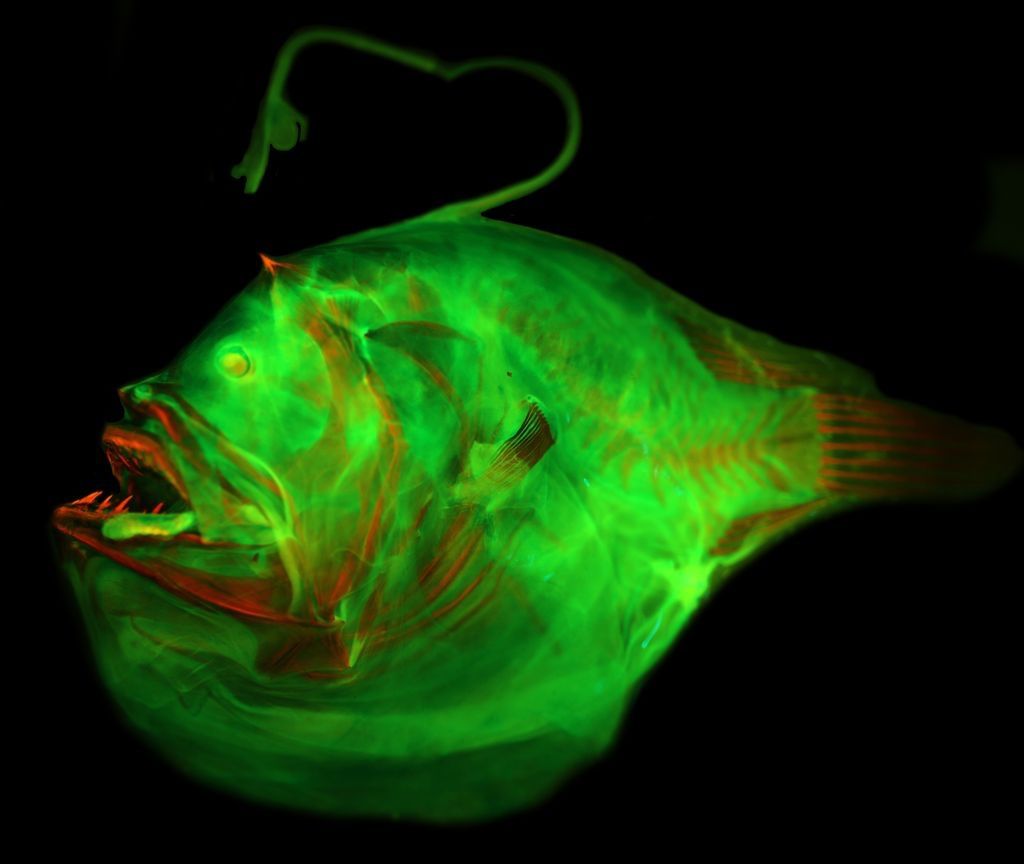
:focal(512x434:513x435)/https://tf-cmsv2-smithsonianmag-media.s3.amazonaws.com/filer_public/a2/17/a21734bc-1485-4912-947a-547e78e44200/dkl8pfeg.jpeg) The reseachers investigated preserved specimens kept at museums, like this Bufoceratias wedli from the Field Museum in Chicago.
Matthew Davis
The reseachers investigated preserved specimens kept at museums, like this Bufoceratias wedli from the Field Museum in Chicago.
Matthew Davis
Female anglerfish have long been thought to use the long, fishing rod-like lures that protrude from their heads to attract prey. Now, a new study published March 27 in the journal Ichthyology & Herpetology suggests they may also have evolved these distinctive stalks to communicate with potential mates in the dark depths of the ocean.
Scientists have identified more than 400 species of anglerfish, including the rotund Pacific footballfish and the colorful warty frogfish. Across these diverse animals, many females sport a specialized dorsal fin spine that dangles in front of their faces and lures unsuspecting prey right into their mouths.
But these lures come in a variety of shapes and sizes, and they feature an array of capabilities and tricks. Some glow with bioluminescent photobacteria, while others secrete chemicals that attract prey. Others resemble shrimp or worms, which the fish wiggle to mimic live movement.
“All of them are doing this really cool thing, using this lure in so many ways,” says lead author Alex Maile, a biologist at the University of Kansas, in a statement.
/https://tf-cmsv2-smithsonianmag-media.s3.amazonaws.com/filer_public/9b/96/9b967f4e-f1b7-44e0-9bd6-51c6f06d368e/zps2euew.jpeg) Ceratias tentaculatus, also known as the southern seadevil, is a species of anglerfish that lives primarily in the Southern Ocean.
Alex Maile
Ceratias tentaculatus, also known as the southern seadevil, is a species of anglerfish that lives primarily in the Southern Ocean.
Alex Maile
Maile and co-author Matthew Davis, a biologist at St. Cloud State University, were curious to know why anglerfish have so much variability in their lures.
Because the creatures often live hundreds to thousands of feet below the ocean’s surface, they are notoriously difficult to study in the wild. And their unique needs—such as extreme pressure and cold—make them challenging to keep alive in captivity. So, instead, the researchers turned to the next best option: preserved physical specimens and photographs housed at natural history museums.
In total, they investigated more than 100 species of anglerfish at institutions in the United States, Australia and France. The creatures’ DNA and lure shapes allowed the scientists to make an anglerfish evolutionary family tree, which provided a window into the evolutionary origins of their diverse appendages.
/https://tf-cmsv2-smithsonianmag-media.s3.amazonaws.com/filer_public/57/56/5756ce2c-f9c0-449a-94cb-14f81b2eb138/full-cope-114-1-103-f03.jpg) Anglerfish species show a wide variety of lure shapes.
A. J. Maile and M. P. Davis, Ichthyology & Herpetology, 2026 under CC BY
Anglerfish species show a wide variety of lure shapes.
A. J. Maile and M. P. Davis, Ichthyology & Herpetology, 2026 under CC BY
Based on their analysis, the researchers think anglerfish lures evolved step-by-step into a multi-functional tool, with new roles being layered on over time. These new features, which arose depending on where the fish lived and other factors linked to their ability to survive, ultimately helped drive the group’s diversification.
According to the researchers, anglerfish first evolved lures roughly 72 million years ago. These early protuberances did not glow or secrete chemicals but simply moved around to attract prey. Then, between 23 million and 34 million years ago, some deep-sea dwelling anglerfish began to develop glowing lures. Over time, the bioluminescent lures also got longer, likely to keep the anglerfish hidden while projecting light outward.
Lures that release chemicals appear to have evolved independently in two different groups: batfishes roughly 49 million years ago, followed by frogfishes around 5 million years ago.
Batfishes keep their chemical lures tucked inside their skulls—until they get close to the sandy ocean floor, which is full of tasty clams, mussels and worms. Floating above the sand, the fish shoot their lures out “like a slide whistle,” Maile says in the statement, then excrete chemicals that affect the sensitive invertebrates buried below. Once they clear away the sand, the fish chow down on their prey.
Frogfishes, by contrast, secrete chemicals while swimming above a current. As prey trail behind up the current, the fish ambush them.
Today, anglerfish continue to evolve, with bioluminescent groups diversifying faster than non-bioluminescent ones, per the New York Times’ Kate Golembiewski. Many anglerfish spend their lives swimming around the darkest depths of the oceans, with some dwelling as deep as 13,200 feet, so glowing lures not only help them find food but also send out clear signals to any nearby males, the researchers posit.
“You’ve got to eat, and you’ve got to procreate,” Tracey Sutton, a marine ecologist at Nova Southeastern University who was not involved with the research, tells the Times, adding that developing a tool that can help with both tasks “is really an elegant solution to those two problems.”
Did you know? Obligate parasitismSome anglerfish species engage in obligate parasitism. A male—which tends to be much smaller than females—swims around until he finds a mate to latch onto like a parasite. Then, he fuses with her and loses his body parts until all that remains are his testes. In this arrangement, the male provides sperm to the female, and the female provides nutrients to the male. Females can carry multiple males at once.
Meanwhile, Sutton is also eager to see what other insights the newly developed anglerfish family tree might reveal in the future.
“Why are there so many of this kind of fish living in what some would say is the harshest environment on Earth?” he tells the Times. “It’s pitch-black, cold, food-poor. It’s hard to imagine a worse place to live. And yet, this group of fishes thrive in it like no other.”
Moving forward, Maile and Davis hope to explore these questions and more related to anglerfish behavior and lifestyle. For example, they want to understand whether females flash specific patterns with their lures and, if so, what they look like, as well as how males perceive those bioluminescent signals.
“That interaction deserves more attention—how males find or detect females,” Maile says in the statement.
Get the latest stories in your inbox every weekday.
Comments (0)