
Remember me




/https://tf-cmsv2-smithsonianmag-media.s3.amazonaws.com/accounts/headshot/Margherita_Bassi.png)
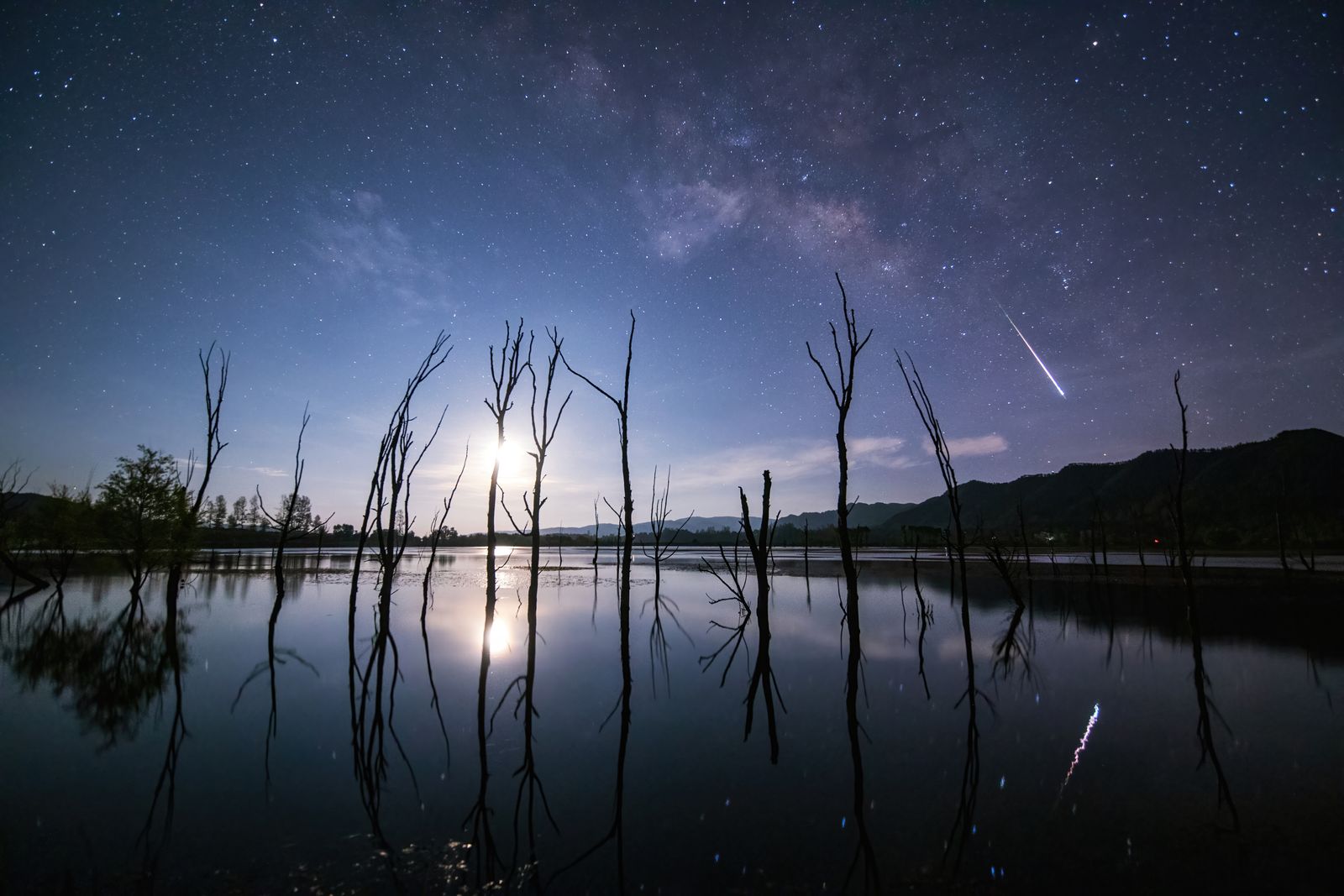
:focal(5527x2080:5528x2081)/https://tf-cmsv2-smithsonianmag-media.s3.amazonaws.com/filer_public/c2/8d/c28de480-0db8-4b28-be52-8647ba1f1a2d/lyrid_of_the_lake_ann22042e.jpg) A Lyrid meteor photographed in Yunnan Province, China, on April 24, 2022
Jianfeng Dai / IAU OAE via Wikimedia Commons under CC BY 4.0
A Lyrid meteor photographed in Yunnan Province, China, on April 24, 2022
Jianfeng Dai / IAU OAE via Wikimedia Commons under CC BY 4.0
It’s once again time for the Lyrid meteor shower, an annual affair that humans have watched for at least 2,700 years—one of the earliest ever documented, according to NASA. The event is known for producing fast and bright meteors, and the best time to view the “shooting stars” is during the late evening of April 21 through dawn the next day, since the shower should peak at 3:15 p.m. Eastern time on April 22, per EarthSky.
Fortunately, the moon, in its waxing crescent phase, will be cooperative. In the contiguous United States, it’ll set within roughly a couple of hours after midnight on the 22nd, providing viewers with a dark sky for the rest of the night.
At its peak, the Lyrids typically produce 10 to 20 meteors per hour, traveling at about 29 miles per second, per NASA. However, some people have witnessed up to 100 meteors per hour during what’s called an “outburst,” although researchers struggle to predict when one might happen, according to Space.com’s Daisy Dobrijevic.
The Lyrid meteor shower is named after the constellation Lyra, the harp, because the meteors seem to come from a point close to the constellation. But that’s just from Earth’s perspective, since the Lyrids actually come from debris trailing behind comet C/1861 G1 Thatcher, discovered by A. E. Thatcher in 1861.
/https://tf-cmsv2-smithsonianmag-media.s3.amazonaws.com/filer_public/91/10/91105476-a9b6-4547-9067-ca80d07e4627/lyrid_meteor_shower_radiant_point.jpeg) The Lyrids look like they originate from a point in the sky close to the constellation Lyra.
Bruce McClure and Joni Hall / EarthSky.org via Wikimedia Commons under CC-BY-SA 3.0
The Lyrids look like they originate from a point in the sky close to the constellation Lyra.
Bruce McClure and Joni Hall / EarthSky.org via Wikimedia Commons under CC-BY-SA 3.0
Comets are bodies of dust, rock and frozen gases that formed far from the sun’s heat during the solar system’s birth around 4.6 billion years ago. Today, these space rocks orbit our star. When they get close to the sun and are warmed up, they spew gases and dust, creating their iconic tails. Bits of the tail can enter Earth’s atmosphere and burn up, resulting in radiant meteors that streak across the sky.
Comet Thatcher is much harder to observe than the Lyrids it produces, since it takes hundreds of years to orbit the sun. The “dirty snowball” should make its next appearance in the year 2278, according to EarthSky.
“We only get to see the actual comet once every 415 years. But we pass through the grains that have been left in its wake every year around the same time,” Maria Valdes, a geochemist at the Field Museum and the School of the Art Institute of Chicago, tells the Associated Press’ Adithi Ramakrishnan.
The Lyrids are among the earliest known meteor showers, with the first recorded sighting made by the Chinese in 687 B.C.E., per NASA. However, they aren’t the most spectacular of these events. For instance, they’re not nearly as quick as the Leonids, which peak in November and zoom at speeds of about 44 miles per second, making it one of the fastest annual meteor showers.
“The Leonids hit us head-on,” Bill Cooke, lead of NASA’s Meteoroid Environment Office, tells Space.com. “The Lyrids are more like hitting the left front fender.”
According to the American Meteor Society, the Lyrids are “a medium-strength shower that usually produces good rates for three nights centered on the maximum.” While these meteors usually don’t leave long trails of dust, they can impress viewers with their occasional ultrabright flashes that outshine Venus, called fireballs.
Fun fact: Recent string of fireballsUltrabright meteors, which appear to be unrelated to one another, have recently streaked above U.S. skies at a seemingly high rate. Some were so dazzling they could be seen during the day, and some exploded with resounding booms.
The best way to enjoy the meteor shower is to get away from light pollution and find a spot with a good view of the sky. Stargazers should let their eyes adjust to the darkness for around 30 minutes. Though your instinct might be to focus on Lyra, NASA suggests looking away from it, which should make the meteor streaks appear longer than if you were to stare directly at the constellation.
Get the latest stories in your inbox every weekday.
Comments (0)