
Remember me

/https://tf-cmsv2-smithsonianmag-media.s3.amazonaws.com/accounts/headshot/MicheleDebczak.png)
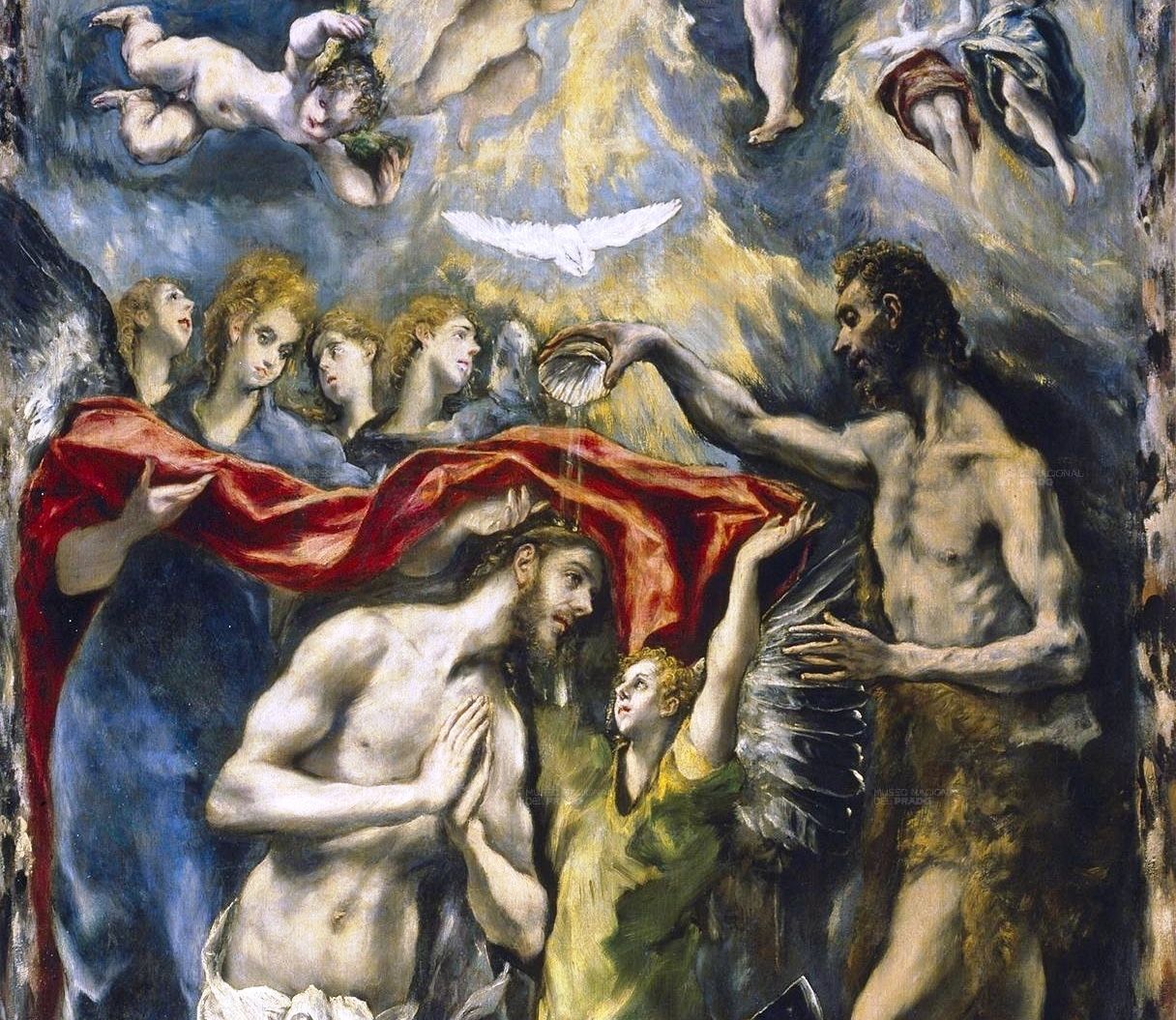
:focal(608x533:609x534)/https://tf-cmsv2-smithsonianmag-media.s3.amazonaws.com/filer_public/ea/ea/eaea3f01-054e-404d-a23c-35d963632fa6/el_bautismo_de_cristo_el_greco_1597.jpg) El Greco’s The Baptism of Christ, c. 1608-14
Public domain via Wikimedia Commons
El Greco’s The Baptism of Christ, c. 1608-14
Public domain via Wikimedia Commons
El Greco’s The Baptism of Christ is as famous for its striking imagery as for the enduring mystery behind it. Experts long believed that the 17th-century oil painting—which depicts Saint John the Baptist pouring water onto the head of Jesus as God and an audience of angels look on—was a joint effort between the artist and his son. More than four centuries after the artwork was completed, new A.I. analysis published in Science Advances suggests that El Greco alone deserves most of the credit.
Many artworks produced during the Renaissance were the product of multiple hands. Masters like El Greco had workshops where they employed a team of apprentices to help with various tasks, including adding finishing touches to paintings. Art historians long suspected that apprentices played a vital role in completing El Greco’s later works. In the case of The Baptism of Christ, the widely held theory argued that El Greco hadn’t finished the canvas when he died in 1614, and that his pupils as well as his son, Jorge Manuel, painted much of the artwork.
Until recently, to determine the origins of different elements of a painting, art experts relied on their own analyses of the minute details of brushstrokes, Jackie Flynn Mogensen reports for Scientific American. But this method is rife with error and has led to numerous misattributions over the centuries. The new study, led by anthropologist Andrew Van Horn of Purdue University, employed artificial intelligence to try to paint a more accurate picture of a painting’s history.
/https://tf-cmsv2-smithsonianmag-media.s3.amazonaws.com/filer_public/9a/2a/9a2a4b31-0a8b-43d9-82ad-40205c1f9a02/el_bautismo_de_cristo_el_greco_1597.jpg) New research calls into question the theory that other artists contributed to one of El Greco’s last paintings.
Public domain via Wikimedia Commons
New research calls into question the theory that other artists contributed to one of El Greco’s last paintings.
Public domain via Wikimedia Commons
Researchers fed their PATCH (“pairwise assignment training for classifying heterogeneity”) machine learning system 25 paintings by nine student artists to train it. Then they prompted the model to analyze two works by El Greco: Christ on the Cross, whose authorship is undisputed, and The Baptism of Christ. After analyzing differences in brushstroke textures that the human eye can’t detect, PATCH determined that a lone artist painted the first work. And it attributed to El Greco portions of The Baptism of Christ that scholars had previously attributed to other artists.
The differences in these brushstrokes, researchers say, may have been the result of the artist’s loss of motor skills toward the end of his life. Some experts believe that El Greco suffered a stroke in 1608.
“It is too early for this technology to distinguish between the master’s hand and that of his collaborators. However, it emerges as a promising and rigorous tool, more effective as a complement to historians’ analysis, especially for what the human eye cannot perceive and which can help formulate new questions,” José María Riello, an art historian at the Autonomous University of Madrid, tells Laura Reyes of El Mundo America.
Fun fact: Spanish inspiration El Greco's work inspired that of another artist from Spain, centuries later: Pablo Picasso.Born in Crete in 1541, Doménikos Theotokópoulos, better known as El Greco, became one of the most influential artists of the Renaissance. He got his start painting religious icons, and by 1566, he was already regarded as a master painter. He moved to Venice, where he emulated the work of such artists as Titian, Tintoretto and Jacopo Bassano, then to Rome, and by 1577 he had relocated to Spain, where he completed some of his most iconic works. Many scholars regard the artist’s expressionistic style, which often emphasizes bold colors, as ahead of his time.
“El Greco rejected naturalism as a vehicle for his art just as he rejected the idea of an art easily accessible to a large public,” Keith Christiansen, curator emeritus for the Metropolitan Museum of Art, wrote in 2004. “The paradox is that, at a time when the blatant display of artifice inherent in Mannerism was being criticized as an indulgence, and artists in Rome were striving to rid their paintings of anything that might seem mere display, El Greco took just the opposite route. He made elongated, twisting forms, radical foreshortening, and unreal colors the very basis of his art.”
Get the latest stories in your inbox every weekday.
Comments (0)