
Remember me







/https://tf-cmsv2-smithsonianmag-media.s3.amazonaws.com/accounts/headshot/Margherita_Bassi.png)
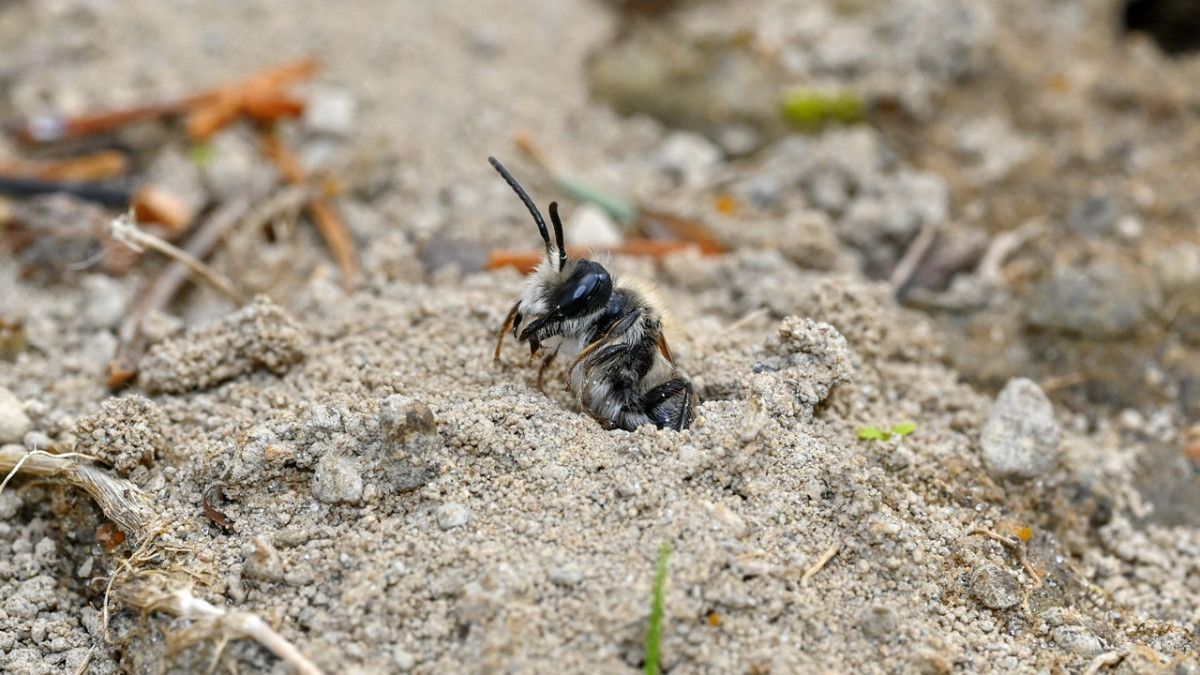
:focal(600x337:601x338)/https://tf-cmsv2-smithsonianmag-media.s3.amazonaws.com/filer_public/9f/24/9f24fd05-460a-4984-b035-27dc59fc2cb9/andrena_regularisdsc_4467cropped-a.jpg) Andrena regularis, or the regular mining bee, is an important pollinator species.
Bryan Danforth
Andrena regularis, or the regular mining bee, is an important pollinator species.
Bryan Danforth
Bees are commonly imagined as insects that live in hives hanging from trees. In reality, however, about 70 percent of native bees build their nests in the ground. And, according to new research, some sites might hold far more nesting bees than expected.
In 2023, researchers found an estimated 5.6 million ground-nesting bees living under the East Lawn Cemetery in Ithaca, New York, the team reports in a study published last week in the journal Apidologie.
“I was completely floored when we did the calculations,” study co-author Bryan Danforth, an entomologist at Cornell University, tells Scientific American’s Jackie Flynn Mogensen.
Danforth and his colleagues investigated an aggregation of Andrena regularis, or the regular mining bee, revealing it to be one of the largest and oldest known aggregations of ground-nesting bees to date. The species is a type of solitary bee, meaning that its females nest individually—but large numbers of their nests may be situated together. The team estimated that in 2023, between 3.1 million and 8 million of the bees emerged from the ground in the Ithaca cemetery, with the average estimate being 5.56 million. For comparison, Manhattan’s population is about 1.7 million people.
“What is definitely uncommon, at least given current knowledge, is the size of this aggregation,” Sean Brady, research entomologist and chair of the entomology department at the Smithsonian’s National Museum of Natural History, tells Smithsonian magazine in an email. “There are a handful of studies that estimate numbers of individual bee nests in an aggregation in the hundreds of thousands and only two that I know of that estimate millions of nests in an aggregation.” Brady did not participate in the study, though he has worked with Danforth extensively.
A. regularis has been recorded in the East Lawn Cemetery, which was founded in 1878, since the early 20th century. To figure out these buzzing residents’ population size, sex ratios and timing of emergence after the winter, Danforth and his colleagues used emergence traps—small, mesh tents that serve to guide bees, as well as other critters coming out from the ground, into a glass jar. Between March 30 and May 16, 2023, the team put up ten of these devices throughout the cemetery.
“We collected 3,251 individuals representing 16 species of bees, flies and beetles, with A. regularis being the dominant species,” Danforth and his colleagues write in the paper. “This study contributes to our knowledge of bee ecology and emphasizes the potential importance of cemeteries as refugia for ground-nesting bee populations.” Despite their prominence, ground-nesting bees are significantly understudied, reports Krishna Ramanujan for the Cornell Chronicle.
Female A. regularis dig underground burrows and lay their eggs in compartments with nectar and pollen. While still underground, the eggs hatch, and the baby bees grow into adults. Lead author Steven Hoge, who conducted the research as a Cornell undergraduate student in Danforth’s lab, tells the Cornell Chronicle that the ability of A. regularis to make it through the winter as adults is relatively rare. This lifestyle contributes to their early spring emergence, which aligns with the bloom of apple trees and other plants, he says.
The researchers found that male A. regularis emerge with the warmer April weather, days before the females do. They also calculated the number of bees coming out of a square meter of ground and applied that to the cemetery’s approximately 6,000 square meters of area to estimate the total number of bees. They offered high, low and average estimates because the number of bees in each trap varied.
“These populations [of ground-nesting bees] are huge, and they need protection,” Danforth tells the Cornell Chronicle. “If we don’t preserve nest sites and someone paves over them, we could lose—in an instant—5.5 million bees that are important pollinators.”
“Our instinct perhaps is to focus more on preserving rare, uncommon species at a site so that they don’t go extinct,” Brady explains to Smithsonian magazine. “But preserving large populations of common species at a site, such as the one in the paper, I think is also quite important because of the large-scale and stable pollination services they can provide.”
Get the latest stories in your inbox every weekday.
Comments (0)