
Remember me





/https://tf-cmsv2-smithsonianmag-media.s3.amazonaws.com/accounts/headshot/Ellen_Wexler.png)
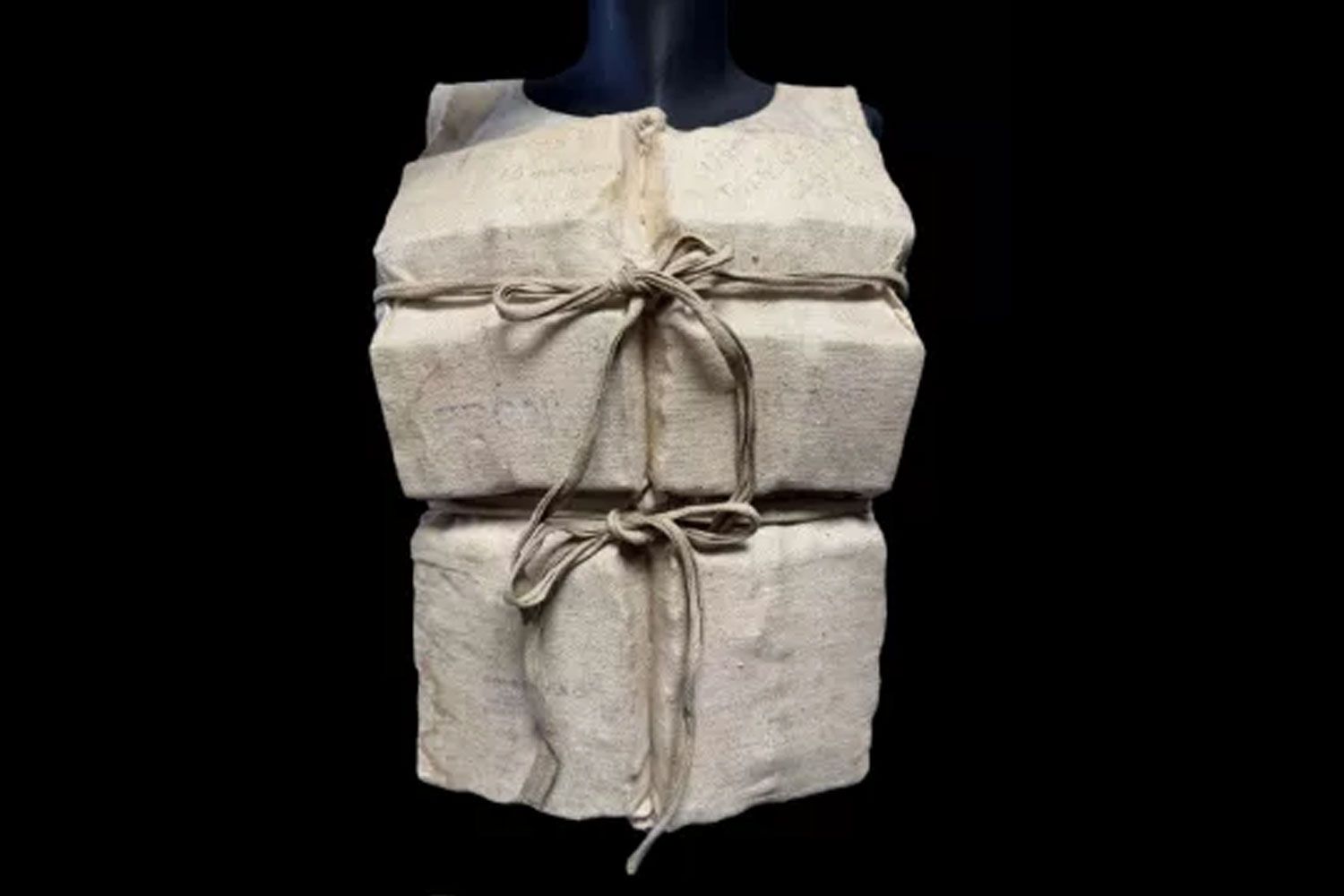
:focal(750x500:751x501)/https://tf-cmsv2-smithsonianmag-media.s3.amazonaws.com/filer_public/1d/98/1d98898b-65d2-41db-9eda-422f167f2275/life-jacket.jpg) The life jacket worn by Titanic survivor Laura Mabel Francatelli
Henry Aldridge & Son
The life jacket worn by Titanic survivor Laura Mabel Francatelli
Henry Aldridge & Son
In the fateful moments after the RMS Titanic struck an iceberg, a man handed Laura Mabel Francatelli a life jacket, assuring her that it was only a precaution. She need not be alarmed.
But when she arrived on deck, she couldn’t help noticing a series of alarming tableaus. On the starboard side, workers were lowering lifeboats down to the water. And the water—the frigid blackness that she had loomed above in the daylight—was closer to the deck than she remembered.
Francatelli, a British first-class passenger aboard the ocean liner, would cling to her life vest as she boarded one of the lifeboats, from where she watched the 883-foot-long vessel disappear beneath the waves. She wore it as she awaited rescue, huddling with fellow passengers for warmth, and as the RMS Carpathia appeared on the horizon hours later.
On April 18, Francatelli’s life vest sold for $906,000. According to Andrew Aldridge, managing director at the auction house Henry Aldridge and Son, “it’s the only life jacket ever sold from a Titanic survivor.”
“These record-breaking prices illustrate the continuing interest in the Titanic story, and the respect for the passengers and crew whose stories are immortalized by these items of memorabilia,” he tells Smithsonian magazine.
/https://tf-cmsv2-smithsonianmag-media.s3.amazonaws.com/filer_public/eb/bf/ebbf0c83-dfb3-4660-80d1-dd4f2e0a243b/gettyimages-105870917.jpg) Images of Titanic survivors taken from the Carpathia
Universal Images Group / Getty Images
Images of Titanic survivors taken from the Carpathia
Universal Images Group / Getty Images
When she boarded the Titanic in April 1912, Francatelli was working as a secretary for fashion designer Lucy Duff-Gordon. The two women were on their way to Chicago with Lucy’s husband, Cosmo Duff-Gordon.
At 11:40 p.m. on April 14, when the ship struck an iceberg, Francatelli was getting into bed. “The collision shook me, as well as everything else in my room,” she later wrote in a letter. “I immediately slipped on my dressing gown and opened my door.” Two men approached and instructed her to go back to sleep.
Francatelli decided instead to go to the Duff-Gordons. Outside her room, she noticed water seeping onto the floor of the hallway. As she climbed the stairs, more passers-by assured her that all was well. But when Francatelli went with the Duff-Gordons to the deck, she immediately realized disaster was at hand. “I believe we are sinking,” she recalled saying. Cosmo replied, “Nonsense.”
Francatelli and Lucy were offered spots in a lifeboat, but they refused to board it without Cosmo. When all the lifeboats on the starboard side were gone, they stayed put as the remaining passengers rushed to the other side. Fortunately, they were offered spots in one of the Titanic’s two small emergency boats, each of which had a capacity of 40. The emergency boat that Francatelli and the Duff-Gordons boarded was lowered with only 12 people. When the Titanic vanished beneath the surface, they opted not to row back and attempt to rescue more passengers.
Quick facts: The hours after the sinking Only one passenger in the lifeboat, Charles Hendrickson, suggested that they return to rescue more passengers, but the others decided against it. Cosmo Duff-Gordon was later accused of bribing workers to facilitate his rescue, but he said he’d only offered the men money because they’d worried their pay would stop once the Titanic sank.“There was an awful rumbling when she went. Then came the screams and cries. I do not know how long they lasted,” Francatelli later recalled in an affidavit. “We had hardly any talk. The men spoke about God and prayers and wives. We were all in the darkness.”
After Francatelli was rescued, she kept the life vest, which she and seven other survivors from her lifeboat signed, according to a statement from the auction house. It remained in her family until some 20 years ago, when a private collector purchased it.
Manufactured by Fosbery & Co., the life vest is made of canvas and 12 cork-filled pockets. Only a small number of Titanic life vests are known to survive, and most are on display in museums.
Roughly 2,200 people were aboard the Titanic’s maiden voyage. More than 1,500—around 68 percent—died in the wreck. The vessel was equipped to carry 64 lifeboats, but it only carried 20 on its maiden voyage, and many launched well below capacity.
/https://tf-cmsv2-smithsonianmag-media.s3.amazonaws.com/filer_public/a9/15/a9154d25-bab2-42b3-bc71-9850de98007f/a1387b62-c441-4ac3-8978-b41100abbd79.jpeg) The life jacket is signed by eight passengers from the lifeboat.
Henry Aldridge & Son
The life jacket is signed by eight passengers from the lifeboat.
Henry Aldridge & Son
Most of the victims who didn’t make it onto a lifeboat died of hypothermia even as the cork life vests kept many of them afloat. The currents carried their corpses far from the wreck site, and hundreds were found in the weeks that followed. In 1985, the wreckage of the Titanic was discovered 12,000 feet below the surface.
The wreck has captivated the public ever since. James Cameron’s 1997 film is one of the highest-grossing movies of all time, and artifacts associated with the disaster routinely sell for jaw-dropping sums.
Henry Aldridge and Son is one of the main auction houses selling Titanic memorabilia, and it holds a sale every year to mark the anniversary of the sinking.
Other items in this year’s sale included a lifeboat seat cushion and a handwritten letter on Titanic stationary.
“This story can be summed up in a sentence: A big ship hits an iceberg and sinks, with a terrible loss of life,” Aldridge tells NBC News’ Francie Ebert. “But take it a step further, and there are 2,200 chapters in this story, each one a person.”
Get the latest stories in your inbox every weekday.
Comments (0)